Secondary Keywords: AI agents, AI automation, difference between AI agents and AI automation, AI agent automation, AI automation tools, AI agents and automation
Introduction
Artificial intelligence is changing how businesses automate tasks, make decisions, and manage workflows. Two terms that are becoming increasingly common are AI Agents and AI Automation.
Although they are related, AI agents and AI automation are not exactly the same. Understanding the difference can help businesses, professionals, and students choose the right approach for different tasks and workflows.
What Is AI Automation?
AI automation uses artificial intelligence to automate predefined tasks and workflows with minimal human intervention.
A typical AI automation workflow follows a defined process:
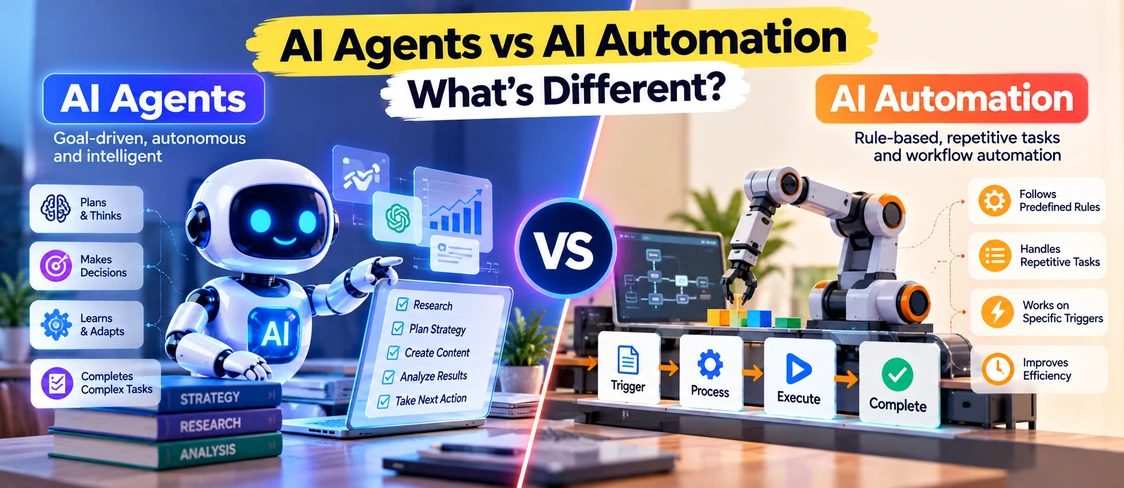
Trigger → AI/Tool → Action → Result
For example, an AI-powered workflow could automatically:
- Read incoming customer emails
- Categorize the emails
- Extract relevant information
- Add information to a CRM
- Send a predefined response
- Notify the appropriate team
AI automation is particularly useful when a business process is repetitive and follows predictable rules.
What Are AI Agents?
AI agents are AI-powered systems designed to work toward a goal by understanding information, making decisions, using tools, and taking actions.
Instead of following only a fixed sequence, an AI agent can determine what steps may be required to complete a task.
An AI agent may be able to:
- Understand a user's objective
- Analyze information
- Plan multiple steps
- Use external tools
- Make decisions
- Execute actions
- Evaluate results
- Adjust its approach when necessary
For example, an AI agent could be given the goal of researching potential customers. It could gather information, analyze prospects, organize the findings, and prepare a report.
AI Agents vs AI Automation: Key Difference
The main difference is how they handle tasks and decisions.
AI automation generally follows a predefined workflow, while AI agents can work toward a goal and dynamically determine the steps needed to achieve it.
| Feature | AI Automation | AI Agents |
|---|---|---|
| Workflow | Usually predefined | Can be dynamic |
| Decision-making | Limited to configured rules/models | Can make context-based decisions |
| Goal-oriented | Usually task-oriented | Strongly goal-oriented |
| Adaptability | Lower | Higher |
| Human intervention | Depends on workflow | Can operate with greater autonomy |
| Tool usage | Configured integrations | Can select/use available tools |
| Best for | Repetitive processes | Complex, multi-step tasks |
| Workflow changes | Usually requires configuration | Can adapt within its capabilities |
How Does AI Automation Work?
AI automation typically connects different applications and services into an automated workflow.
For example:
Customer submits form → AI analyzes request → CRM updated → Email sent → Team notified
The workflow is designed in advance, and each stage performs a specific function.
AI automation is useful when businesses want consistency and predictable execution.
How Do AI Agents Work?
AI agents generally work through a cycle of:
Understand → Plan → Act → Observe → Adjust
An agent receives a goal and evaluates the available information. It can then determine what actions are needed and use connected tools to perform those actions.
For example, a customer-support AI agent could:
- Understand a customer's question.
- Search relevant information.
- Determine an appropriate response.
- Respond to the customer.
- Escalate the issue if necessary.
The exact steps may vary depending on the situation.
Examples of AI Automation
Common AI automation use cases include:
Email Automation
AI can classify emails, summarize messages, extract information, and trigger follow-up workflows.
Marketing Automation
AI automation can help schedule campaigns, analyze leads, generate content, and organize marketing data.
Data Processing
AI can extract information from documents and transfer it into business systems.
Customer Support
Automated workflows can categorize support requests and route them to the appropriate department.
Social Media Automation
Businesses can automate parts of content scheduling, reporting, and social media workflows.
Examples of AI Agents
AI agents can be used for more complex tasks, such as:
Research Agents
An AI agent can research a topic, collect information, analyze findings, and prepare a structured report.
Customer Support Agents
Agents can understand customer questions, access relevant information, and determine how to respond or escalate an issue.
Sales Agents
AI agents can research prospects, analyze customer information, personalize outreach, and assist with follow-up activities.
Coding Agents
AI coding agents can analyze requirements, work with code, identify issues, and help implement solutions.
Personal Productivity Agents
An AI agent can help organize information, plan tasks, and interact with connected tools based on a user's objective.
AI Agents and AI Automation: When Should You Use Each?
AI automation can be suitable when:
- The workflow is repetitive.
- The steps are clearly defined.
- The process is predictable.
- Consistency is important.
- Specific triggers and actions are known.
AI agents can be useful when:
- The task has multiple possible paths.
- The goal is more important than a fixed sequence.
- The system needs to make decisions.
- Different tools may need to be used.
- The environment or information can change.
In some business systems, AI agents and automation can work together.
AI Agents vs AI Automation for Businesses
Businesses can use both technologies for different purposes.
For example, a marketing workflow might use automation to:
Collect leads → Add leads to CRM → Send confirmation email
An AI agent could then:
Analyze the lead → Research the company → Determine relevant information → Prepare personalized recommendations
This demonstrates how AI agents and automation can complement each other.
Benefits of AI Automation
AI automation can help businesses:
- Reduce repetitive manual work
- Improve workflow efficiency
- Standardize processes
- Reduce processing time
- Connect multiple applications
- Automate routine tasks
Benefits of AI Agents
AI agents can help with:
- Complex workflows
- Dynamic decision-making
- Multi-step tasks
- Research and analysis
- Tool-based workflows
- Goal-oriented processes
Limitations of AI Agents and AI Automation
Both approaches have limitations.
AI automation may become difficult to manage when workflows require frequent exceptions or complex decision-making.
AI agents can introduce additional challenges because autonomous systems may require stronger monitoring, permissions, testing, security controls, and human oversight.
The right approach depends on the complexity and requirements of the workflow.
AI Agents vs AI Automation: Which Skills Should You Learn?
If you are interested in building a career in AI, learning both AI automation and AI agents can be useful.
Important areas to explore include:
- Generative AI
- Prompt engineering
- AI tools
- Workflow automation
- APIs
- AI agent frameworks
- No-code and low-code automation
- Data handling
- Business process automation
Understanding how these technologies work together can help you build practical AI solutions.
AI Agents vs AI Automation: Future of Workflows
AI agents and AI automation are becoming important components of modern digital workflows.
Automation can handle structured and repetitive processes, while AI agents can assist with more dynamic and goal-oriented tasks.
As AI systems become more capable, businesses may increasingly combine automation, AI models, agents, and human oversight to create more flexible workflows.
FAQs
What is the difference between AI agents and AI automation?
AI automation generally executes predefined workflows, while AI agents can work toward a goal and dynamically determine actions within their capabilities.
Are AI agents a type of automation?
AI agents can be used as part of automated workflows, but not all automation requires an AI agent.
Is AI automation easier to implement than AI agents?
The complexity depends on the use case. A simple predefined workflow may be easier to implement than a system requiring an agent to make decisions across multiple steps.
Can AI agents and automation work together?
Yes. AI agents can perform decision-making or goal-oriented tasks while automation connects systems and executes predefined workflow steps.
What should beginners learn first: AI agents or AI automation?
Beginners can start with basic AI concepts and workflow automation before progressing to AI agents, APIs, prompt engineering, and agent-based systems.
Conclusion
AI Agents and AI Automation are related but different technologies. AI automation focuses primarily on executing predefined workflows, while AI agents are designed to work toward goals and can make decisions about the steps required to complete tasks.
Understanding AI Agents vs AI Automation can help students, professionals, and businesses identify where each approach can be applied and how both technologies can work together to create more efficient AI-powered workflows.
📍 Address: A-3, Third Floor, Rajouri Garden, New Delhi – 110027