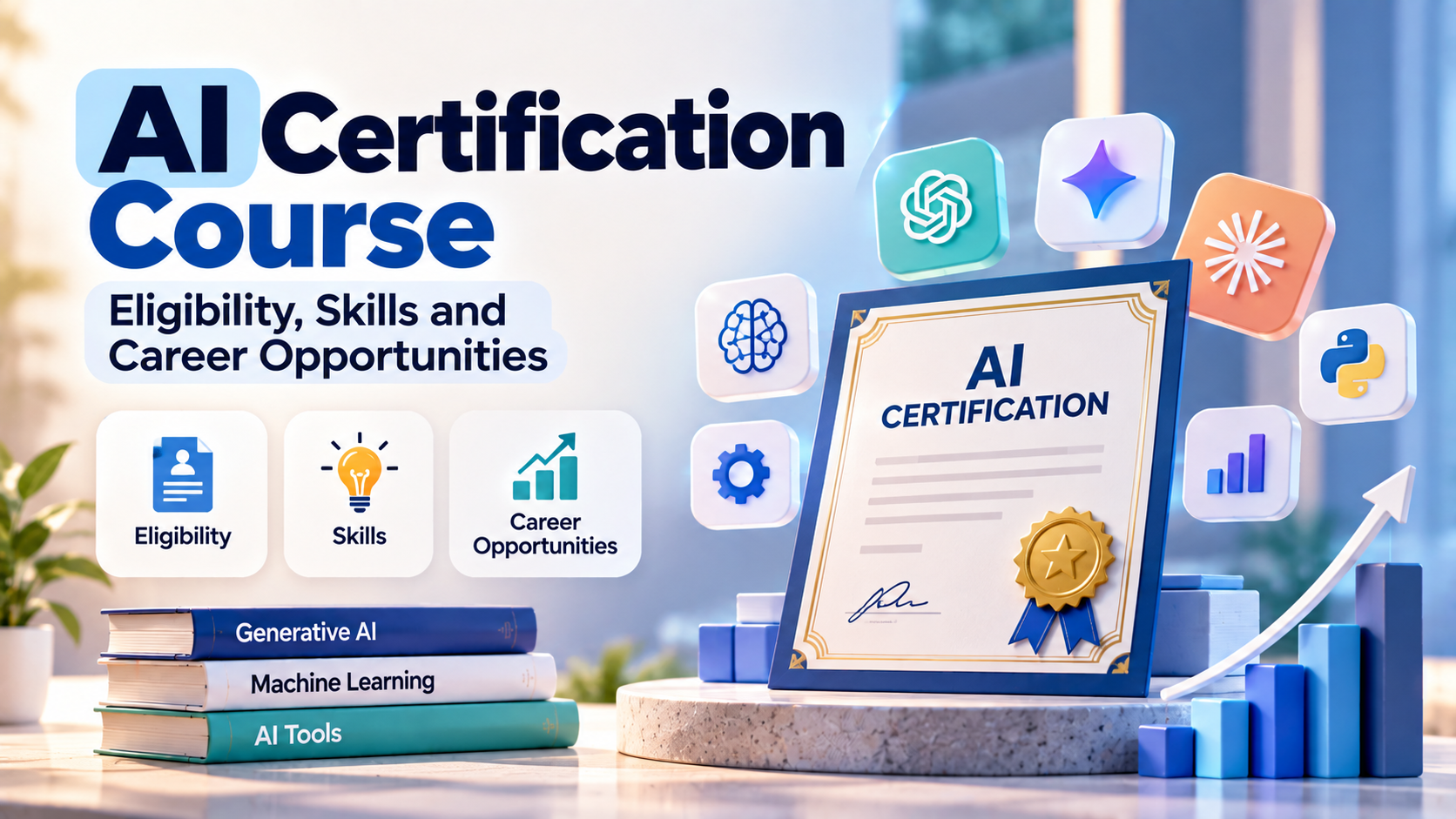
AI Certification Course: Eligibility, Skills and Career Opportunities
Artificial Intelligence is becoming an important skill across technology, marketing, business, education, finance and many other industries. As organisations increasingly adopt Generative AI, automation and AI-powered tools, professionals with practical AI knowledge are finding new ways to improve productivity and work with modern technologies.
If you are looking for an AI certification course, it is important to understand more than just the certificate you receive. You should also consider the eligibility requirements, skills covered, practical training, projects, course duration and career opportunities available after completing the program.
This guide explains what you should know before enrolling in an AI certification course, including who can join, what skills you can develop and how AI knowledge can be applied to different career paths.
AI Certification Course
An AI certification course is a structured learning program designed to help learners understand Artificial Intelligence concepts, tools and practical applications. Depending on the course, the curriculum can range from beginner-friendly Generative AI and prompt engineering to AI automation, AI agents and advanced technical concepts.
A certification can provide evidence that you have completed a particular learning program, but the actual value of the course also depends on the skills and practical experience you gain during training.
A career-focused AI program can combine live learning, practical assignments, industry projects, AI tools, mentorship, internship exposure and certification to create a more complete learning experience.
Who Can Join an AI Certification Course?
AI is no longer limited to computer science professionals. Beginner-friendly programs can be suitable for students, graduates, working professionals, entrepreneurs and people looking to transition into technology-related careers.
Students
College students can use an AI certification course to develop practical skills alongside their academic education. Working on projects can also help students create a portfolio before they start applying for internships or entry-level opportunities.
Graduates
Graduates from computer science, IT, engineering, business, commerce, management and other backgrounds can explore AI depending on their career goals and existing skills.
Working Professionals
Professionals can learn AI to improve productivity, automate repetitive tasks and understand how AI can be integrated into their existing roles.
Career Changers
People looking to switch careers can begin with AI fundamentals, Generative AI, AI tools and automation before progressing into more technical areas such as Machine Learning or AI development.
Entrepreneurs
Business owners can learn how AI tools can support content creation, research, customer communication, automation, data analysis and other business workflows.
Eligibility for an AI Certification Course
Eligibility varies from one institute to another. Beginner-oriented AI programs may not require previous programming experience, while technical AI and Machine Learning programs may recommend knowledge of programming, mathematics or statistics.
For a beginner-friendly AI certification course, basic computer knowledge, logical thinking and an interest in learning new technologies can be sufficient to get started.
If you plan to move toward technical Artificial Intelligence, it can be useful to gradually develop programming and mathematical skills alongside your AI learning.
Is Coding Required?
Coding is not necessarily required to begin learning Generative AI, prompt engineering, AI tools or AI automation. Many modern AI platforms can be used through graphical interfaces and natural-language instructions.
However, programming becomes more important if your goal is to build AI applications, work with Machine Learning models or pursue technical AI development.
What Skills Do You Learn in an AI Certification Course?
The exact syllabus depends on the program, but a modern AI certification course can include several practical and technical areas.
1. Artificial Intelligence Fundamentals
The foundation of an AI course usually begins with understanding what Artificial Intelligence is, how it has evolved and how AI systems are used across different industries.
You can learn about common AI applications, the role of AI in modern businesses and the importance of responsible and ethical AI usage.
2. Generative AI
Generative AI has become an important part of modern AI workflows. It refers to AI systems that can generate content such as text, images, ideas and other forms of digital output.
Learners can explore how Generative AI can be used for research, content creation, productivity, brainstorming and business workflows.
3. Prompt Engineering
Prompt engineering involves creating clear and structured instructions for AI systems. It can help users get more relevant and consistent results from Generative AI tools.
You can learn how to provide context, define objectives, specify output formats and refine prompts based on the results generated by an AI system.
4. ChatGPT and AI Assistants
AI assistants can support a wide range of tasks, including brainstorming, writing, research, summarisation, planning and productivity.
An AI certification course can help learners understand how to use AI assistants effectively while also recognising the importance of reviewing and validating AI-generated information.
5. Google Gemini and Other AI Tools
Modern AI training can expose learners to multiple AI platforms instead of focusing on only one tool. Depending on the course, this can include tools such as Google Gemini, Claude and other AI applications.
Learning different platforms can help learners understand how AI tools can be selected according to specific tasks and workflows.
6. AI Automation
AI automation combines Artificial Intelligence with automated workflows to reduce repetitive manual work.
Examples can include automated research, content workflows, lead management, reporting, customer communication and business process automation.
7. AI Agents
AI agents can be designed to perform sequences of tasks by combining AI models with instructions, tools and workflows.
Learning about AI agents can help learners understand how AI systems are moving beyond simple question-and-answer interactions toward task-oriented workflows.
8. Machine Learning Fundamentals
Some comprehensive AI programs also introduce Machine Learning concepts. These can include supervised learning, unsupervised learning, model training, data preparation and model evaluation.
Machine Learning is particularly relevant for learners who want to develop a deeper technical understanding of Artificial Intelligence.
9. Neural Networks and Deep Learning
Neural networks are an important foundation for many modern AI systems. Depending on the level of the program, learners may be introduced to neural network concepts and their applications.
Advanced learning paths can progress into areas such as Deep Learning, Natural Language Processing and Computer Vision.
10. Practical AI Projects
Practical projects allow learners to apply AI concepts and tools to real-world use cases. Projects can also provide examples of work that can be included in a professional portfolio.
Upskill Now's current AI Master Program includes 50+ industry projects as part of its practical learning structure.
Skills You Can Build with AI Certification
Completing an AI certification course can help learners develop a combination of technical, analytical and practical skills.
- Artificial Intelligence fundamentals
- Generative AI knowledge
- Prompt engineering
- AI tool selection and usage
- AI automation
- AI agent concepts
- Problem-solving skills
- AI-assisted productivity
- Practical project development
- Understanding of Machine Learning fundamentals
- AI workflow development
- Responsible use of AI technologies
AI Certification Course Duration
The duration of an AI certification course depends on the depth of the curriculum. Short courses may focus on AI tools and Generative AI, while comprehensive programs can cover AI applications, automation, agents and other advanced topics over several months.
Upskill Now's current AI Master Program has a listed duration of 3 months and focuses on Generative AI, automation, AI agents and practical AI tools.
The learning format includes live training, recorded sessions, industry projects, internship exposure, AI tools access and career support.
Before enrolling, compare the course duration with the amount of practical training included. A shorter course may be suitable for learning specific tools, while a longer structured program may provide more time for projects and skill development.
AI Certification Course Fees
The fees for an AI certification course vary depending on the institute, course duration, learning format, curriculum, projects, mentorship and career support.
The current Upskill Now AI Master Program is listed at ₹65,000 for the online program and ₹75,000 for the offline classroom program.
The online program includes live online classes, recorded sessions, 50+ industry projects, internship certification, placement support, AI tools library access and AI certification.
The offline classroom program includes in-person classroom training, dedicated mentor access, industry projects, internship certification, placement support, AI tools library access and AI certification with a LinkedIn badge.
Fees and program inclusions can change, so learners should confirm the latest details with the institute before enrolling.
Career Opportunities After AI Certification
AI skills can be applied across technology, marketing, business operations, content, analytics and other professional areas. Your career path will depend on your background, specialisation, technical ability and the type of AI skills you develop.
Some potential career directions include:
- AI Automation Specialist
- Generative AI Specialist
- AI Content Specialist
- Prompt Engineering Roles
- AI Operations Roles
- AI Product Roles
- Machine Learning Roles
- Data and AI Analysis
- AI-Powered Digital Marketing
- AI Consulting
- AI Freelancing
These roles can have different technical requirements. For example, a prompt-focused or AI productivity role may require less programming than a Machine Learning or AI development position.
AI Automation Specialist
AI automation specialists work with AI tools and automation platforms to design workflows that reduce repetitive tasks and improve business processes.
Generative AI Specialist
Generative AI specialists can work with AI platforms for content generation, research, ideation, productivity and business applications.
AI-Powered Digital Marketing
Digital marketers can use AI for keyword research, content ideation, campaign planning, ad copy, social media, reporting, analytics and marketing automation.
An AI certification can complement existing marketing skills by helping professionals understand how AI can be integrated into everyday marketing workflows.
AI Product Roles
AI product roles involve understanding user needs, AI capabilities and business requirements to help design and manage AI-powered products and features.
Machine Learning and Technical AI
Learners who want a more technical career can continue their education toward Python, Machine Learning, Deep Learning, Natural Language Processing, Computer Vision and AI application development.
Why Practical Experience Matters
An AI certification demonstrates that you completed a particular learning program, but practical experience can help demonstrate what you can actually do with AI.
Projects, assignments and case studies can help learners practise AI workflows and develop examples of their work.
Upskill Now's current AI Master Program includes practical industry projects, internship exposure and career support alongside its certification component.
For learners exploring an AI certification course, it is therefore useful to look at the complete learning experience rather than considering the certificate alone.
Online vs Offline AI Certification Courses
AI certification programs can be available in online and offline formats. The right format depends on your schedule, location and preferred learning environment.
Online AI Certification
- Learn from home or another convenient location
- Suitable for students and working professionals
- Live instructor-led sessions can provide interaction
- Recorded sessions can support revision
- No regular travel to a classroom
Offline AI Certification
- Face-to-face interaction with trainers
- Classroom-based learning environment
- Direct interaction with mentors
- Structured learning schedule
- Useful for learners who prefer physical classroom training
Upskill Now currently provides both online and classroom learning options for its AI Master Program.
How to Choose an AI Certification Course
With many AI programs available, it is useful to compare the complete curriculum before enrolling.
Check the Curriculum
Review the topics included in the program. If your goal is Generative AI, look for topics such as prompt engineering, AI tools, automation and AI agents. If you want technical AI skills, check whether the course includes programming, Machine Learning and other technical subjects.
Look for Practical Projects
Check whether learners work on real projects, assignments or case studies. Practical work can help you understand how AI concepts are applied outside the classroom.
Understand the Certification
Check what type of certificate you receive, when it is issued and whether the program provides any additional verification or digital badge.
Compare Mentorship
Mentorship can be useful when learning new AI tools and workflows because learners may need guidance while completing projects and assignments.
Review Career Support
If your objective is career development, check whether the institute provides resume support, portfolio development, mock interviews, internship opportunities and placement assistance.
Compare Learning Formats
Consider whether online or classroom training fits your schedule, location and learning preferences.
AI Certification and Your Professional Portfolio
A certificate can be one part of your professional profile, but your portfolio can provide additional evidence of your skills.
For example, you can create projects demonstrating AI-powered content workflows, automation systems, research assistants, AI agents, productivity workflows or other practical applications.
Adding project descriptions, tools used, your role and the outcome of each project can make your portfolio more informative for recruiters and potential clients.
Can Beginners Learn AI?
Yes. Beginners can start with AI fundamentals, Generative AI, prompt engineering and commonly used AI tools before progressing toward more technical topics.
You do not have to learn every AI technology at once. A structured learning path can help you understand the fundamentals first and gradually build more advanced skills.
If your goal is technical AI development, you can later add Python, statistics, Machine Learning and Deep Learning to your learning path.
Conclusion
An AI certification course can provide a structured way to learn Artificial Intelligence and understand how modern AI tools are being used across different industries.
Before enrolling, consider your current skill level and career objective. Beginners can start with Generative AI, prompting, AI tools and automation, while learners interested in technical AI can continue toward Python, Machine Learning, Deep Learning and AI application development.
Most importantly, look beyond the certificate. A combination of structured learning, practical projects, mentorship, internship exposure and continuous practice can help you develop skills that are useful in real-world situations.
Contact Upskill Now
Address: A-3, Third Floor, Rajouri Garden, New Delhi – 110027
Phone: 9999848160 | 9711448765
Email: connect@upskillnow.in