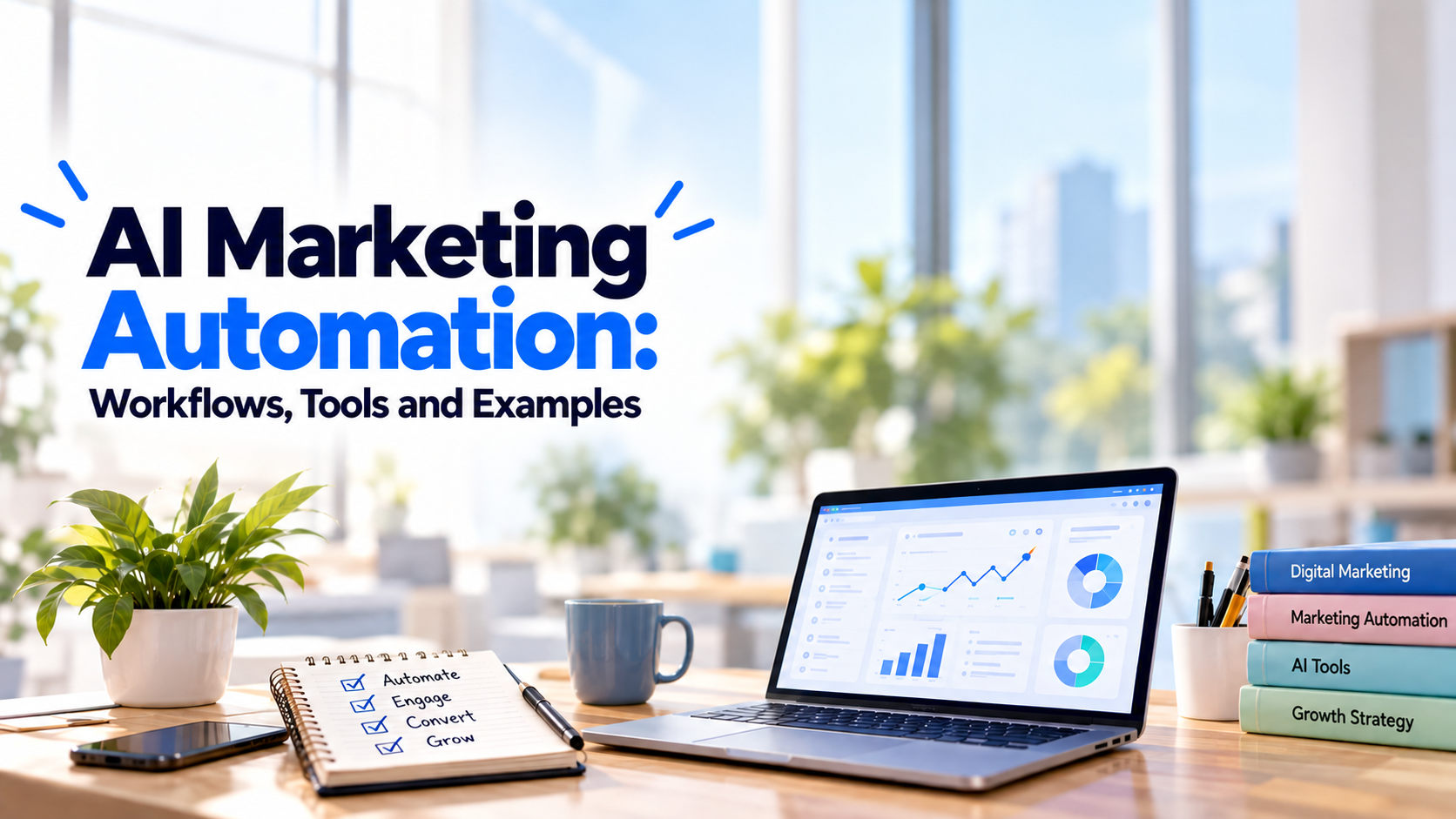
AI Marketing Automation: Workflows, Tools and Examples
Marketing teams today are expected to create more content, manage multiple channels and respond to customers faster than ever. At the same time, repetitive marketing tasks can consume a significant amount of time. This is where AI marketing automation can help.
AI marketing automation combines artificial intelligence with automated workflows to streamline tasks such as lead nurturing, content creation, customer segmentation, email marketing, campaign analysis and reporting.
This practical guide explains how AI marketing automation works, where it can be used, which tools can support different workflows, and how marketers can build useful automation without removing human judgment from the process.
What Is AI Marketing Automation?
AI marketing automation refers to the use of artificial intelligence and automation technologies to streamline marketing activities and customer interactions.
Traditional automation generally follows predefined rules. For example, when a customer submits a form, an automated email can be sent immediately.
AI can add another layer by helping marketers analyse customer information, generate content, identify patterns, personalise communication and support decision-making.
This makes AI marketing automation useful for both repetitive tasks and more data-driven marketing workflows.
For learners who want to develop digital marketing skills alongside practical AI applications, AI digital marketing training can provide a structured way to understand these workflows.
AI Marketing Automation vs Traditional Marketing Automation
Traditional marketing automation is generally based on fixed rules and predefined conditions. AI marketing automation can use data analysis, machine learning and generative AI to make workflows more adaptive.
For example, a traditional workflow may send the same email to every lead after three days. An AI-supported workflow can help segment leads based on their behaviour and support more relevant communication.
AI does not necessarily replace traditional automation. Instead, the two can work together to create more flexible marketing workflows.
AI Marketing Automation Workflows
AI marketing automation can be applied to several areas of digital marketing. The workflow depends on the business objective, available data and tools being used.
1. Lead Generation Workflow
A lead generation workflow can automatically capture and organise information from website forms, landing pages, social media campaigns or other marketing channels.
Once a prospect submits their information, the workflow can record the lead, assign a category and trigger a follow-up communication.
AI can assist by analysing available lead information and helping marketers identify relevant segments or follow-up content.
2. Lead Nurturing Workflow
Not every lead is ready to make a purchase immediately. Lead nurturing workflows help maintain communication with prospects over time.
A typical workflow may begin with a welcome email followed by educational content, product information and a follow-up message.
AI can help marketers generate message variations, analyse engagement and support content personalisation.
3. Email Marketing Workflow
Email marketing is one of the most common areas for automation.
A workflow can trigger emails when someone subscribes to a newsletter, downloads a resource, completes a purchase or becomes inactive.
AI can support subject-line ideas, content variations, segmentation and analysis of engagement patterns.
4. Content Marketing Workflow
Content teams can use AI marketing automation to streamline research, planning and content production.
A workflow might begin with keyword research, move into topic development and content outlining, and then create tasks for writing, editing and publishing.
Human review remains important because marketers need to verify accuracy, maintain brand voice and ensure that the content provides genuine value.
5. Social Media Workflow
Social media automation can help marketers organise content calendars, prepare posts and monitor campaign activity.
AI can support content ideas, caption variations, audience analysis and performance summaries.
A practical workflow can move from content planning to AI-assisted drafting, human approval, scheduling and performance analysis.
6. Customer Segmentation Workflow
Different customers may have different interests, behaviours and stages in the buying journey.
AI can help marketers identify patterns in customer data and create useful audience segments.
These segments can then be connected to email campaigns, advertising audiences or personalised website experiences.
7. Reporting and Analytics Workflow
Marketing teams often spend considerable time collecting information from different platforms and preparing reports.
Automation can bring campaign information together, while AI can help summarise performance trends and identify areas that may require further investigation.
Marketers should still verify the underlying data before making important campaign decisions.
AI Marketing Automation Tools
AI marketing automation can involve several categories of tools rather than one single platform. The right combination depends on the business, marketing channels and workflow requirements.
Content and Copywriting
Tools such as ChatGPT, Google Gemini, Claude, Copy.ai and Jasper can support content research, brainstorming, outlines, copy variations and email drafts.
Design and Creative Work
Canva AI and Midjourney can support marketing creatives, visual concepts, social media graphics and campaign assets.
Video Content
Synthesia, Pictory and Runway can support video scripts, presentation videos, short-form content and AI-assisted video production.
Planning and Productivity
Notion AI and similar AI productivity tools can assist with campaign planning, documentation, content calendars, research organisation and summarisation.
The goal should not be to use every available AI tool. Marketers should select tools based on the workflow they need to solve and the outcome they want to achieve.
Example: AI Lead Nurturing Workflow
Consider a digital marketing company that receives leads through a course enquiry form.
- A visitor submits the enquiry form.
- The lead is automatically added to the CRM.
- The workflow checks the selected course or area of interest.
- The lead is placed into an appropriate segment.
- An introductory email is automatically sent.
- AI assists in creating personalised follow-up content.
- Engagement is tracked.
- Highly engaged leads can be assigned to the sales team.
- Inactive leads can enter a separate nurturing sequence.
This workflow reduces repetitive manual work while allowing marketing and sales teams to focus on leads that require direct interaction.
Example: AI Content Marketing Workflow
A content marketing team can create an AI-assisted workflow for publishing educational content.
- Identify a target topic.
- Research relevant search queries.
- Analyse the search intent.
- Create a content brief.
- Use AI to generate initial ideas or an outline.
- Write and edit the content.
- Optimise the content for search.
- Publish the article.
- Track traffic and engagement.
- Use performance data to improve future content.
AI can speed up several stages of the process, but the final content should still be reviewed by a human marketer.
Example: AI Social Media Workflow
A social media team can use automation to move from content planning to publishing and reporting.
The workflow can begin with a monthly content calendar. AI can assist with generating content concepts and caption variations. After human review, approved content can be scheduled across the relevant platforms.
At the end of the campaign period, analytics data can be collected and summarised to identify which content formats and topics performed well.
Benefits of AI Marketing Automation
When implemented properly, AI marketing automation can support marketing teams in several ways.
- Reduces repetitive manual tasks
- Improves workflow consistency
- Supports faster content production
- Helps analyse large amounts of marketing data
- Supports personalised communication
- Improves lead nurturing processes
- Helps marketers monitor campaign performance
- Creates more structured marketing workflows
The actual results depend on the quality of the workflow, data, tools and marketing strategy being used.
Challenges of AI Marketing Automation
Automation can create problems when it is implemented without proper planning.
Poor-quality customer data can result in inaccurate segmentation. Over-automation can make communication feel repetitive or impersonal. AI-generated content can also require significant editing to ensure that it is accurate, relevant and aligned with the brand.
Privacy, data security and responsible use of customer information should also be considered when designing automated marketing systems.
Skills Needed for AI Marketing Automation
Marketers who want to work with AI automation should develop both marketing and technical workflow skills.
- Digital marketing fundamentals
- SEO and content marketing
- Email marketing
- Social media marketing
- Marketing analytics
- AI prompting
- Marketing automation
- CRM fundamentals
- Data interpretation
- Critical thinking
- Campaign strategy
Understanding how different marketing channels work together is particularly important because automation usually connects multiple stages of the customer journey.
AI Marketing Automation Skills by Role
Different marketing roles use automation in different ways. Understanding this connection can help marketers decide which skills to develop.
- CRM and marketing automation: Workflow design, lead nurturing, segmentation, CRM management and automated communication.
- Email marketing: Customer segmentation, automated sequences, personalisation, testing and engagement analysis.
- Performance marketing: Campaign data, audience segmentation, reporting, testing and optimisation.
- Content marketing: Research, content planning, AI-assisted drafting, editing and publishing workflows.
- Social media marketing: Content calendars, AI-assisted creative development, scheduling and performance analysis.
- Marketing analytics: Data collection, reporting, pattern identification and performance interpretation.
These skills work together because marketing automation often connects several stages of the customer journey rather than operating as a single isolated task.
How to Learn AI Marketing Automation
If you are new to AI marketing automation, start with digital marketing fundamentals before moving into advanced workflows.
- Learn digital marketing fundamentals.
- Understand SEO and content marketing.
- Learn social media and paid advertising.
- Understand email marketing and lead nurturing.
- Learn marketing analytics.
- Practise AI prompting.
- Explore relevant automation platforms.
- Build simple workflows.
- Connect multiple marketing tools.
- Measure and optimise the results.
Practical projects are especially useful because they show how individual tools work together in a complete marketing process.
Practical Project Examples
A lead-generation project could connect a website form, CRM, customer segmentation, automated email communication and performance reporting.
A content project could combine keyword research, search-intent analysis, AI-assisted content planning, human editing, publishing and performance tracking.
A social media project could combine content planning, AI-assisted caption development, human approval, scheduling and performance analysis.
These projects help demonstrate how AI and automation can support a complete marketing process while keeping strategy and decision-making with the marketer.
AI Marketing Automation for Businesses
Businesses can use AI marketing automation to connect different stages of the customer journey, from awareness and lead generation to nurturing, conversion and retention.
For example, a business can automatically capture leads from its website, segment them, send educational emails, track engagement and notify the sales team when a prospect reaches a particular stage.
The objective should be to improve the overall customer journey rather than automate every interaction.
Who Can Learn AI Marketing Automation?
AI marketing automation can be useful for people at different stages of their learning or professional journey.
- Students: Build digital marketing knowledge and practical workflow projects.
- Fresh graduates: Develop practical skills and create a portfolio.
- Working professionals: Add AI and automation capabilities to existing marketing skills.
- Business owners: Understand how automated workflows can support marketing operations.
- Freelancers: Develop services around content, SEO, social media, email and automation.
- Marketing professionals: Improve workflow efficiency and data-driven decision-making.
Conclusion
AI marketing automation can help businesses and marketers streamline repetitive tasks, personalise communication, analyse campaign data and create more structured marketing workflows.
The most effective approach is to combine automation with strong digital marketing fundamentals. AI can accelerate processes, but strategy, creativity, critical thinking and human oversight remain essential.
Whether you are a student, freelancer, business owner or marketing professional, learning how to design practical AI-powered workflows can become a useful part of your digital marketing skill set.
Start Learning Digital Marketing with AI
If you want to develop practical digital marketing skills while learning how AI and automation can support modern marketing workflows, a structured learning program can help you build these skills step by step.
UpskillNow's AI Digital Marketing Master Program covers digital marketing fundamentals, SEO, social media marketing, Google Ads, Meta Ads, content marketing, analytics, email marketing, automation and AI tools for digital marketing.
To learn more about practical digital marketing, SEO, automation and AI applications, explore the AI Digital Marketing Course.
Contact UpskillNow
Address:
A-3, Third Floor,
Rajouri Garden,
New Delhi – 110027
Phone:
9999848160
9711448765
Email:
connect@upskillnow.in