
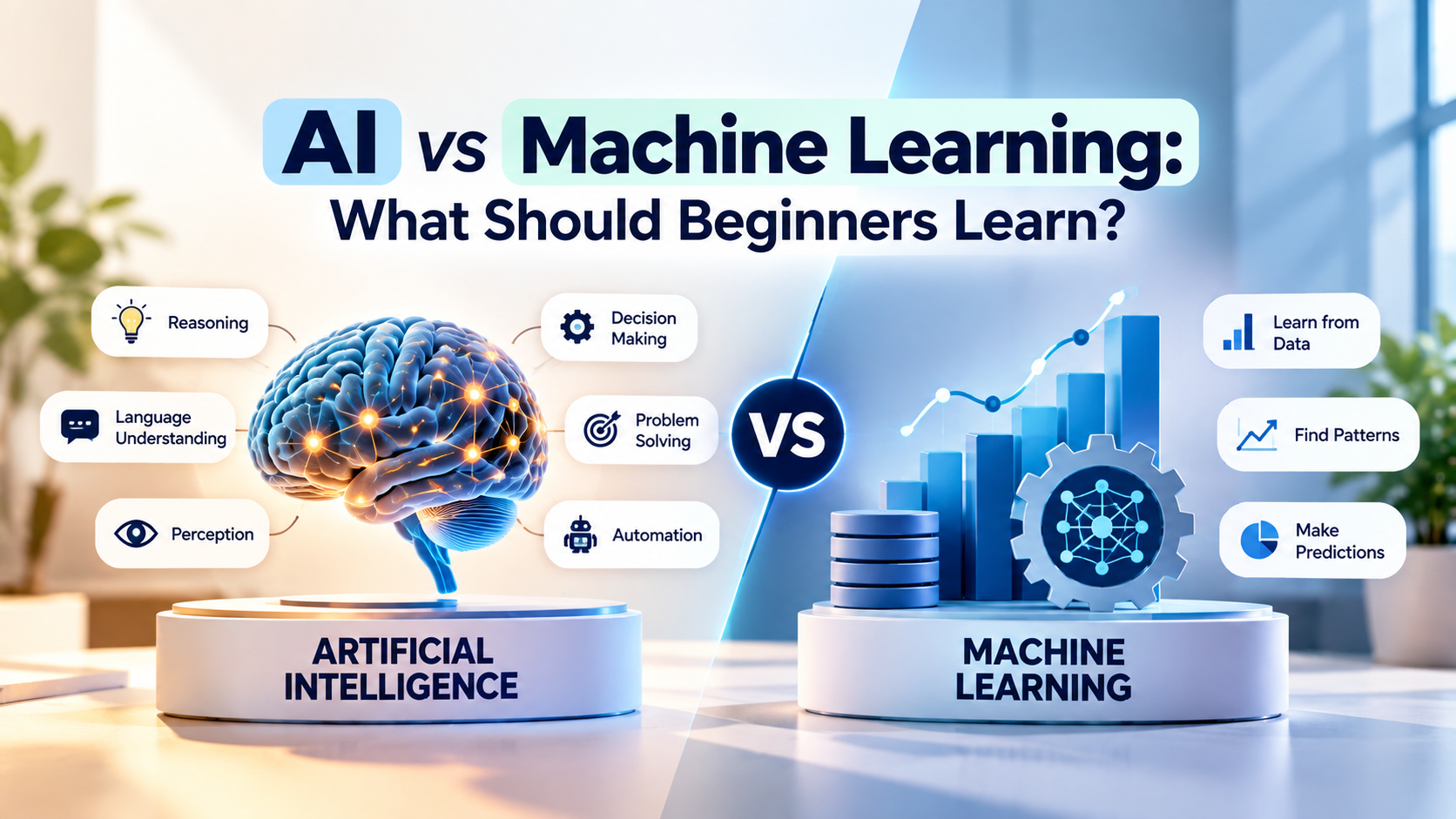
AI vs Machine Learning: What Should Beginners Learn?
Artificial Intelligence and Machine Learning are closely related fields, but they are not exactly the same. As businesses increasingly use AI-powered tools, automation, recommendation systems, chatbots and predictive technologies, beginners often come across terms such as Artificial Intelligence, Machine Learning, Deep Learning and Generative AI.
One common question is: AI vs Machine Learning — what is the difference, and what should a beginner learn first?
Artificial Intelligence is the broader field, while Machine Learning is one of the major approaches used to build AI systems. Understanding this relationship can make it easier to decide which concepts and skills to learn first.
This guide explains the difference between Artificial Intelligence and Machine Learning, where Deep Learning and Generative AI fit, which skills beginners should develop and how different learning goals can affect the path you choose.
AI vs Machine Learning: Key Difference
The simplest distinction is that Artificial Intelligence is the broader field, while Machine Learning is a specific approach within Artificial Intelligence.
| Aspect | Artificial Intelligence | Machine Learning |
|---|---|---|
| Scope | Broader field focused on intelligent systems and tasks | Subset of AI focused on learning patterns from data |
| Main Focus | Performing tasks associated with intelligence | Learning patterns and making predictions or decisions |
| Techniques | Rules, logic, search, Machine Learning and other approaches | Statistical and computational learning methods |
| Data Requirement | Depends on the approach being used | Typically relies on training data |
| Examples | Chatbots, intelligent search and decision-support systems | Spam detection, forecasting and recommendation systems |
| Beginner Focus | AI concepts, applications and different AI technologies | Programming, data, statistics and model development |
In simple terms, Machine Learning can be considered one of the important methods used to develop AI systems. Not every AI system necessarily has to use Machine Learning.
What Is Artificial Intelligence?
Artificial Intelligence refers to technologies that enable computers and machines to perform tasks that normally require aspects of human intelligence.
Depending on the system, AI can involve reasoning, decision-making, language understanding, perception, planning, problem-solving, pattern recognition and content generation.
Examples of Artificial Intelligence
- AI chatbots and virtual assistants
- Speech recognition
- Image recognition
- Recommendation systems
- Language translation
- Generative AI tools
- AI-powered automation
- Intelligent search systems
- Decision-support systems
AI can be implemented using different approaches. Some systems can use predefined rules and logic, while others use Machine Learning models that learn patterns from data.
What Is Machine Learning?
Machine Learning is a branch of Artificial Intelligence that enables systems to learn patterns from data and use those patterns to make predictions or decisions on new information.
Instead of explicitly programming every possible outcome, developers train a Machine Learning model using data. The model identifies relationships and patterns that can then be used for a particular task.
Examples of Machine Learning
- Email spam detection
- Product recommendations
- Fraud detection
- Sales forecasting
- Customer segmentation
- Predictive analytics
- Image classification
- Speech and language applications
Machine Learning is widely used in modern AI systems, particularly when large amounts of data are available for training models.
How AI and Machine Learning Are Connected
Artificial Intelligence and Machine Learning should not be treated as completely separate technologies. Machine Learning is one of the important approaches used to develop AI systems.
For example, a recommendation system can be considered an AI application. A Machine Learning model can analyse previous user behaviour and identify patterns that help generate recommendations.
This relationship becomes important when learning related technologies such as Deep Learning and Generative AI because both areas are closely connected with Machine Learning.
Understanding the relationship between these fields also helps beginners avoid treating AI and Machine Learning as competing technologies. Instead, Machine Learning can be understood as one part of the broader AI landscape.
Where Do Deep Learning and Generative AI Fit?
Deep Learning
Deep Learning is a specialised area of Machine Learning that uses neural networks with multiple layers to process complex patterns in data.
Deep Learning is commonly associated with applications involving images, speech, language and other large or complex datasets.
Beginners do not necessarily need to start with Deep Learning. Understanding basic AI, programming, data and Machine Learning concepts first can provide a stronger foundation for advanced topics.
Generative AI
Generative AI refers to AI systems that can generate new content such as text, images, audio, video or other outputs.
Modern Generative AI applications are closely connected with Machine Learning and Deep Learning. Large AI models are trained using large datasets and can generate outputs based on patterns learned during training.
For beginners, Generative AI can provide an accessible introduction to practical AI applications because many tools can be used through natural-language prompts without requiring advanced programming.
What Should Beginners Learn First?
There is no single learning path for every beginner. The right starting point depends on whether you want to use AI tools, build AI applications, work with data or develop Machine Learning models.
A useful approach is to learn the fundamentals first and then specialise according to your goal rather than trying to study every AI technology at the same time.
Step 1: Understand AI Fundamentals
Start by understanding what Artificial Intelligence is, how it is used and how different AI technologies relate to one another.
Focus on concepts such as intelligent systems, AI applications, automation, decision-making, natural language processing, computer vision, Machine Learning and Generative AI.
Step 2: Learn Basic Programming
If your goal is technical AI or Machine Learning, programming is an important foundation.
Python is commonly used in Machine Learning and AI development because of its libraries, frameworks and ecosystem.
Beginners should become comfortable with variables, data types, conditions, loops, functions, lists, dictionaries, file handling and basic object-oriented programming.
Step 3: Learn Mathematics and Statistics
Technical Machine Learning requires an understanding of mathematical and statistical concepts.
Beginners can gradually learn:
- Basic algebra
- Probability
- Statistics
- Mean, median and standard deviation
- Correlation
- Basic linear algebra
- Data interpretation
You do not need to master advanced mathematics immediately. Learning mathematical concepts alongside practical Machine Learning can make them easier to understand.
Step 4: Learn Data Fundamentals
Machine Learning depends heavily on data. Beginners should understand how data is collected, cleaned, transformed and prepared for analysis.
Important concepts include datasets, features, labels, training data, testing data, missing values and data preprocessing.
Step 5: Learn Machine Learning Basics
Once you understand programming and data fundamentals, you can begin studying Machine Learning.
Start with major learning approaches such as:
- Supervised Learning
- Unsupervised Learning
- Reinforcement Learning
You can then gradually explore algorithms such as linear regression, logistic regression, decision trees, clustering and other commonly used Machine Learning techniques.
Step 6: Practise With Small Projects
Projects can help beginners understand how theoretical concepts work with real data.
Start with manageable projects such as:
- House price prediction
- Customer segmentation
- Spam email classification
- Sales prediction
- Recommendation systems
- Simple image classification
As your knowledge improves, you can move toward larger datasets and more complex applications.
Step 7: Explore Generative AI and Modern AI Tools
After understanding the fundamentals, beginners can explore modern Generative AI tools and applications.
This can include prompt engineering, AI assistants, AI content generation, AI automation and AI agents.
Learning these applications alongside fundamental AI concepts can help you understand both the technology and its practical uses.
Which Learning Path Fits Your Goal?
The most suitable learning path depends on what you want to do with AI. Beginners can use their intended outcome to decide how much emphasis to place on programming, data, Machine Learning or practical AI tools.
| Goal | Skills to Prioritise | Possible Next Step |
|---|---|---|
| Use AI Tools | AI fundamentals, Generative AI, prompting and AI tools | AI-assisted productivity and automation |
| Build AI Applications | Python, programming, APIs, data and AI concepts | Machine Learning and AI application development |
| Work With Machine Learning | Python, mathematics, statistics, data and model evaluation | Machine Learning projects and frameworks |
| Work With Generative AI | AI fundamentals, Large Language Models, prompting and AI tools | AI applications, retrieval-based systems, automation and agents |
Beginner Skills and Practical Projects
Learning AI is not only about understanding definitions. Beginners should gradually develop technical, analytical and practical skills that match their chosen direction.
- AI fundamentals
- Python programming
- Mathematics and statistics
- Data analysis
- Machine Learning fundamentals
- Problem-solving
- Prompt engineering
- Generative AI
- AI tools
- Project development
- Critical evaluation of AI outputs
Practical projects are particularly useful because they allow beginners to apply concepts instead of only watching tutorials or reading definitions.
For example, a beginner learning Machine Learning could build a prediction or classification project, while someone focused on practical AI applications could create an AI-assisted research, content or automation workflow.
Career Directions and Required Skills
AI and Machine Learning skills can be applied across technology, finance, healthcare, marketing, retail, education, manufacturing and other industries.
Possible career directions include:
- AI Engineer: Requires programming and AI application development skills.
- Machine Learning Engineer: Requires stronger programming, mathematics, data and model-building knowledge.
- Data Analyst: Focuses on data handling, analysis and interpretation.
- AI Automation Specialist: Focuses on AI tools, workflow automation and practical business applications.
- Generative AI Specialist: Can focus on prompting, AI tools, LLM applications and AI workflows.
- Data Scientist: Generally requires statistics, programming, data analysis and Machine Learning knowledge.
- Computer Vision Roles: Require specialised knowledge of image processing and Machine Learning or Deep Learning.
- Natural Language Processing Roles: Require specialised knowledge of language data and AI or Machine Learning techniques.
These roles have different technical requirements. A beginner should therefore choose a learning path based on the skills required for the type of work they want to pursue.
Current Upskill Now AI Master Program
The following section is specifically about the Upskill Now AI Master Program rather than AI and Machine Learning education in general.
The program information supplied for this article focuses on modern AI applications such as Generative AI, AI tools, automation and AI agents. Learners considering a structured program should compare its curriculum with their own learning objectives.
An AI Master Program can be considered as one structured learning option for learners who want to explore practical AI tools, Generative AI, automation and related applications.
Before enrolling in any program, check the current curriculum, learning format, projects, mentorship and other inclusions directly with the training provider.
Common Beginner Mistakes
Trying to Learn Everything at Once
AI includes a wide range of concepts and technologies. Trying to study Machine Learning, Deep Learning, Generative AI, Computer Vision and Natural Language Processing simultaneously can make the learning process difficult to organise.
Instead, build your knowledge step by step and choose a direction after understanding the fundamentals.
Ignoring the Basics
Jumping directly into advanced AI tools without understanding basic concepts can make it harder to understand what happens behind the technology.
Only Watching Tutorials
Courses and tutorials can introduce concepts, but practical exercises are important for developing problem-solving skills.
Focusing Only on Certificates
A certificate can document course completion, but projects and practical skills can provide stronger evidence of what you can actually do.
Not Practising With Data
Machine Learning is strongly connected with data. Beginners should spend time understanding datasets, preprocessing, training and evaluating models.
Why Practical AI Training Can Help Beginners
A structured learning program can help beginners organise the large number of AI concepts, tools and technologies available today.
Practical assignments and projects can also help learners move beyond theory and understand how AI can be applied to real-world tasks.
If you are considering an AI training program, check whether the curriculum matches your learning goal and whether it includes practical learning, projects and appropriate guidance.
When comparing an AI learning program, review the syllabus, practical work, learning format and support rather than relying only on the program title.
Conclusion
Understanding AI vs Machine Learning becomes easier once you recognise their relationship. Artificial Intelligence is the broader field, while Machine Learning is a major approach within AI that enables systems to learn patterns from data.
Beginners do not need to learn every AI technology at once. Start with AI fundamentals, understand how the technologies are connected, develop basic technical skills and then choose a direction based on your goals.
If you want to work with technical AI systems, build knowledge of Python, mathematics, statistics, data and Machine Learning. If your goal is practical AI use, explore Generative AI, prompting, automation and AI tools.
The most useful learning path is the one that matches the type of AI work you want to do and gives you opportunities to practise what you learn.
Contact Upskill Now
Address:
A-3, Third Floor,
Rajouri Garden,
New Delhi – 110027
Phone:
9999848160
9711448765
Email:
connect@upskillnow.in