AI Tools for Digital Marketers in 2027: Tools, Uses and Workflows
Artificial intelligence is becoming an important part of modern digital marketing. From content creation and SEO to advertising, social media, analytics and automation, AI tools can help marketers reduce repetitive work and spend more time on strategy and creativity.
As marketing workflows become increasingly AI-assisted, knowing which tools to use and when to use them is becoming just as important as knowing how to operate the tools themselves.
This guide explains how AI tools can support different areas of digital marketing, what each tool can be used for, how marketers can combine tools into practical workflows and what to consider before selecting an AI marketing platform.
Last updated: 2027. AI tools and features can change frequently, so tool capabilities should be reviewed periodically before making purchasing or workflow decisions.
What Are AI Tools for Digital Marketing?
AI tools for digital marketing are software platforms that use artificial intelligence to support marketing activities such as content generation, research, SEO, advertising, design, analytics, customer communication and automation.
Some tools focus on one particular marketing activity, while others combine several AI capabilities into a broader workspace.
The right tool depends on the marketing objective. A content marketer may need an AI writing assistant, while an SEO professional may need keyword research and content optimisation capabilities. A performance marketer may benefit more from AI-supported campaign analysis and automation.
Marketers who want to build practical skills across SEO, content, advertising, analytics and AI can also explore AI digital marketing training to understand how these areas can work together.
Why AI Tools Matter for Digital Marketers
Digital marketers deal with large amounts of information every day. They research keywords, analyse audiences, create content, manage campaigns, monitor analytics and communicate with customers.
AI can help accelerate many of these activities by generating ideas, summarising information, identifying patterns and assisting with repetitive tasks.
However, AI should be treated as a productivity and decision-support technology rather than a complete replacement for marketing expertise.
The most useful approach is to connect AI capabilities with clear marketing objectives, reliable data and human review.
How These AI Marketing Tools Were Selected
This guide focuses on tools that can support commonly performed digital marketing activities such as content creation, research, SEO, design, CRM, automation and campaign analysis.
The tools are discussed according to their practical marketing use rather than simply their popularity. Marketers should also consider workflow compatibility, integrations, output quality, privacy controls, human review requirements and the specific task they want to improve.
Because AI platforms change frequently, the features and capabilities described in this article should be checked against the provider's current product information before implementation.
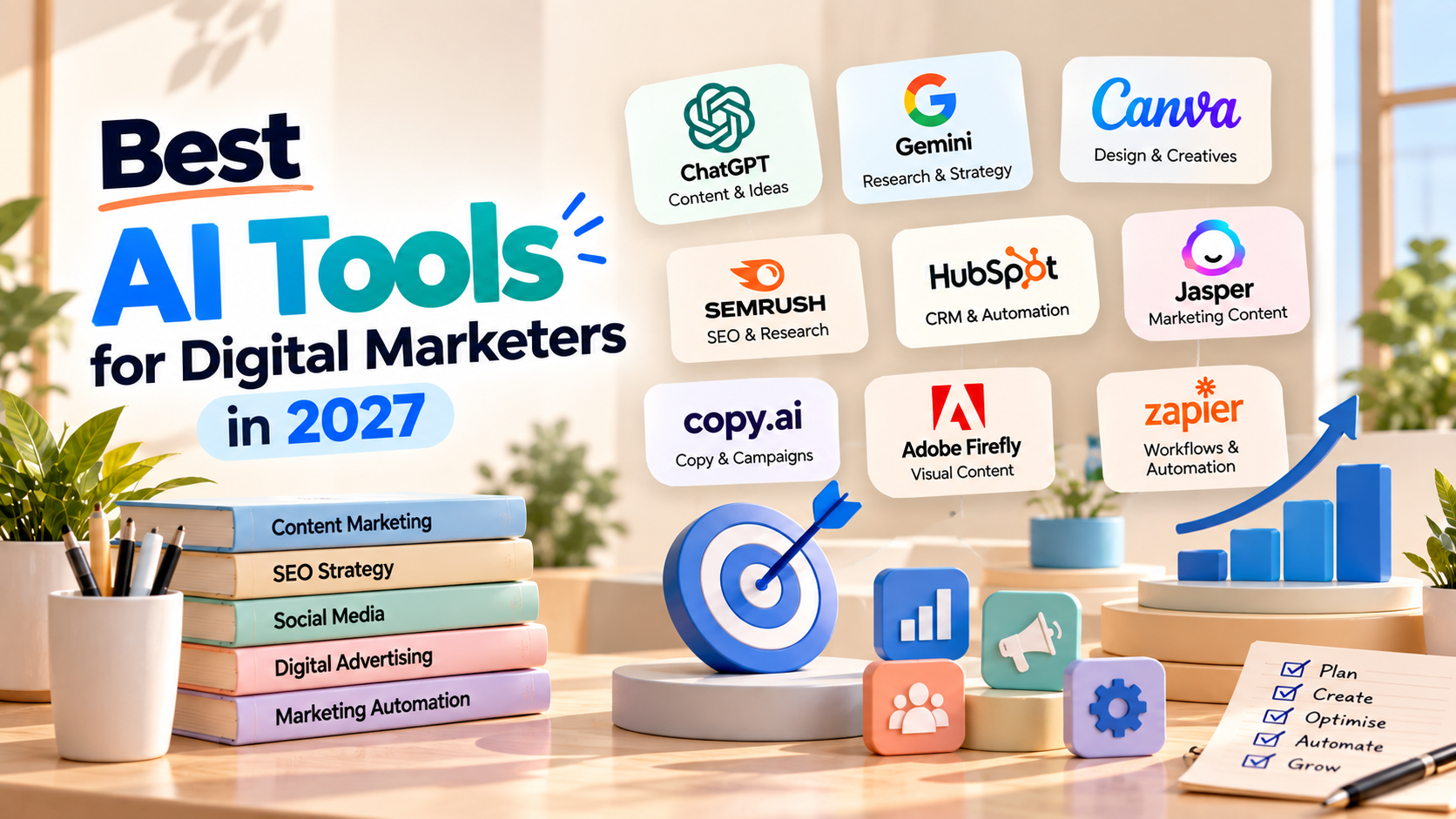
AI Tools for Digital Marketing: Quick Comparison
| AI Tool | Primary Marketing Use | Useful For | Example Workflow |
|---|---|---|---|
| ChatGPT | Content and marketing assistance | Content, research, ideas and strategy | Brief → ideas → draft → human review |
| Google Gemini | Research and content ideation | Research, summaries and content planning | Research → organise information → content brief |
| Claude | Long-form content and analysis | Detailed briefs and document-based tasks | Brief → analysis → draft → review |
| Jasper | Marketing content | Marketing copy and brand messaging | Campaign brief → copy → editing |
| Copy.ai | Content and workflows | Marketing and sales-related workflows | Input → AI workflow → human approval |
| Canva AI | Design and creative content | Social media and promotional graphics | Concept → design → brand review |
| Adobe Firefly | Generative creative work | Visual concepts and creative variations | Concept → AI generation → creative review |
| Semrush | SEO and marketing research | Keyword research and SEO planning | Keyword research → intent → content planning |
| Surfer | Content optimisation | On-page content optimisation | Draft → optimisation → human editing |
| HubSpot AI | CRM and marketing workflows | Leads, customer data and communication | Lead → CRM → segmentation → communication |
| Zapier | Marketing automation | Connecting marketing applications | Trigger → data transfer → automated action |
| AI Email Marketing Tools | Email content and optimisation | Subject lines, variations and segmentation | Audience → email → engagement analysis |
| AI Social Media Tools | Social content and analysis | Content ideas, captions and performance | Calendar → content → scheduling → analysis |
| AI Advertising Tools | Advertising support and optimisation | Ad concepts, audience ideas and analysis | Campaign → creative → data → optimisation |
1. ChatGPT for Digital Marketing
ChatGPT can support marketers across multiple stages of the marketing process. It can be used for brainstorming, content outlines, campaign ideas, audience research, email drafts, social media concepts, keyword clustering and marketing strategy discussions.
A marketer can use the same type of AI assistant for several marketing tasks by providing the right context and instructions.
For better results, marketers should provide information about the target audience, brand voice, campaign objective, platform and desired output instead of relying on short generic prompts.
2. Google Gemini for Marketing Research
Google Gemini can be useful for marketers who need assistance with research, content ideation, summarisation and information organisation.
Marketers can use AI assistants such as Gemini to explore campaign ideas, structure content briefs, generate variations and support research workflows.
As with any AI-generated research, marketers should verify important information before using it in published content or business decisions.
3. Claude for Content and Strategy
Claude can be useful for marketers working with longer documents, detailed briefs and structured content tasks.
Marketing teams can use it for developing content frameworks, reviewing drafts, analysing information and refining messaging.
It can be particularly useful when a marketing task requires maintaining context across a longer piece of information.
4. Jasper for Marketing Content
Jasper is designed around marketing and content workflows. It can assist teams with creating marketing copy, campaign content and brand-focused messaging.
Marketing teams can use dedicated AI writing platforms when they want a workflow that is specifically designed around content production rather than a general-purpose AI assistant.
Human editing is still important for maintaining brand identity, factual accuracy and originality.
5. Copy.ai for Marketing Workflows
Copy.ai focuses on AI-assisted content and workflow creation. It can be useful for teams that want to streamline repetitive marketing and sales-related processes.
Marketers can explore its capabilities for content creation, campaign workflows, sales communication and other repetitive marketing activities.
The value of an AI workflow depends on how well it is connected to the team's actual processes and objectives.
6. Canva AI for Marketing Design
Visual content is an important part of digital marketing, and Canva provides AI-assisted features that can support marketers with design and content creation.
Marketers can use AI-powered design features to develop social media creatives, presentations, promotional graphics and other visual marketing materials.
These capabilities can help marketers create initial concepts faster while allowing them to refine the final design according to brand guidelines.
7. Adobe Firefly for AI Creative Work
Adobe Firefly provides generative AI capabilities for creative workflows. It can be useful for marketers who need support with image generation, creative variations and visual experimentation.
AI-generated visuals can help marketing teams explore creative directions quickly before finalising campaign assets.
Marketers should ensure that generated visuals are appropriate for their brand and intended commercial use.
8. Semrush for SEO and Marketing Research
SEO requires keyword research, competitor analysis, content planning and performance monitoring. Semrush provides marketing and SEO capabilities that can support these activities.
Marketers can use SEO platforms alongside AI tools to combine keyword and search data with AI-assisted content planning.
The important skill is understanding the search intent and business objective behind the data rather than simply generating content around keywords.
9. Surfer for AI-Assisted SEO
Surfer can support content optimisation by helping marketers analyse search results and identify opportunities for improving content structure and topical coverage.
It can be used as part of an SEO workflow that includes keyword research, content planning, writing, optimisation and performance monitoring.
SEO tools should support the creation of useful content rather than encouraging marketers to produce content only for search engines.
10. HubSpot AI for Marketing and CRM
CRM platforms are becoming increasingly connected with AI capabilities. HubSpot provides marketing, sales and customer relationship tools with AI-supported features.
Marketers can use CRM systems to organise leads, manage customer information, automate communication and analyse marketing activities.
Combining CRM data with AI can help marketing teams build more structured customer journeys.
11. Zapier for AI Automation
Automation becomes especially useful when marketing teams use several different platforms.
Zapier can connect applications and automate repetitive workflows. Marketers can use automation to move information between tools, trigger actions and reduce manual data entry.
For example, a lead submitted through a website form can be sent to a CRM, added to a marketing workflow and assigned to a team member automatically.
AI Tools for Email Marketing
Email marketing platforms are increasingly incorporating AI features for content generation, segmentation, personalisation and campaign optimisation.
Marketers can use AI to generate subject-line ideas, create content variations and analyse engagement patterns.
Effective email marketing still depends on understanding the audience, customer journey and purpose of the communication.
AI Tools for Social Media Marketing
Social media marketers can use AI for content ideation, caption writing, content calendars, audience research and performance analysis.
AI can help create multiple versions of a social media post for different platforms while marketers maintain control over the final messaging.
The strongest workflows combine AI-assisted production with human creativity, platform knowledge and brand strategy.
AI Tools for Digital Advertising
Advertising platforms increasingly use machine learning and automation to support campaign management and optimisation.
Marketers can also use AI assistants to generate advertising concepts, audience ideas, copy variations and campaign analysis frameworks.
Understanding campaign objectives, conversion tracking, audience targeting and performance metrics remains essential even when AI is involved.
How to Choose the Right AI Marketing Tool
There is no single AI tool that is perfect for every marketing task. Before selecting a platform, marketers should identify the specific problem they want to solve.
- What marketing task needs improvement?
- How frequently is the task performed?
- Does the tool integrate with existing platforms?
- Does it provide sufficient control over the output?
- Does it support the team's workflow?
- What level of human review is required?
- Does the tool provide appropriate data and privacy controls?
- How easy is it to measure the value created by the tool?
A tool that saves time but produces unreliable output may create additional work. Marketers should therefore evaluate both productivity and quality.
AI Marketing Workflows for Digital Marketers
AI becomes more useful when individual tools are connected to a complete marketing workflow rather than used as isolated applications.
SEO Workflow
A practical SEO workflow can include keyword research, search intent analysis, competitor research, content outlining, AI-assisted drafting, human editing, on-page optimisation and performance tracking.
Content Marketing Workflow
A content workflow can begin with audience research and topic selection, followed by content planning, AI-assisted drafting, human editing, publishing, content distribution and performance analysis.
Social Media Workflow
A social media workflow can move from content planning to AI-assisted caption development, creative production, human approval, scheduling and performance analysis.
Email Marketing Workflow
An email workflow can use audience segmentation, AI-assisted subject-line and content variations, automated delivery and engagement analysis while keeping the overall communication strategy under human control.
Lead Management Workflow
A lead workflow can begin when a visitor submits a website form. The lead can then be stored in a CRM, categorised, added to an email sequence and assigned to the relevant sales or marketing team.
AI can assist with content generation, segmentation and analysis while automation handles the movement of information between systems.
AI Tools and Human Skills
Using AI tools does not eliminate the need for marketing knowledge. Marketers still need creativity, communication, strategic thinking, analytical skills and an understanding of customer behaviour.
The marketer's role is to decide what should be created, why it should be created, who it is for and how success should be measured.
AI can accelerate execution, but marketing strategy, quality control and human judgment remain essential.
Important Skills to Learn Alongside AI Tools
- Search engine optimisation
- Content marketing
- Social media marketing
- Google Ads
- Meta Ads
- Email marketing
- Marketing analytics
- AI prompting
- Marketing automation
- Data interpretation
- Creative strategy
- Campaign planning
Learning these fundamentals makes it easier to understand where AI can provide genuine value and where human judgment is more important.
Developing these fundamentals alongside practical AI applications can help learners understand how marketing tools fit into real-world workflows. Structured digital marketing learning can also help connect individual skills into complete marketing campaigns.
Practical AI Marketing Projects
Practical projects can help marketers understand how individual AI tools work together in a complete marketing process.
AI-Assisted SEO Project
A practical SEO project could combine keyword research, search-intent analysis, content planning, AI-assisted drafting, human editing, on-page optimisation and performance tracking.
AI Content Marketing Project
A content project could combine audience research, topic development, AI-assisted content planning, human editing, publishing, content repurposing and performance analysis.
AI Social Media Project
A social media project could combine content planning, AI-assisted caption development, creative production, human approval, scheduling and performance analysis.
AI Lead-Nurturing Project
A lead-generation project could connect a website form, CRM, customer segmentation, automated email communication and performance reporting.
Who Can Use AI Tools for Digital Marketing?
AI marketing tools can be useful for people at different stages of their learning or professional journey.
- Students: Build digital marketing knowledge and practical AI workflow projects.
- Fresh graduates: Develop practical skills and create a portfolio.
- Working professionals: Add AI capabilities to existing marketing skills.
- Business owners: Understand how AI-assisted workflows can support marketing operations.
- Freelancers: Develop services around content, SEO, social media, email and automation.
- Marketing professionals: Improve workflow efficiency and data-driven decision-making.
Conclusion
AI tools for digital marketing can help marketers research faster, create content more efficiently, automate repetitive workflows and analyse campaign information.
However, successful AI-powered marketing requires more than access to technology. Marketers need strong fundamentals, strategic thinking, creativity, analytical skills and the ability to evaluate AI-generated output.
The most useful approach is to select AI tools according to specific marketing objectives and integrate them into practical workflows while keeping human judgment at the centre of important decisions.
Start Building AI-Powered Digital Marketing Skills
If you want to understand how AI can be applied to SEO, content marketing, social media, advertising, analytics and automation, structured practical learning can help you develop these skills step by step.
UpskillNow's AI Digital Marketing Master Program covers digital marketing fundamentals, SEO, social media marketing, Google Ads, Meta Ads, content marketing, analytics, email marketing, automation and AI tools for digital marketing.
To learn more about applying AI alongside core digital marketing skills, explore the AI Digital Marketing Course.
Contact UpskillNow
Address:
A-3, Third Floor,
Rajouri Garden,
New Delhi – 110027
Phone:
9999848160
9711448765
Email:
connect@upskillnow.in