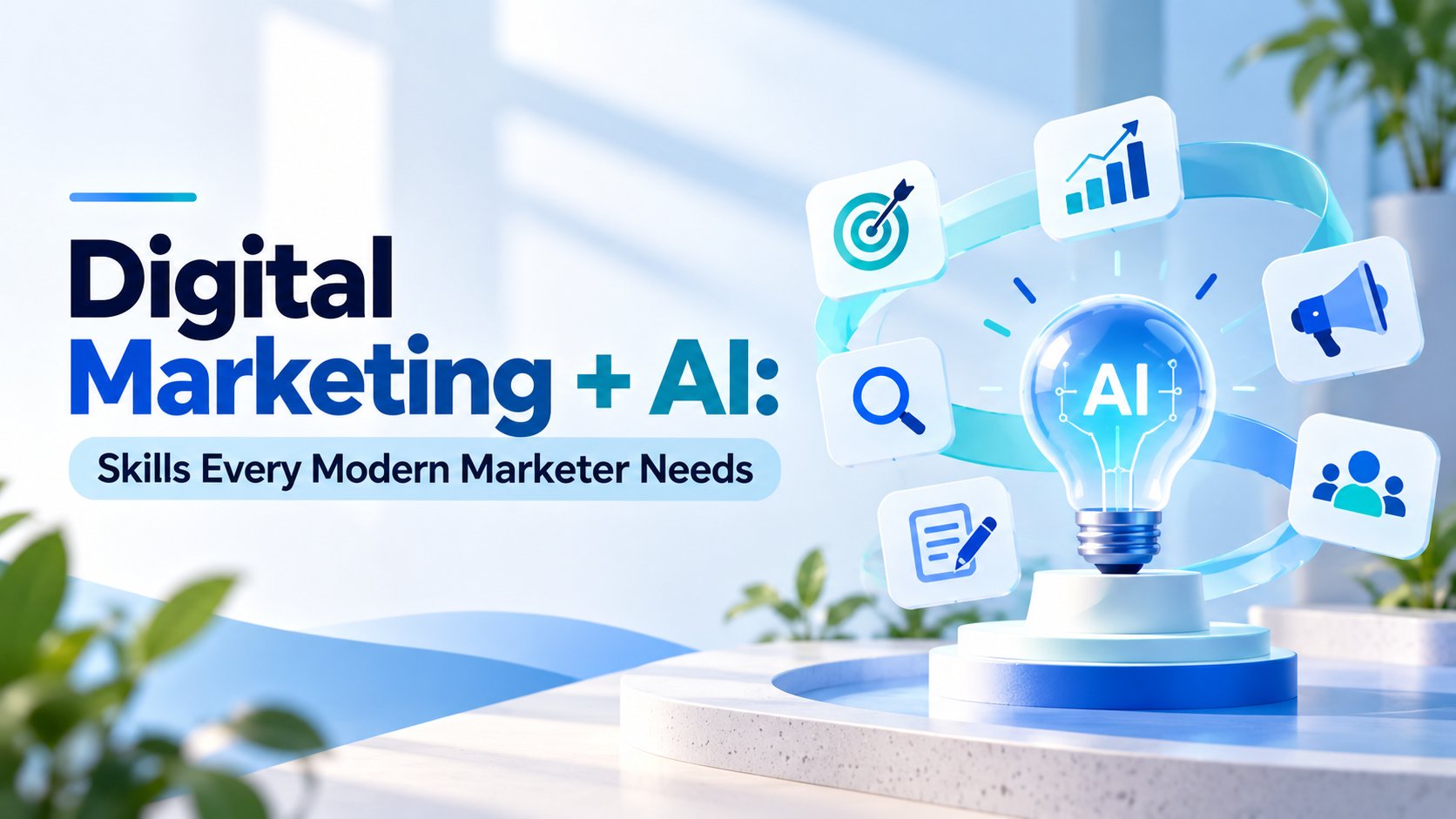
Digital Marketing + AI: Skills Every Modern Marketer Needs
Digital marketing is changing as artificial intelligence becomes part of everyday marketing workflows. From content creation and SEO to social media, paid advertising, analytics and automation, AI can help marketers research faster, create more efficiently and work with large amounts of information.
However, using an AI tool is not the same as understanding digital marketing. Modern marketers need strong marketing fundamentals along with practical AI skills to understand audiences, build campaigns, analyse performance and make informed decisions.
This guide focuses on the key digital marketing with AI skills modern marketers can develop, how AI can support different marketing functions, and how practical projects can help turn these skills into usable experience.
Digital Marketing with AI: What Does It Mean?
Digital marketing with AI combines established digital marketing practices with artificial intelligence, automation and data-driven workflows. Instead of treating AI as a separate subject, marketers can use it throughout activities such as research, content planning, SEO, advertising, reporting and customer communication.
AI can help generate ideas, analyse information, create content variations, identify patterns and automate repetitive tasks. The marketer still needs to provide the context, review the output and make decisions based on the audience and business objective.
For learners who want structured training in these areas, an AI digital marketing learning program can combine marketing fundamentals with practical AI applications.
The most useful approach is to combine marketing knowledge with AI rather than replacing marketing skills with AI tools.
Digital Marketing Fundamentals
Before applying AI to marketing, it is important to understand how digital marketing works. Marketers need to know who they are targeting, what problem they are solving, which channel they are using and what outcome they want to achieve.
Important fundamentals include:
- Target audience and customer research
- Customer journey and marketing funnels
- Brand positioning and messaging
- Search engine optimisation
- Social media marketing
- Paid advertising
- Content marketing
- Email marketing
- Analytics and conversion measurement
These fundamentals provide the context needed to use AI effectively. Without a clear objective, AI-generated content or campaign ideas may be quick to produce but difficult to connect with real marketing outcomes.
1. AI Prompting for Marketing
Prompting is an increasingly useful skill for marketers working with generative AI. A useful marketing prompt should provide enough context for the AI system to understand the task.
A structured prompt can include:
- Business or campaign context
- Target audience
- Marketing objective
- Platform or content format
- Brand tone
- Required output
- Important restrictions or information
Marketers can use prompts to develop content ideas, advertising variations, email drafts, social media calendars, keyword research frameworks and campaign briefs.
The important skill is not simply generating an answer. Marketers should review, edit and improve AI-generated output to make sure it is accurate, relevant, original and appropriate for the brand.
2. AI-Powered SEO Skills
SEO remains an important digital marketing skill, while AI is changing how marketers approach research, content planning and optimisation.
AI can assist with:
- Keyword research
- Search intent analysis
- Content briefs
- Topic clustering
- Competitor research
- Content optimisation
- Internal linking ideas
- Content gap analysis
AI does not replace the need to understand technical SEO, on-page optimisation, website structure, internal linking, search intent and content quality.
Modern SEO also requires marketers to consider how people discover information through search engines and AI-powered search experiences. Useful content, clear structure and strong topical relevance remain important parts of an effective SEO strategy.
3. Content Creation and Copywriting
Content is a core part of digital marketing. AI can speed up brainstorming, research, outlining and first-draft creation across different formats.
Marketers can use AI to support:
- Blog ideas and outlines
- SEO content planning
- Social media captions
- Email drafts
- Landing page copy
- Video scripts
- Advertising variations
Human judgment remains essential. A marketer needs to understand the audience, brand voice, messaging and purpose of the content before using AI to accelerate production.
AI-generated content should be reviewed for factual accuracy, relevance, originality, tone and usefulness before publication.
4. Social Media Marketing with AI
AI can support social media marketers throughout the planning and optimisation process. It can help identify content themes, generate post variations, organise content calendars and analyse performance information.
Important social media skills include:
- Audience research
- Content strategy
- Platform-specific content
- Content calendar planning
- Community engagement
- Performance analysis
- Brand communication
For example, a marketer could use AI to analyse a month's content performance, identify recurring themes and generate new content ideas. The marketer would then select the ideas that fit the brand and audience rather than publishing every generated suggestion.
5. Google Ads and Performance Marketing
Paid advertising platforms use automation and machine learning for several campaign functions. Digital marketers therefore need to understand both marketing strategy and campaign technology.
Important skills include:
- Campaign objectives
- Audience targeting
- Keyword selection
- Ad copy
- Landing pages
- Conversion tracking
- Budget management
- Performance analysis
AI can help generate advertising variations, organise research and identify patterns in campaign data. The marketer remains responsible for understanding the business objective and evaluating whether the campaign is producing useful results.
6. Meta Ads and Creative Optimisation
Meta advertising requires an understanding of audiences, campaign objectives, creative formats, messaging and conversion goals.
AI can assist with:
- Creative concepts
- Ad-copy variations
- Audience research
- Content ideas
- Creative testing ideas
- Performance pattern analysis
A practical workflow could involve creating several creative concepts with AI, reviewing them against the target audience and brand guidelines, testing selected versions and then analysing the campaign results.
The combination of advertising knowledge, creative thinking and AI-assisted optimisation can help marketers build more structured campaign workflows.
7. Marketing Analytics and Data Interpretation
Modern marketing depends heavily on data. Collecting numbers is not enough; marketers need to understand what the numbers mean and what action should follow.
Important metrics include:
- Website traffic
- Engagement rate
- Conversion rate
- Cost per lead
- Customer acquisition cost
- Return on advertising spend
- Revenue
AI can help summarise large datasets, identify patterns and highlight unusual changes. However, marketers still need analytical thinking to determine whether an observed pattern is meaningful and what should be done next.
8. Marketing Automation
Automation helps marketers reduce repetitive manual tasks and create structured customer journeys.
AI and automation can support:
- Email workflows
- Lead nurturing
- Customer segmentation
- Follow-up sequences
- Reporting
- Campaign workflows
- Repetitive administrative tasks
For example, a lead-generation workflow can move a new enquiry into a CRM, trigger a follow-up email, segment the lead based on available information and notify a sales team when further action is required.
Understanding how different marketing tools connect is important because automation is most useful when individual activities work together as one workflow.
9. Personalisation and Customer Experience
Customers increasingly expect brands to provide relevant information at the right stage of their journey. AI can help marketers analyse customer behaviour and support more personalised experiences.
Personalisation can be applied to:
- Email campaigns
- Website content
- Product recommendations
- Advertising messages
- Customer communication
The goal should be to make communication more relevant and useful. Customer information should be handled responsibly, and personalisation should not make communication feel repetitive or intrusive.
10. Human Skills That Remain Important
Technical AI knowledge is only one part of becoming a modern marketer. Human skills remain important when marketers need to understand problems, communicate ideas and make strategic decisions.
Important skills include:
- Communication
- Creativity
- Critical thinking
- Storytelling
- Problem-solving
- Adaptability
- Strategic decision-making
A marketer must be able to understand a business problem, identify the target audience, develop a suitable strategy and judge whether an AI-generated solution actually makes sense.
Digital marketing with AI is therefore best understood as a combination of technology and human judgment rather than a collection of AI tools.
AI Tools for Digital Marketing Workflows
Different AI tools can support different marketing activities. The goal is not to use every available tool but to understand which type of tool is useful for a particular task.
- ChatGPT: Content ideas, research frameworks, campaign brainstorming, outlines and copy drafts.
- Google Gemini: Research, information analysis and marketing ideation.
- Claude: Long-form content, document analysis and structured workflows.
- Canva AI: Social media graphics, presentations and marketing creatives.
- Midjourney: AI-assisted image and visual generation.
- Copy.ai and Jasper: Marketing copy, advertising content and email workflows.
- Pictory and Synthesia: Video creation and presentation-style content.
- Notion AI: Planning, documentation and content organisation.
- Runway: AI-assisted video creation and editing.
- Grammarly AI: Writing refinement, tone and communication support.
The value of an AI tool depends on how it is applied. Marketers should focus on the marketing problem first and then select an appropriate tool.
What Should You Learn in Digital Marketing with AI?
A practical learning path can begin with digital marketing fundamentals and gradually introduce AI into each major marketing function.
- Digital marketing fundamentals
- Search engine optimisation
- Social media marketing
- Google Ads and performance marketing
- Meta Ads
- Content marketing and copywriting
- Marketing analytics
- Email marketing
- Marketing automation
- AI prompting for marketing
- AI-assisted content creation
- AI-powered SEO workflows
- AI-assisted campaign research and optimisation
- Portfolio and practical project development
How AI Skills Map to Different Marketing Roles
Not every marketing role requires the same combination of skills. Understanding the connection between marketing functions and AI applications can help learners focus their practice.
- SEO roles: Search intent, keyword research, content optimisation, technical SEO and AI-assisted research.
- Content roles: Research, content planning, copywriting, editing and AI-assisted content workflows.
- Social media roles: Content calendars, audience research, creative development and performance analysis.
- Performance marketing roles: Campaign strategy, targeting, conversion tracking, testing and data analysis.
- Analytics roles: Reporting, data interpretation, performance measurement and pattern identification.
- Marketing automation roles: CRM workflows, segmentation, lead nurturing and automated communication.
Developing skills across several areas can provide a broader understanding of how different marketing functions work together.
Why Practical Experience Matters
Reading about digital marketing and AI is different from applying these skills to a real marketing problem.
Learners can build practical experience by creating:
- Sample SEO campaigns
- Social media calendars
- Google Ads campaign structures
- Meta Ads campaign plans
- Content strategies
- Email workflows
- Analytics reports
- AI-assisted marketing workflows
Example: AI-Assisted SEO Workflow
A practical SEO workflow can use AI at selected stages while keeping strategic decisions with the marketer:
Keyword Research → Search Intent → Content Brief → AI-Assisted Outline → Human Review → SEO Optimisation → Publishing → Performance Analysis
AI can help with research, clustering and initial content planning, while the marketer checks search intent, accuracy, originality, relevance and overall content quality.
Example: AI-Assisted Campaign Workflow
A paid marketing workflow can involve researching the target audience, generating initial creative and copy concepts, selecting suitable variations, launching the campaign, analysing performance and using the results to inform the next round of optimisation.
Projects like these can help learners explain their approach during interviews because they can demonstrate how they identified a problem, selected appropriate tools and evaluated the outcome.
Career Opportunities with Digital Marketing and AI Skills
Combining digital marketing knowledge with AI skills can support different marketing roles and responsibilities.
- Digital Marketing Executive
- SEO Specialist
- Social Media Manager
- Performance Marketing Executive
- Google Ads Specialist
- Content Marketing Specialist
- Email Marketing Specialist
- Marketing Analyst
- Marketing Automation Specialist
- Digital Marketing Consultant
- Freelance Digital Marketer
The responsibilities can vary between companies and roles. Actual opportunities depend on individual skills, experience, portfolio quality and employer requirements.
Who Can Learn Digital Marketing with AI?
Digital marketing with AI can be relevant to people at different stages of their learning or career journey.
- Students: Build marketing knowledge and practical projects alongside academic studies.
- Fresh graduates: Develop practical skills and create a portfolio.
- Working professionals: Add digital marketing and AI capabilities to existing skills.
- Business owners: Understand online customer acquisition and marketing workflows.
- Freelancers: Develop services around SEO, content, social media and paid advertising.
- Content creators: Improve research, content planning and production workflows.
How to Build a Career in Digital Marketing with AI
A practical career-building path can start with the fundamentals and gradually introduce AI into different marketing functions.
- Understand digital marketing fundamentals.
- Learn SEO and search intent.
- Build social media marketing skills.
- Learn Google Ads and Meta Ads.
- Develop content and copywriting skills.
- Learn analytics and performance measurement.
- Practise AI prompting for marketing tasks.
- Build AI-assisted marketing workflows.
- Create practical projects for your portfolio.
- Apply your skills through internships, freelance projects or entry-level opportunities.
The goal is not to learn every AI tool available. Focus on understanding marketing principles first and then learn how AI can make specific workflows more efficient.
How to Learn Digital Marketing with AI
If you decide to learn through a structured program, focus on the learning experience rather than the number of tools mentioned in a course description.
A useful training program should provide a balance of:
- Digital marketing fundamentals
- SEO and search intent
- Social media marketing
- Google Ads and Meta Ads
- Content marketing
- Analytics and reporting
- Email marketing and automation
- AI applications in marketing
- Practical assignments
- Projects and portfolio development
- Mentorship or trainer guidance
Online and classroom learning can both be useful. The appropriate format depends on your schedule, learning preferences, access to practical guidance and the structure of the program.
Conclusion
Digital marketing with AI is not simply about learning the latest artificial intelligence tools. It is about combining marketing fundamentals with technology, analytics, creativity and strategic thinking.
Modern marketers need to understand audiences, digital channels, campaign objectives and performance metrics while learning how AI can support research, content, advertising, automation and analysis.
Practical projects can help turn these concepts into usable skills. By combining structured learning with regular experimentation and portfolio development, learners can build a stronger understanding of how modern marketing workflows operate.
Build Your Digital Marketing + AI Skills
If you want to develop practical digital marketing skills while learning how AI can support modern marketing workflows, a structured learning approach can help you progress from fundamentals to practical application.
UpskillNow's AI Digital Marketing Master Program covers areas such as digital marketing fundamentals, SEO, social media marketing, Google Ads, Meta Ads, content marketing, analytics, email marketing, automation and AI applications.
To explore the program and its curriculum, visit the AI Digital Marketing Course.
Contact UpskillNow
A-3, Third Floor, Rajouri Garden, New Delhi – 110027
Phone: 9999848160 | 9711448765
Email: connect@upskillnow.in