Generative AI for Beginners: Concepts, Tools & Practical Uses
Generative AI has quickly become one of the most accessible areas of Artificial Intelligence for beginners. From creating text and images to summarising information, assisting with coding, generating ideas and automating repetitive tasks, Generative AI is being used across education, marketing, business, software development and many other industries.
If you are new to Artificial Intelligence, learning Generative AI can be a practical way to understand how modern AI systems work and how they can be applied to real-world problems. You do not need to learn every advanced AI concept at once. A structured approach that begins with basic concepts, AI tools, prompt engineering and practical projects can help you build a strong foundation.
Generative AI for Beginners
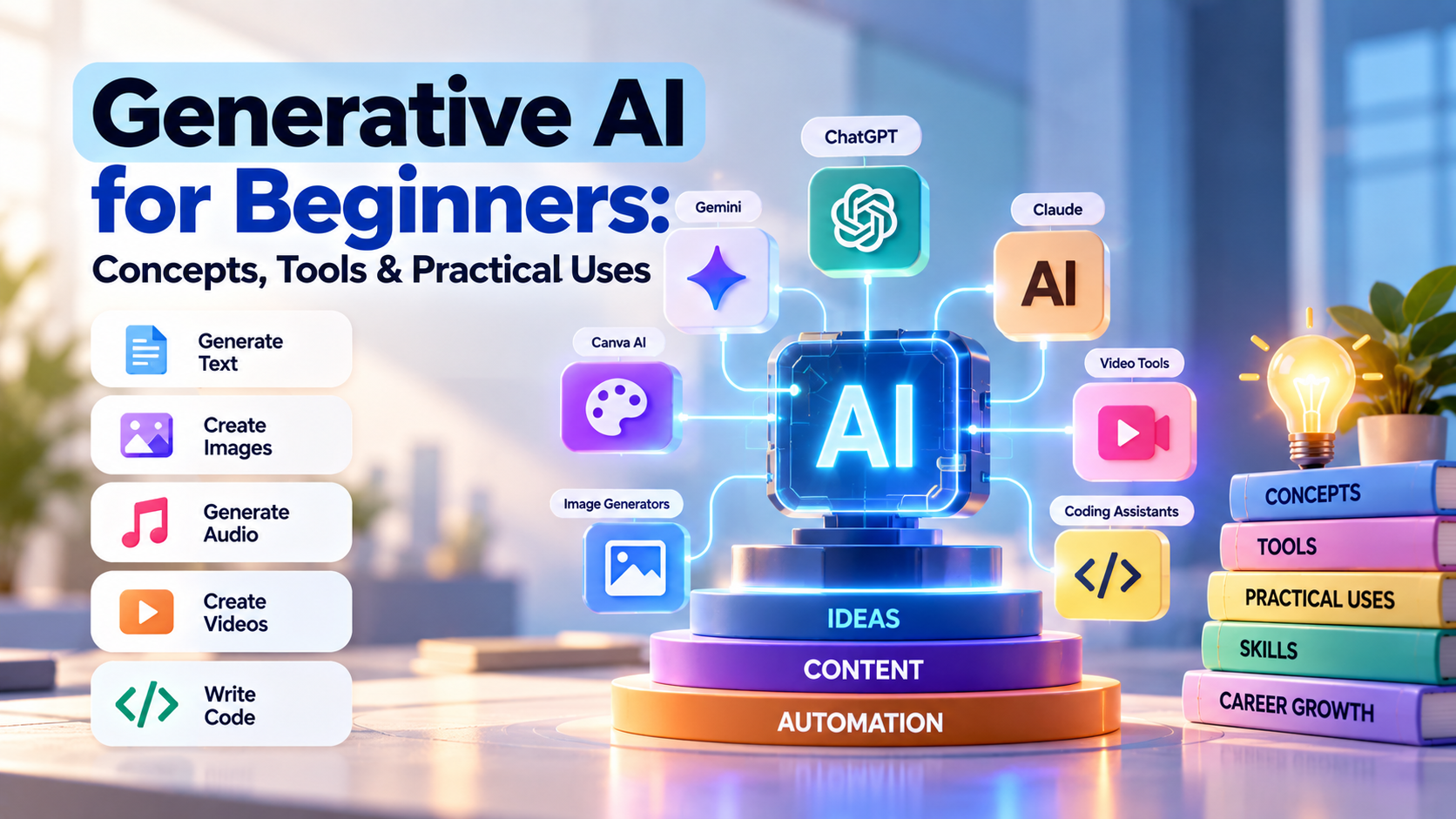
Generative AI refers to AI systems that can create new content based on patterns learned from large amounts of data. Depending on the model and application, Generative AI can produce text, images, audio, video, code and other types of digital content.
For beginners, one of the easiest ways to understand Generative AI is to think of it as technology that can interpret instructions and generate content based on the context provided by the user.
For example, a user can ask an AI system to explain a difficult concept, create a social media caption, summarise a document, generate programming code or develop ideas for a marketing campaign.
What Is Generative AI?
Generative AI is a category of Artificial Intelligence designed to generate new content rather than simply analyse or classify existing information.
Traditional AI systems can be designed to recognise patterns, classify information or make predictions. Generative AI goes a step further by producing new outputs based on patterns learned during training.
Large language models are an important part of modern Generative AI. They can understand natural-language instructions and generate responses based on the context of a user's request.
Generative AI is not limited to text. Different models can work with images, audio, video, programming code and other forms of digital content.
How Does Generative AI Work?
Generative AI models are trained using large datasets containing different types of information. During training, the model learns patterns and relationships within that data.
When a user provides an instruction, the AI system processes the input and generates an output based on the patterns it has learned. The result can change depending on the wording of the instruction, the context provided and the capabilities of the particular AI model.
For example, if you ask an AI tool to write a professional email, the system can generate a draft based on the purpose, audience and tone described in your prompt.
This is why understanding how to communicate clearly with AI systems is becoming an important skill for beginners.
Generative AI vs Traditional AI
Traditional AI and Generative AI can perform different types of tasks. A traditional AI system may analyse information, classify data or make predictions, while a Generative AI system can create new content based on a user's instructions.
For example, a Machine Learning model might predict whether a customer is likely to purchase a product, while a Generative AI system could create a personalised product description or marketing message.
Both approaches are part of the broader Artificial Intelligence ecosystem and can be combined in practical applications.
Popular Generative AI Tools for Beginners
There are many Generative AI tools available today, with each platform offering different capabilities. Beginners should focus on understanding the purpose of a tool rather than trying to learn every platform at the same time.
ChatGPT
ChatGPT can be used for writing, brainstorming, learning, summarisation, research assistance, coding support and many other text-based tasks. Beginners can also use it to practise prompt writing and understand how AI responds to different instructions.
Google Gemini
Gemini is Google's Generative AI platform. It can assist with writing, brainstorming, information processing and other AI-supported tasks.
Claude
Claude is a conversational AI system that can assist with writing, analysis, summarisation and document-related workflows.
Canva AI
Canva includes AI-powered features that can assist with visual content creation, presentations, social media graphics and other design workflows.
AI Image Generation Tools
AI image generators can create visual concepts from text descriptions. These tools can be useful for marketing graphics, educational visuals, creative projects and design experimentation.
AI Coding Assistants
AI coding assistants can help developers generate code, understand programming concepts, identify errors and improve development workflows. Beginners can use these tools as learning aids while continuing to develop their own programming fundamentals.
Prompt Engineering for Beginners
Prompt engineering is the process of creating clear and specific instructions for Generative AI systems. It is one of the most practical skills beginners can develop when learning to work with AI.
A useful prompt can include the objective, context, target audience, tone, format, length and specific requirements for the output.
For example, instead of asking an AI tool to "write a blog," you can provide the topic, audience, word count, structure, tone and keywords you want the content to address.
Experimenting with different prompts can help beginners understand how changes in instructions affect AI-generated results.
Practical Uses of Generative AI
Generative AI can support a wide variety of professional, educational and creative tasks. The exact applications depend on the user's requirements and the capabilities of the AI system being used.
Content Creation
Writers and content creators can use Generative AI to brainstorm topics, create outlines, draft content, rewrite text and generate different versions of an idea.
Education
Students can use AI tools to simplify difficult concepts, create practice questions, generate study material and receive explanations of technical topics.
Digital Marketing
Marketers can use Generative AI for content ideas, social media captions, email drafts, advertisement variations, campaign brainstorming and content planning.
Software Development
Developers can use AI tools for code generation, debugging assistance, documentation, code explanations and development brainstorming.
Business Productivity
Businesses can use Generative AI to draft documents, summarise meetings, organise information, create reports and support repetitive knowledge-based workflows.
Research and Analysis
Generative AI can assist with organising information, summarising documents and generating research ideas. Important information should still be reviewed and verified before being used for professional or academic purposes.
Generative AI in Digital Marketing
Generative AI has become increasingly useful in digital marketing workflows. Marketers can use AI to support SEO research, content planning, social media management, email marketing, advertising and campaign ideation.
For example, AI can help generate multiple headline ideas, create social media content variations, organise a content calendar or draft advertising copy.
However, effective digital marketing still requires human understanding of audiences, branding, SEO, analytics, communication and business objectives. AI can support the workflow, but the final content should be reviewed and refined.
Generative AI for Students
Students can use Generative AI as a learning assistant when it is used responsibly. AI tools can explain difficult concepts, generate examples, create practice exercises and help organise study material.
For programming subjects, AI can also explain errors, demonstrate code concepts and provide examples of different programming approaches.
Students should avoid treating every AI-generated response as automatically correct. Understanding the answer and verifying important information remain essential parts of the learning process.
Generative AI for Professionals
Professionals can integrate Generative AI into everyday workflows to support productivity and reduce repetitive tasks.
Some practical applications include:
- Writing and editing documents
- Creating presentations
- Summarising meetings
- Generating reports
- Brainstorming ideas
- Creating marketing content
- Organising information
- Writing and explaining code
- Creating workflow documentation
- Supporting repetitive business processes
The most useful results generally come from combining AI capabilities with human knowledge, judgement and review.
Do You Need Coding to Learn Generative AI?
No. Beginners can explore many Generative AI applications without previous programming knowledge. AI chatbots, writing tools, image generators and productivity applications can generally be accessed through user-friendly interfaces.
However, programming becomes increasingly useful if your goal is to build AI applications, connect AI models with software, work with APIs or move toward technical AI roles.
Python is a particularly useful language to learn if you eventually want to move from using AI tools to developing AI-powered applications.
Skills Beginners Should Learn
Learning Generative AI involves more than knowing how to use a chatbot. Beginners can gradually develop a combination of AI knowledge, technical skills and practical problem-solving abilities.
- Artificial Intelligence fundamentals
- Generative AI concepts
- Prompt engineering
- AI tool usage
- Critical thinking
- Content evaluation
- Basic data understanding
- Python fundamentals
- Automation concepts
- Responsible AI practices
The skills you prioritise should depend on your objective. Someone interested in content creation may focus on AI writing and visual tools, while someone targeting technical AI development will need programming, data and Machine Learning skills.
Build Practical Generative AI Projects
Projects are an important part of learning because they allow beginners to apply concepts in realistic situations instead of only studying theory.
Some beginner-friendly project ideas include:
- AI-powered content assistant
- Study material generator
- AI FAQ chatbot
- Social media content generator
- AI email assistant
- Document summarisation tool
- AI research assistant
- Marketing campaign idea generator
As your knowledge improves, you can create more advanced applications using APIs, databases, Python, automation platforms and AI frameworks.
Learn Generative AI Skills
A structured learning path can help beginners move from basic AI concepts to practical applications. Upskill Now's AI Master Program covers areas such as Generative AI, prompt engineering, AI tools, AI agents and automation.
Generative AI Learning Roadmap for Beginners
A simple roadmap can help beginners stay focused instead of moving randomly between different AI tools.
- Understand Artificial Intelligence fundamentals.
- Learn what Generative AI is and how it works.
- Explore popular Generative AI tools.
- Learn prompt engineering fundamentals.
- Practise AI tools on real-world tasks.
- Develop basic data and AI knowledge.
- Learn Python if you want technical AI skills.
- Explore AI automation and AI agents.
- Build practical Generative AI projects.
- Create a portfolio that demonstrates your skills.
This roadmap can be adjusted according to your career objective. A marketer may spend more time on content, SEO and AI marketing tools, while an aspiring AI developer may eventually need deeper programming, Machine Learning and software development knowledge.
Common Mistakes Beginners Should Avoid
One common mistake is trying to learn every new AI tool immediately. AI platforms and features change quickly, so beginners should focus on concepts and transferable skills rather than depending on a single tool.
Another mistake is accepting AI-generated information without verification. Generative AI systems can sometimes produce inaccurate or incomplete information, so important facts should be checked before they are used.
Beginners should also avoid learning only through theory. Regular practice and small projects can help develop a stronger understanding of how Generative AI can be applied to real problems.
Career Opportunities with Generative AI Skills
Generative AI skills can complement a wide range of existing career paths. Depending on your background and level of technical knowledge, you can apply Generative AI in areas such as:
- AI-assisted content creation
- Digital marketing
- AI automation
- Prompt engineering
- Business operations
- Software development
- Data analysis
- AI product development
- Research and knowledge management
- Creative and design workflows
More technical AI roles can require additional knowledge of Python, Machine Learning, APIs, databases, cloud technologies and AI application development.
How to Choose the Right Generative AI Learning Path
The right learning path depends on what you want to achieve with Generative AI.
If you want to use AI for productivity, content or business tasks, begin with Generative AI tools and prompt engineering. If you are interested in automation, add workflow design and AI automation concepts. If your goal is technical AI development, gradually build Python, data, Machine Learning and software development skills.
Instead of trying to master every AI technology simultaneously, choose a direction, develop practical skills and expand your knowledge as your experience grows.
Upskill Now's current AI Master Program is listed as a 3-month program with practical projects, internship exposure, AI tools, certification, mentorship and placement support. Learners can explore the AI program curriculum to understand the topics and learning structure.
Practical AI Training for Beginners
For learners who prefer guided instruction, structured training can provide a way to combine concepts with practical work. A guided AI learning program can help beginners explore Generative AI, AI tools and related technologies while building practical skills.
Conclusion
Generative AI for beginners provides an accessible way to start exploring Artificial Intelligence and its practical applications. You can begin with fundamental concepts, experiment with popular AI tools, learn prompt engineering and gradually move toward automation, programming and more advanced AI technologies.
The most effective learning approach combines knowledge with practice. Build small projects, experiment with different prompts, verify AI-generated information and focus on solving real problems rather than simply collecting AI tools.
As Generative AI continues to evolve, developing a strong understanding of its concepts and learning how to adapt to new tools can help you use AI more effectively in education, business and professional workflows.
Start Your Generative AI Learning Journey
Upskill Now provides AI-focused learning options in Delhi and online, with practical training covering areas such as Generative AI, Artificial Intelligence, AI tools, automation and related digital skills.
Address: A-3, Third Floor, Rajouri Garden, New Delhi – 110027
Phone: 9999848160 | 9711448765
Email: connect@upskillnow.in