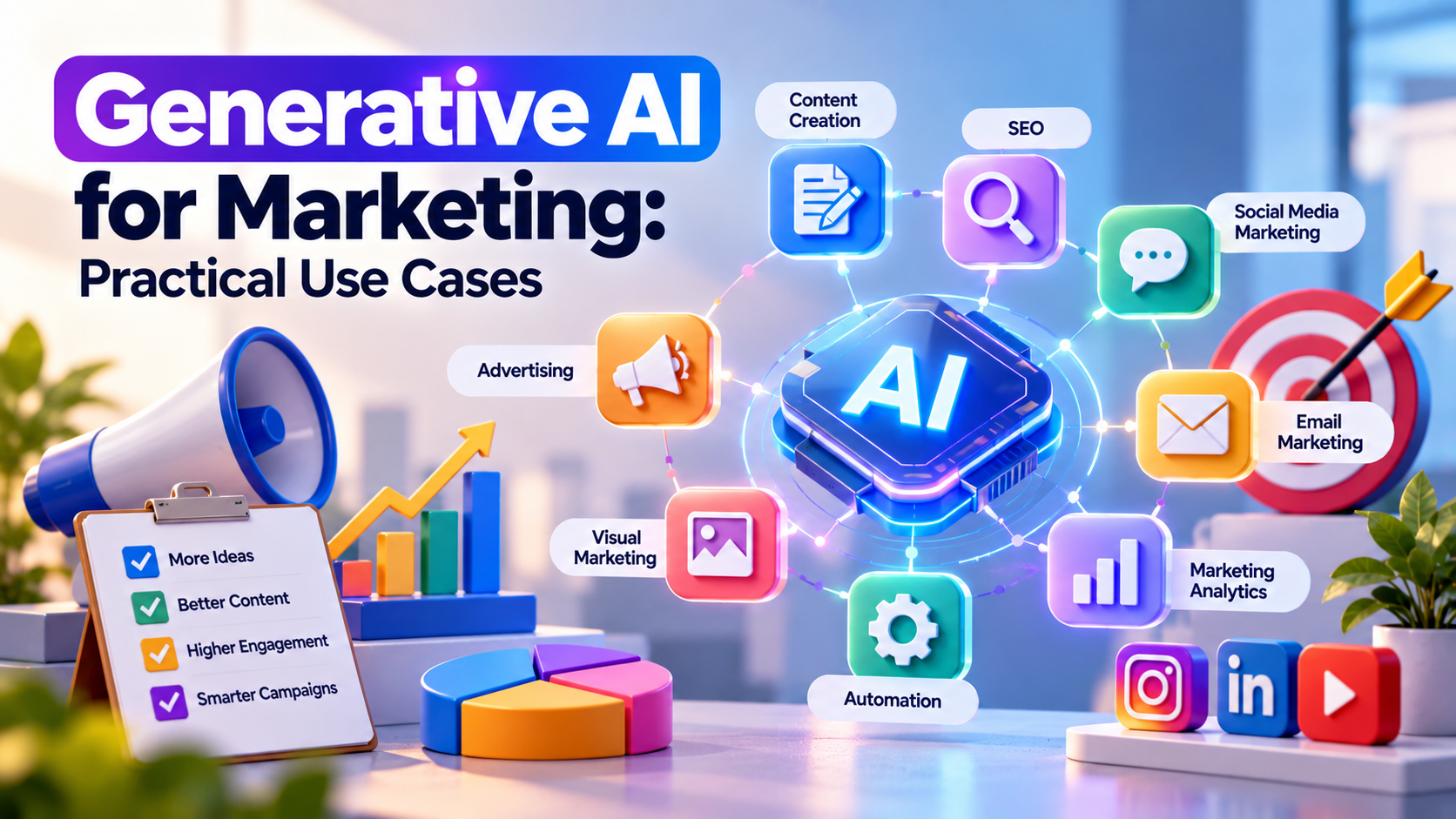
Generative AI for Marketing: Practical Use Cases
Generative AI is changing the way marketers research, create, analyse and optimise campaigns. From generating content and advertising ideas to assisting with SEO, social media, email marketing and customer communication, AI can support marketers across multiple stages of the digital marketing workflow.
For businesses, the value of Generative AI is not simply about producing content faster. It can also help marketers explore ideas, personalise communication, automate repetitive tasks and work with large amounts of information more efficiently. The key is to combine AI capabilities with marketing strategy, audience understanding, creativity and human review.
Generative AI for Marketing
Generative AI for marketing refers to the use of AI systems that can create or transform content and assist with marketing-related tasks. These systems can generate written content, visual concepts, campaign ideas, email drafts, social media posts, advertising variations and other marketing assets.
Instead of replacing the complete marketing process, Generative AI can work as a supporting layer within existing workflows. A marketer can provide the objective, audience and brand requirements, use AI to generate initial ideas or drafts and then review and improve the final output.
This approach allows marketers to spend more time on strategy, creative decisions, campaign optimisation and understanding customer behaviour.
What Is Generative AI in Marketing?
Generative AI uses trained AI models to produce new content based on instructions and context provided by users. In marketing, this capability can be applied to content creation, campaign planning, customer communication, research, creative development and automation.
For example, a marketer can provide information about a product, target audience and campaign objective and ask an AI system to generate several advertising concepts. The marketer can then evaluate those ideas and adapt them to the brand's communication style.
The usefulness of Generative AI depends heavily on the quality of the information provided, the instructions used and the human review applied to the generated output.
Why Are Marketers Using Generative AI?
Marketing involves many repetitive and content-heavy activities. Marketers may need to create multiple versions of social media posts, emails, advertisements, headlines, product descriptions and other assets for different audiences and platforms.
Generative AI can assist with these activities by producing initial drafts, variations and ideas that marketers can review and refine.
Some common benefits include:
- Faster content ideation
- More content variations
- Support for repetitive writing tasks
- Faster campaign brainstorming
- Assistance with audience-specific messaging
- Support for marketing research
- Creative concept development
- Workflow automation
These benefits do not remove the need for marketing expertise. Marketers still need to understand positioning, customer behaviour, branding, SEO, advertising platforms, analytics and campaign objectives.
Generative AI for Content Marketing
Content marketing is one of the most common areas where Generative AI can be applied. Marketers can use AI to brainstorm topics, create content outlines, draft articles, rewrite existing material and develop content variations.
For example, an AI tool can generate several blog topic ideas based on a target audience and industry. The marketer can then select relevant topics, conduct research and develop the final content.
Generative AI can also assist with:
- Blog outlines
- Article introductions
- Content calendars
- Social media captions
- Content repurposing
- Headline variations
- Product descriptions
- Marketing copy
AI-generated content should still be edited for accuracy, originality, brand voice, search intent and audience relevance.
Generative AI for SEO
SEO teams can use Generative AI to support several stages of the search optimisation process. AI can help organise keyword ideas, develop content outlines, generate title variations and identify potential content topics.
For example, a marketer can provide a primary keyword and target audience and ask an AI tool to suggest related questions, subtopics and possible content structures.
Generative AI can also assist with:
- Keyword clustering
- Search intent analysis
- Content briefs
- Meta title ideas
- Meta description drafts
- FAQ topic ideas
- Content optimisation suggestions
- Internal linking ideas
AI should support SEO research rather than replace proper keyword research, competitor analysis, technical SEO and human evaluation of search intent.
Generative AI for Social Media Marketing
Social media marketers regularly need to create content for multiple platforms. Generative AI can help produce ideas and variations that can then be adapted to the requirements of each platform.
A marketer can use AI to brainstorm posts around a product launch, create different caption styles, generate content calendar ideas or turn a long-form article into shorter social media content.
AI can also help with:
- Instagram caption ideas
- LinkedIn post drafts
- Short-form video concepts
- Content calendar planning
- Social media hooks
- Call-to-action variations
- Audience-specific messaging
The final content should reflect the brand's tone and platform-specific audience instead of publishing AI-generated text without review.
Generative AI for Advertising
Advertising teams can use Generative AI to develop multiple versions of ad copy and creative concepts. This can be useful when marketers need to test different messages for different audience segments.
For example, an AI tool can generate several headline and description variations for a campaign. Marketers can then select suitable versions and test them through the relevant advertising platform.
Generative AI can assist with:
- Ad headline ideas
- Ad descriptions
- Call-to-action variations
- Campaign concepts
- Creative briefs
- Audience-specific messaging
- Landing page copy
Performance data should remain the basis for campaign optimisation. AI-generated variations still need to be tested against real campaign results.
Generative AI for Email Marketing
Email marketing involves creating subject lines, email copy, promotional messages, newsletters and follow-up communication. Generative AI can help marketers create initial drafts and variations for these activities.
For example, an AI system can generate several subject line options for the same campaign or rewrite an email for different customer segments.
Possible applications include:
- Email subject lines
- Newsletter drafts
- Promotional emails
- Welcome sequences
- Lead nurturing content
- Follow-up messages
- Personalised email variations
Marketers should review AI-generated emails for accuracy, brand consistency and appropriate communication before sending them to customers.
Generative AI for Customer Research
Marketing decisions depend on understanding customers, their needs and the problems they are trying to solve. Generative AI can assist marketers in organising and analysing customer-related information.
For example, marketers can use AI to summarise customer feedback, organise common themes from reviews or generate possible customer questions based on available information.
AI can help identify patterns in large collections of text, but marketers should verify important findings against the original data rather than relying entirely on generated summaries.
Generative AI for Personalisation
Personalisation involves adapting marketing communication to different audiences or customer segments. Generative AI can help create different versions of messaging based on audience characteristics and campaign objectives.
For example, the same product can be presented differently to a first-time visitor, an existing customer and a business buyer. AI can assist marketers in drafting variations while the marketing team controls the overall strategy.
Personalisation should be based on appropriate customer information and should respect privacy, consent and applicable data protection requirements.
Generative AI for Visual Marketing
Modern Generative AI tools can also support visual content creation. Marketers can use image-generation and design tools to explore creative concepts for campaigns, social media, presentations and other marketing materials.
Possible applications include:
- Social media graphics
- Campaign concepts
- Creative mood boards
- Product visual concepts
- Blog illustrations
- Presentation visuals
- Advertising creative ideas
Visual content should be reviewed for brand consistency, accuracy, licensing considerations and suitability for the intended audience.
Generative AI for Marketing Automation
Generative AI can become more useful when it is connected with marketing workflows and automation systems. Instead of using AI for a single task, marketers can incorporate it into a sequence of activities.
For example, a workflow could collect customer information, classify a query, generate a draft response and route the information to the appropriate team for review.
Other possible applications include:
- Automated content workflows
- Lead response assistance
- Email content generation
- Customer query summarisation
- Campaign reporting assistance
- Content repurposing workflows
- Marketing data organisation
Automation should include appropriate review and controls, particularly when AI-generated content is sent directly to customers.
Generative AI for Marketing Analytics
Marketing teams work with data from websites, advertising platforms, social media channels, email campaigns and other sources. Generative AI can help marketers interpret and summarise information when the underlying data is properly prepared.
For example, marketers can use AI to summarise campaign performance, identify areas that require attention or generate questions for further analysis.
AI-generated analysis should not be treated as a replacement for accurate measurement, analytics knowledge or direct examination of campaign data.
Popular AI Tools for Marketing
Marketers can choose from a growing range of AI tools depending on the task they want to perform.
- ChatGPT for content, brainstorming and campaign ideation
- Google Gemini for research and marketing assistance
- Claude for long-form content and analysis
- Canva AI for visual content
- Jasper for marketing content and brand-focused writing
- Copy.ai for copywriting and marketing workflows
- Midjourney for visual concept generation
- Pictory for AI-assisted video creation
- Runway for AI video workflows
- Grammarly AI for writing refinement
The right tool depends on the marketing task, existing workflow, budget, required output and level of human oversight.
How Marketers Can Use AI Responsibly
Generative AI can produce useful outputs, but marketers should not assume that every generated response is accurate or suitable for publication.
Responsible use includes:
- Checking factual claims
- Reviewing AI-generated content
- Protecting confidential customer information
- Checking copyright and licensing considerations
- Maintaining brand consistency
- Avoiding misleading marketing claims
- Reviewing sensitive or high-impact communication
Human judgement remains important when AI is used for customer-facing marketing activities.
Skills Marketers Need for Generative AI
Learning Generative AI does not mean marketers need to become Machine Learning engineers. However, they should understand how AI tools work and how to apply them effectively within marketing workflows.
- Prompt engineering
- Content strategy
- SEO fundamentals
- Audience research
- Advertising fundamentals
- Social media strategy
- Marketing analytics
- AI tool evaluation
- Marketing automation
- Critical thinking and editing
A marketer who combines traditional marketing knowledge with AI skills can use Generative AI more effectively than someone who relies only on automated content generation.
Learn AI-Powered Marketing Skills
A structured learning program can help marketers understand how AI tools fit into broader digital marketing workflows. Upskill Now's AI Master Program covers Generative AI, AI tools, prompt engineering, automation and related AI applications.
Practical Generative AI Marketing Projects
Practical projects can help learners understand how Generative AI can be applied to real marketing tasks.
Some project ideas include:
- AI-powered content calendar
- SEO content planning workflow
- AI-assisted social media strategy
- Advertising copy generator
- Email marketing workflow
- AI customer research assistant
- AI-powered campaign reporting system
- Automated content repurposing workflow
These projects can demonstrate how AI tools can be combined with marketing strategy rather than being used as isolated content-generation tools.
Generative AI Marketing Workflow
A practical AI-assisted marketing workflow can follow a simple process:
- Define the marketing objective.
- Identify the target audience.
- Collect relevant information and research.
- Create a clear AI prompt.
- Generate initial ideas or content.
- Review the AI-generated output.
- Apply brand guidelines and marketing strategy.
- Publish or launch the campaign.
- Measure performance.
- Use the results to improve future campaigns.
This workflow keeps the marketer involved throughout the process rather than treating AI as an automatic replacement for marketing decision-making.
How Generative AI Can Support Different Marketing Channels
One advantage of Generative AI is that the same core technology can support different marketing channels while the strategy and output are adapted for each platform.
For SEO, AI can assist with content research and ideation. For social media, it can generate post concepts and captions. For advertising, it can produce copy variations. For email marketing, it can assist with personalised drafts. For content marketing, it can help with outlines and content repurposing.
The marketer remains responsible for deciding which ideas are relevant and how they should be used.
Choosing AI Marketing Training
When learning Generative AI for marketing, look for a learning path that combines AI tools with actual marketing concepts rather than focusing only on prompt writing.
Important areas to consider include SEO, social media marketing, advertising, content marketing, analytics, automation, AI tools and practical projects.
Upskill Now's current AI Digital Marketing program lists training in SEO, Google Ads, Meta Ads, performance marketing, content marketing, analytics, email marketing, automation and AI tools, alongside practical projects and assignments.
Learners interested in developing these skills can review the AI marketing learning path and compare the curriculum with their own career objectives.
Career Applications of Generative AI Marketing
Generative AI skills can be applied across several marketing-related roles and workflows. Professionals can use AI to support content marketing, SEO, social media, performance marketing, email marketing, campaign planning and automation.
These skills can complement roles such as:
- Digital Marketing Executive
- SEO Specialist
- Social Media Manager
- Performance Marketer
- Content Marketer
- Marketing Analyst
- Marketing Automation Specialist
- Brand Manager
- Digital Marketing Consultant
- Freelance Digital Marketer
The specific responsibilities and required skills can vary by organisation and role.
Conclusion
Generative AI marketing has practical applications across content creation, SEO, social media, advertising, email marketing, customer research, personalisation, visual content and automation. It can help marketers generate ideas, create variations and support repetitive workflows while allowing marketing teams to focus on strategy and optimisation.
The most effective approach is not to rely on AI-generated content without review. Marketers should combine AI tools with audience understanding, creativity, marketing fundamentals, analytics and human judgement.
As AI tools continue to evolve, marketers who understand both marketing principles and practical AI applications can use these technologies more effectively across different campaigns and channels.
Address: A-3, Third Floor, Rajouri Garden, New Delhi – 110027
Phone: 9999848160 | 9711448765
Email: connect@upskillnow.in