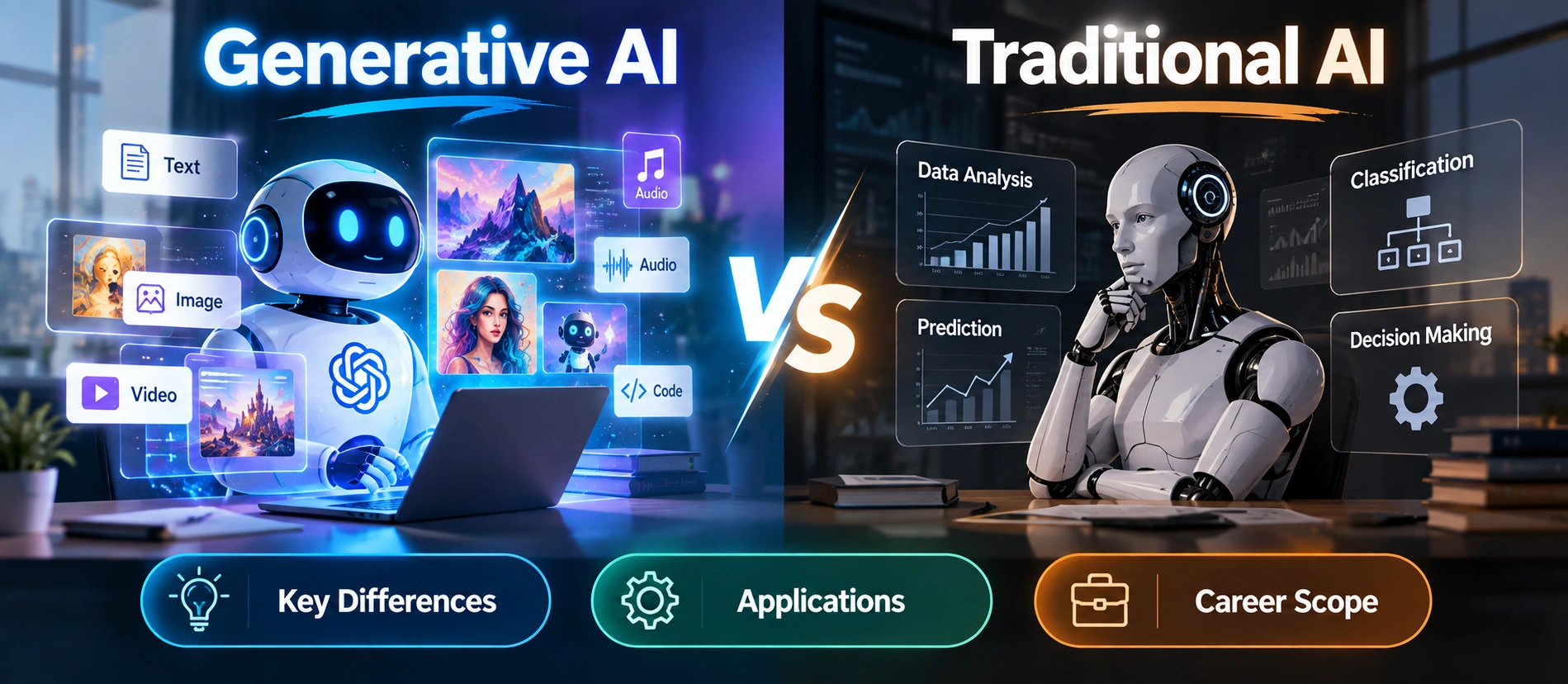
Two important areas of AI are Traditional AI and Generative AI. Although both are based on artificial intelligence, they serve different purposes and are used for different types of problems.
Understanding the difference between Generative AI vs Traditional AI can help students, professionals, and businesses understand which technology is suitable for different applications and what skills may be useful for an AI career.
What Is Traditional AI?
Traditional AI refers to AI systems designed to perform specific tasks such as analyzing data, identifying patterns, making predictions, classifying information, or supporting decisions.
Traditional AI commonly uses techniques such as:
-
Machine learning
-
Deep learning
-
Natural language processing
-
Computer vision
-
Rule-based systems
-
Predictive analytics
For example, a recommendation system can analyze a user's previous activity and recommend products, movies, or other content.
A fraud detection system can analyze transaction patterns and identify potentially unusual activity.
Traditional AI generally focuses on analyzing existing information and producing predictions, classifications, recommendations, or decisions.
What Is Generative AI?
Generative AI is a type of AI designed to create new content based on patterns learned from data.
Generative AI can produce:
-
Text
-
Images
-
Videos
-
Audio
-
Code
-
Presentations
-
Summaries
-
Other digital content
Large language models are an important example of Generative AI. Users can provide natural-language instructions, known as prompts, and the model can generate a response based on the instructions and context.
Examples of Generative AI applications include AI writing assistants, image-generation tools, coding assistants, chatbots, and AI-powered content creation platforms.
Generative AI vs Traditional AI: Key Differences
The main difference between the two can be summarized simply:
Traditional AI generally analyzes data to make predictions or decisions, while Generative AI generates new content based on learned patterns.
However, the distinction is not always absolute. Generative AI systems can also analyze information, while traditional machine learning can be used as part of larger Generative AI applications.
Comparison Table
| Feature | Traditional AI | Generative AI |
|---|---|---|
| Primary purpose | Prediction, classification and decision support | Creating new content |
| Typical output | Prediction, score, recommendation or classification | Text, images, audio, video or code |
| Interaction | Often task-specific | Often natural-language and conversational |
| Common technologies | Machine learning, deep learning and rules | Foundation models and large language models |
| Examples | Fraud detection, recommendations and forecasting | AI chatbots, image generation and coding assistants |
| Main focus | Analyzing existing information | Generating new content |
Applications of Traditional AI
Traditional AI is used across many industries.
Fraud Detection
Financial organizations can use AI models to identify unusual transaction patterns and support fraud detection.
Recommendation Systems
E-commerce platforms, streaming services, and other digital platforms can use AI to recommend products or content based on user behavior.
Predictive Analytics
Businesses can use machine learning models to analyze historical data and support forecasting.
Customer Segmentation
AI can help organizations identify customer groups based on characteristics and behavior.
Computer Vision
AI systems can analyze images and videos for applications such as quality inspection, object detection, and image classification.
Applications of Generative AI
Generative AI has expanded the use of AI across creative and knowledge-based workflows.
Content Creation
Generative AI can assist with:
-
Blog content
-
Social media posts
-
Email drafts
-
Product descriptions
-
Marketing ideas
-
Video scripts
Image Generation
Generative AI can create images from text descriptions and support creative and design workflows.
Software Development
AI coding tools can assist developers with:
-
Code generation
-
Code explanation
-
Debugging
-
Documentation
-
Testing
Customer Support
Generative AI can help answer common questions, summarize customer conversations, and assist support teams.
Education
Students and educators can use Generative AI for explanations, summaries, study materials, and practice questions.
Business Automation
Generative AI can be combined with automation tools to assist with document processing, content generation, data handling, and business workflows.
Benefits of Traditional AI
Traditional AI can be useful for specific, well-defined tasks.
Key benefits include:
-
Data-driven predictions
-
Pattern recognition
-
Automated decision support
-
Process optimization
-
Consistent task execution
-
Specialized business applications
Benefits of Generative AI
Generative AI provides additional capabilities for content and knowledge-based tasks.
Benefits can include:
-
Faster content creation
-
AI-assisted brainstorming
-
Coding assistance
-
Document summarization
-
Natural-language interaction
-
Personalized content
-
Productivity support
-
Creative assistance
AI-generated outputs should still be reviewed for accuracy, quality, relevance, and potential risks.
Generative AI vs Traditional AI: Career Scope
Both areas can provide different career opportunities.
Traditional AI and machine learning can lead to roles such as:
-
Machine Learning Engineer
-
AI Engineer
-
Data Scientist
-
Computer Vision Engineer
-
NLP Engineer
-
Research Engineer
Generative AI has created opportunities in areas such as:
-
Generative AI Engineer
-
AI Developer
-
Prompt Engineer
-
AI Automation Specialist
-
AI Solutions Specialist
-
AI Product Specialist
-
AI Consultant
The specific requirements for each role vary depending on the company, industry, job responsibilities, and experience level.
Skills Required for Traditional AI Careers
Professionals interested in Traditional AI and machine learning can develop skills such as:
-
Python programming
-
Mathematics
-
Statistics
-
Data analysis
-
Machine learning
-
Deep learning
-
Model evaluation
-
Data visualization
-
Problem-solving
Skills Required for Generative AI Careers
Generative AI professionals can develop skills such as:
-
Generative AI fundamentals
-
Prompt engineering
-
Large language models
-
AI tools
-
APIs
-
AI application development
-
AI automation
-
AI agents
-
Model evaluation
Communication and problem-solving skills are also valuable because AI professionals often need to understand business problems and translate them into practical solutions.
Which AI Should You Learn?
The answer depends on your interests and career goals.
If you enjoy data, statistics, programming, predictive models, and machine learning, Traditional AI and machine learning may be areas you want to explore.
If you are interested in Generative AI tools, large language models, prompt engineering, AI applications, content generation, and automation, Generative AI may be a suitable area to explore.
You can also learn both. Understanding machine learning fundamentals while developing Generative AI skills can provide a broader understanding of the AI ecosystem.
Future Scope of Generative AI and Traditional AI
Both Traditional AI and Generative AI have important applications.
Traditional AI continues to support prediction, classification, recommendation, optimization, and other specialized tasks.
Generative AI is expanding AI applications in content creation, software development, research, customer support, education, and business workflows.
In many real-world applications, these technologies can complement each other rather than replacing one another.
Frequently Asked Questions
What is the main difference between Generative AI and Traditional AI?
Traditional AI generally focuses on analyzing data, making predictions, classifying information, or supporting decisions. Generative AI focuses on creating new content such as text, images, audio, video, and code.
Is Generative AI part of Artificial Intelligence?
Yes. Generative AI is a category within the broader field of Artificial Intelligence.
Is Machine Learning the same as Generative AI?
No. Machine learning is a broad set of techniques used to help systems learn patterns from data. Generative AI focuses specifically on generating new content.
Which is better for a career, Generative AI or Traditional AI?
Both offer different career paths. Traditional AI is relevant to machine learning, data science, and predictive modeling, while Generative AI is relevant to large language models, AI applications, prompt engineering, and automation.
Can beginners learn Generative AI?
Yes. Beginners can start with AI fundamentals, Generative AI concepts, AI tools, and prompt engineering before progressing to more technical applications.
Conclusion
Generative AI vs Traditional AI is not simply a comparison between two competing technologies. They solve different types of problems and can be used together in modern AI systems.
Traditional AI is commonly used for prediction, classification, recommendation, and decision support, while Generative AI focuses on creating new content and enabling natural-language interactions.
For anyone planning an AI career, understanding both areas can provide a useful foundation. Start with the fundamentals, choose an area that matches your interests, build practical projects, and continue developing your skills as AI technology evolves.
Generative AI and Traditional AI are both important parts of the rapidly developing AI landscape.
📞 Call: 9999848160 | 9711448765
📍 Address: A-3, Third Floor, Rajouri Garden, New Delhi – 110027