Generative AI vs Traditional AI: What's the Difference?
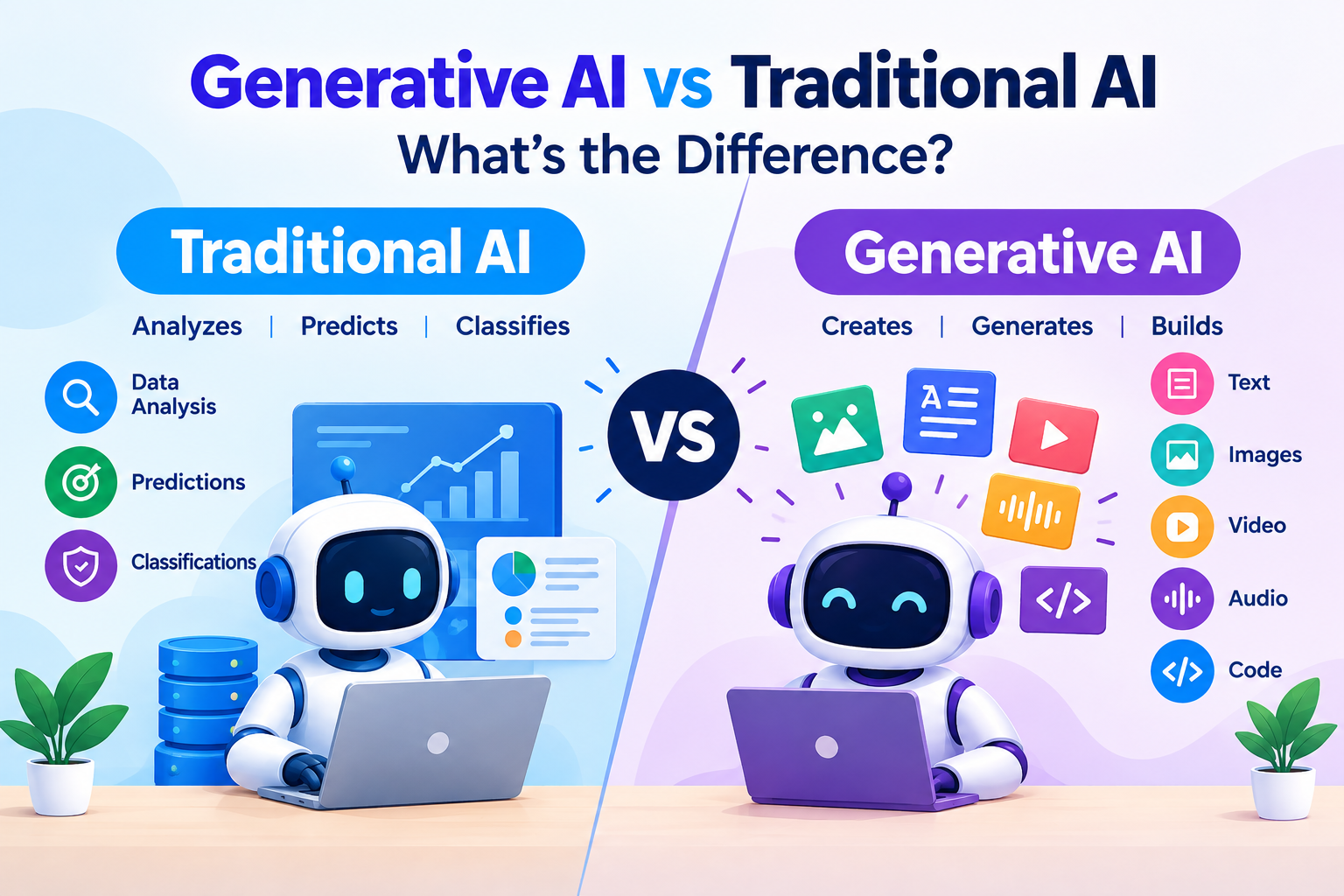
Generative AI and traditional AI are two important approaches within artificial intelligence, but they are designed to solve different types of problems. Traditional AI generally focuses on analyzing information, recognizing patterns, making predictions, classifying data or following defined objectives, while generative AI is designed to create new content such as text, images, audio, video and code.
The difference is not simply that one is "old AI" and the other is "new AI." Both can use machine learning, neural networks and large datasets. The key difference is what the AI system is designed to do with the patterns it learns.
For example, a traditional AI system might analyze a customer's behavior and predict whether they are likely to purchase a product. A generative AI system could use information about that customer to create a personalized product message.
This guide explains generative AI vs traditional AI, how both technologies work, their differences, applications, advantages, limitations and when businesses should use each approach.
Generative AI vs Traditional AI: Quick Answer
Traditional AI is primarily designed to analyze existing data, identify patterns, classify information, make predictions or perform specific tasks. Generative AI is designed to create new content based on patterns learned from training data and user inputs.
A simple example:
Traditional AI: "Is this transaction likely to be fraudulent?"
Generative AI: "Write a report explaining the transaction pattern."
Traditional and generative AI are not mutually exclusive. A modern system can use traditional AI for prediction and generative AI for communication or content creation.
What Is Traditional AI?
Traditional AI refers broadly to AI systems designed to perform specific tasks such as classification, prediction, recommendation, decision support or pattern recognition.
It is sometimes associated with terms such as narrow AI, conventional AI or predictive AI, although these terms are not always interchangeable.
Traditional AI systems can use predefined rules, statistical methods or machine learning models depending on the problem.
Examples include:
-
Spam detection
-
Fraud detection
-
Recommendation systems
-
Predictive maintenance
-
Image classification
-
Demand forecasting
-
Risk scoring
-
Search ranking
-
Customer churn prediction
For example, an e-commerce recommendation system can analyze previous purchases and browsing behavior to predict which products a customer may be interested in.
How Traditional AI Works
A simplified traditional AI workflow looks like this:
Data → Training/Rules → AI Model → Input → Prediction or Decision
Suppose a company wants to identify potentially fraudulent transactions.
The system can analyze historical transaction data and learn patterns associated with fraudulent activity.
When a new transaction arrives, the model can produce a prediction or risk score.
The output might be:
Fraud probability: 92%
The system is not necessarily creating a new piece of content. It is analyzing information and producing a decision, classification or prediction.
Examples of Traditional AI
Common examples include:
-
Email spam filters
-
Search algorithms
-
Fraud detection systems
-
Recommendation engines
-
Predictive maintenance
-
Credit-risk models
-
Customer churn prediction
-
Traffic prediction
-
Product recommendations
-
Medical image classification
These systems can be extremely valuable when the objective is clearly defined and measurable.
Common Traditional AI Applications
Traditional AI is particularly useful for tasks where organizations need:
-
Accurate predictions
-
Classification
-
Risk assessment
-
Pattern detection
-
Recommendations
-
Automated decisions
-
Real-time monitoring
For example, a manufacturing company might use predictive AI to identify equipment that is likely to fail so maintenance can be performed before the equipment breaks down.
What Is Generative AI?
Generative AI is a type of artificial intelligence that creates new content based on patterns learned from data.
It can generate:
-
Text
-
Images
-
Audio
-
Video
-
Computer code
-
Synthetic data
Generative AI systems can respond to natural-language prompts or other forms of input.
For example:
Prompt: "Create a 500-word article explaining SEO to beginners."
The system can generate a new article based on patterns represented in its model.
Generative AI includes technologies such as large language models, transformer-based systems, diffusion models and generative adversarial networks.
If you want to build a broader understanding of AI technologies and practical tools, you can also explore the AI and digital skills programs at UpSkillNow, which currently include AI, Digital Marketing, Python and Machine Learning programs.
How Generative AI Works
A simplified workflow is:
Training Data → Model Training → Prompt/Input → Inference → Generated Output
During training, the model learns patterns from large datasets.
When a user provides an instruction, the model processes that input and generates an output based on its learned representations and the context available to it.
For example:
Input: "Create a social media caption for a digital marketing course."
Output: A newly generated caption.
This ability to synthesize new content is the defining characteristic of generative AI.
Examples of Generative AI
Examples include systems that can:
-
Write text
-
Generate images
-
Create video
-
Generate or explain code
-
Produce audio
-
Summarize documents
-
Create presentations
-
Assist with research
-
Generate marketing content
Conversational AI systems are one of the most visible examples of generative AI because they can generate responses dynamically based on user prompts and context.
Common Generative AI Applications
Generative AI is used for:
-
Content creation
-
Software development
-
Digital marketing
-
Education
-
Research
-
Design
-
Customer support
-
Business productivity
-
Creative work
-
AI-powered automation
Generative AI vs Traditional AI: Key Differences
The biggest difference is the type of problem each system is optimized to solve.
Traditional AI is commonly used to analyze information and make predictions or decisions.
Generative AI is commonly used to create new information or content.
But there are several other differences worth understanding.
Purpose and Primary Function
Traditional AI is generally built around a specific task or objective.
Examples:
-
Detect fraud
-
Predict demand
-
Classify an image
-
Recommend a product
Generative AI focuses on creating outputs.
Examples:
-
Generate an article
-
Create an image
-
Write code
-
Produce a summary
-
Generate a marketing campaign concept
Type of Output
Traditional AI commonly produces:
-
Classifications
-
Predictions
-
Scores
-
Recommendations
-
Decisions
Generative AI commonly produces:
-
Text
-
Images
-
Audio
-
Video
-
Code
-
Synthetic content
How the Models Learn
Traditional AI can use rules, labeled datasets, statistical methods or machine learning.
Many traditional machine learning applications rely on data where the desired outcome is known during training.
Generative AI often relies on large-scale training data and complex neural-network architectures to learn patterns that can later be used to generate outputs.
The exact training process varies by model and application.
Data Requirements
Generative AI often requires large and diverse datasets because it needs to learn complex patterns that can support content generation.
Traditional AI can sometimes work effectively with smaller, domain-specific datasets, particularly when the problem is narrowly defined.
However, there is no universal rule that traditional AI always needs less data. Requirements depend on the model, task, quality of data and desired performance.
Adaptability and Flexibility
Generative AI applications can often respond to many different prompts without requiring a separate model for every writing or content-generation task.
For example, the same language model can be asked to:
-
Summarize an article
-
Translate text
-
Write an email
-
Explain a technical concept
-
Generate code
Traditional AI systems are often more task-specific.
A fraud-detection model is designed primarily for fraud detection.
A recommendation model is designed primarily for recommendations.
Explainability and Transparency
Traditional AI can sometimes be easier to interpret, particularly when it uses simpler rules or models.
Complex machine learning systems can still be difficult to explain.
Generative AI can be particularly challenging to interpret because modern models can contain very large numbers of parameters and generate outputs through complex learned representations.
This means organizations need appropriate testing, monitoring and human oversight.
Infrastructure and Computing Requirements
Large generative AI models can require substantial computational resources for training and deployment.
Training modern foundation models can involve large datasets and specialized hardware.
Traditional AI applications can range from very lightweight rule-based systems to computationally intensive machine learning models.
Therefore, infrastructure requirements depend on the specific AI solution rather than simply whether it is "traditional" or "generative."
Real-Time Performance
Traditional AI is often well suited to fast, narrowly defined decisions.
Examples include:
-
Fraud scoring
-
Spam detection
-
Recommendation ranking
-
Sensor monitoring
Generative AI can also operate quickly, but generating complex outputs may require more computational resources.
For real-time applications, organizations need to consider latency, model size, infrastructure and cost.
Customization
Traditional AI can be customized for specific business objectives through model training, rules, features or domain-specific data.
Generative AI can also be customized through:
-
Prompting
-
Retrieval-Augmented Generation
-
Fine-tuning
-
System instructions
-
Domain-specific data
The appropriate method depends on the application.
Human Involvement
Traditional AI can automate decisions within clearly defined workflows.
Generative AI often works as a human-assistance or human-in-the-loop system, particularly for tasks involving writing, analysis, design or decision support.
Human review is important because generative AI can produce inaccurate or unsupported information.
Generative AI vs Traditional AI Comparison Table
|
Feature |
Traditional AI |
Generative AI |
|
Primary purpose |
Analyze, classify, predict or recommend |
Generate new content |
|
Typical output |
Prediction, score, classification or recommendation |
Text, image, audio, video or code |
|
Typical examples |
Fraud detection, recommendations, forecasting |
AI writing, image generation, coding assistants |
|
Learning |
Rules, supervised/unsupervised ML and other approaches |
Large-scale neural-network training and other generative approaches |
|
Adaptability |
Often task-specific |
Often flexible across multiple prompts/tasks |
|
Data |
Often domain-specific |
Often large and diverse training datasets |
|
Explainability |
Varies by model |
Can be difficult for complex foundation models |
|
Computing needs |
Varies widely |
Large models can require substantial compute |
|
Best suited for |
Prediction and decision-making |
Content creation and synthesis |
|
Examples |
Spam filter, fraud model, recommender |
LLM, AI image generator, code-generation model |
Generative AI vs Predictive AI
Predictive AI focuses on using existing information to estimate what may happen or classify what is happening.
For example:
"Which customer is most likely to cancel their subscription?"
Generative AI focuses on producing new content.
For example:
"Create a personalized retention email for this customer."
A business could use both technologies in the same workflow:
Predictive AI → identifies customers at risk → Generative AI → creates personalized communication
Generative AI vs Machine Learning
Machine learning is a broader field within artificial intelligence.
Machine learning allows systems to learn patterns from data.
Generative AI uses machine learning techniques to create new outputs.
Therefore:
AI → Machine Learning → Many Different Applications
Generative AI is one category of AI systems that can use machine learning to generate content.
Not every machine learning system is generative.
For readers who want to develop practical knowledge in this area, the Machine Learning program at UpSkillNow covers machine learning fundamentals, predictive modeling, Python, data analysis, deep learning and hands-on projects.
For example, a machine learning model that predicts house prices is not necessarily a generative AI system.
Generative AI vs Deep Learning
Deep learning is a machine learning approach based on multi-layer neural networks.
Generative AI can use deep learning to generate content.
For example:
Deep learning → neural networks → generative model → generated output
The terms describe different concepts:
-
Artificial Intelligence: broad field
-
Machine Learning: systems that learn from data
-
Deep Learning: machine learning using deep neural networks
-
Generative AI: AI systems designed to generate new content
These categories can overlap.
What Technologies Power Generative AI?
Modern generative AI is supported by several technologies and model architectures.
Large Language Models
Large Language Models (LLMs) are AI models designed to process and generate human language.
They can support:
-
Question answering
-
Summarization
-
Translation
-
Writing
-
Coding
-
Conversational AI
LLMs are an important part of generative AI, but generative AI is broader than language models.
Transformer Models
Transformers are a neural-network architecture that became highly important for modern language models.
They use attention mechanisms to process relationships within sequences of information.
Many modern language-generation systems are based on transformer architectures or related techniques.
Generative Adversarial Networks
Generative Adversarial Networks (GANs) use two neural networks:
-
A generator
-
A discriminator
The generator creates synthetic content while the discriminator evaluates it.
GANs have been used for image generation, image enhancement and synthetic-data applications.
Diffusion Models
Diffusion models are widely used in modern image-generation systems.
They learn to generate structured outputs from noise through a process involving repeated denoising.
They have become important in AI image and media generation.
Foundation Models
Foundation models are large models trained on broad datasets that can serve as a base for multiple applications.
They can support different tasks through prompting, adaptation, fine-tuning or additional systems such as retrieval.
Real-World Examples of Traditional AI and Generative AI
Consider a digital marketing company.
Traditional AI Example
An AI model analyzes historical campaign data and predicts:
"This audience has a high probability of converting."
Generative AI Example
A generative AI system receives the campaign information and creates:
"Three ad-copy variations for this audience."
Combined AI Workflow
The strongest workflow can use both:
Traditional AI → analyzes data
↓
Predictive model → identifies opportunity
↓
Generative AI → creates content
↓
Human → reviews and approves
Generative AI vs Traditional AI Across Industries
Healthcare
Traditional AI can support:
-
Medical image analysis
-
Risk prediction
-
Patient classification
-
Predictive analytics
Generative AI can support:
-
Document summarization
-
Research assistance
-
Drafting documentation
-
Synthetic data generation
High-stakes healthcare applications require strong validation and professional oversight.
Finance
Traditional AI can support:
-
Fraud detection
-
Credit-risk analysis
-
Transaction monitoring
-
Forecasting
Generative AI can support:
-
Report generation
-
Document summarization
-
Customer communication
-
Research assistance
Education
Traditional AI can support:
-
Student performance prediction
-
Recommendation systems
-
Automated classification
Generative AI can support:
-
Personalized explanations
-
Study material
-
Practice questions
-
Summaries
-
Learning assistants
Digital Marketing
Traditional AI can support:
-
Customer segmentation
-
Conversion prediction
-
Recommendation systems
-
Campaign analytics
Generative AI can support:
-
Content creation
-
Ad-copy variations
-
Social media content
-
Email drafts
-
SEO content ideation
-
Creative concepts
For readers who want to combine these skills professionally, the Digital Marketing + AI course covers digital marketing, SEO, performance marketing, AI integration, automation and practical projects.
E-commerce
Traditional AI can power:
-
Product recommendations
-
Demand forecasting
-
Fraud detection
-
Customer segmentation
Generative AI can create:
-
Product descriptions
-
Customer responses
-
Marketing campaigns
-
Shopping assistants
Software Development
Traditional AI can support:
-
Anomaly detection
-
Predictive analytics
-
Testing systems
-
Code analysis
Generative AI can support:
-
Code generation
-
Debugging
-
Documentation
-
Test creation
-
Code explanation
Can Traditional AI and Generative AI Work Together?
Yes. In many real-world applications, combining both approaches can be more useful than choosing only one.
Consider an online retailer.
Step 1
Traditional AI analyzes customer behavior.
Step 2
A predictive model identifies customers who are likely to purchase a particular product.
Step 3
Generative AI creates personalized marketing messages.
Step 4
An automation system delivers the appropriate communication.
Step 5
Analytics measure the result.
The complete workflow could therefore be:
Data → Traditional AI → Prediction → Generative AI → Content → Automation → Measurement
This demonstrates why generative AI and traditional AI should not always be viewed as competing technologies.
When Should You Use Traditional AI?
Traditional AI is generally a strong choice when the main objective is:
-
Prediction
-
Classification
-
Fraud detection
-
Risk scoring
-
Recommendation
-
Forecasting
-
Anomaly detection
-
Pattern recognition
-
Real-time decision-making
When Should You Use Generative AI?
Generative AI is generally useful when you need to:
-
Create content
-
Generate ideas
-
Summarize information
-
Generate code
-
Create images
-
Produce natural-language responses
-
Transform existing content
-
Assist with research
-
Support creative workflows
Which Is Better: Generative AI or Traditional AI?
There is no universal winner.
The better technology depends on the problem.
|
Your Goal |
Better Starting Point |
|
Predict customer churn |
Traditional/predictive AI |
|
Detect fraud |
Traditional/predictive AI |
|
Recommend products |
Traditional AI |
|
Generate an article |
Generative AI |
|
Generate an image |
Generative AI |
|
Write code |
Generative AI |
|
Forecast demand |
Predictive AI |
|
Create personalized content |
Generative AI |
|
Analyze customer behavior |
Traditional AI |
|
Analyze data and create a report |
Potentially both |
The most effective solution may combine both.
Benefits and Limitations of Traditional AI
Benefits
Traditional AI can offer:
-
Strong performance on clearly defined tasks
-
Predictive capabilities
-
Automation
-
Consistent decision-making
-
Efficient processing of structured problems
-
Useful real-time applications
Limitations
Traditional AI can have:
-
Narrow task scope
-
Dependence on quality data
-
Limited flexibility outside its trained objective
-
Model-maintenance requirements
-
Potential bias in training data
-
Difficulty handling open-ended creative tasks
Benefits and Limitations of Generative AI
Benefits
Generative AI can provide:
-
Faster content creation
-
Flexible interaction
-
Creative assistance
-
Natural-language interfaces
-
Coding support
-
Personalized outputs
-
Rapid prototyping
-
Productivity improvements
Limitations
Generative AI can also produce:
-
Incorrect information
-
Hallucinations
-
Biased outputs
-
Privacy risks
-
Security concerns
-
Copyright considerations
-
Inconsistent results
-
Need for human review
Generative AI should therefore be used with appropriate validation and safeguards.
The Future of Traditional AI and Generative AI
The future is unlikely to be simply "traditional AI versus generative AI."
Instead, businesses are increasingly likely to combine:
-
Predictive AI
-
Machine learning
-
Generative AI
-
Large language models
-
Retrieval-Augmented Generation
-
AI agents
-
Automation
-
Data analytics
For example, an AI-powered business system could analyze customer data, predict an outcome, retrieve relevant company information, generate a response and then trigger an automated workflow.
This creates a more complete AI system than using a single model for a single task.
Skills You Need to Learn AI
If you are a beginner, start with the fundamentals rather than trying to learn every AI tool available.
For Non-Technical Learners
Focus on:
-
AI fundamentals
-
Generative AI
-
Prompt engineering
-
AI tools
-
Critical thinking
-
Data literacy
-
Responsible AI
For Digital Marketers
Combine:
-
SEO
-
Digital marketing
-
Analytics
-
Generative AI
-
Prompt engineering
-
AI automation
-
Content strategy
You can explore the Digital Marketing + AI program if you want to combine marketing skills with AI tools and automation.
For Technical AI Careers
Develop:
-
Python
-
Mathematics
-
Statistics
-
Machine learning
-
Deep learning
-
Neural networks
-
Data science
-
NLP
-
Computer vision
-
APIs
-
AI application development
If you are starting with programming, explore Python Programming training to build a foundation in Python, automation, APIs and AI applications.
You can also explore UpSkillNow's courses to compare its AI, Machine Learning, Data Science, Digital Marketing, Python and other learning paths.
Conclusion
The difference between generative AI and traditional AI comes down primarily to their objectives.
Traditional AI is commonly used to analyze data, recognize patterns, predict outcomes, classify information and support decisions. Generative AI is designed to create new content from learned patterns and user inputs.
But the two technologies are not competitors in every situation.
A business can use traditional AI to identify a customer segment, predictive AI to estimate buying behavior and generative AI to create personalized content for that audience.
That is why the most useful question is not:
"Which AI is better?"
Instead, ask:
"What problem am I trying to solve?"
If you need prediction, classification or structured decision-making, traditional or predictive AI may be the better starting point.
If you need content generation, natural-language interaction, creative assistance or code generation, generative AI may be more appropriate.
And when a problem requires both analysis and content generation, combining traditional AI with generative AI can create a more powerful end-to-end solution.
Frequently Asked Questions
What is the main difference between generative AI and traditional AI?
Traditional AI is commonly used to analyze information, make predictions, classify data or perform specific tasks, while generative AI is designed to create new content such as text, images, audio, video and code.
Is generative AI better than traditional AI?
Neither is universally better. Traditional AI is often better for prediction, classification and narrowly defined decisions, while generative AI is better suited to content generation and open-ended assistance.
Is ChatGPT traditional AI or generative AI?
ChatGPT is a generative AI application because it generates responses based on user prompts and context.
What are examples of traditional AI?
Examples include fraud detection, spam filtering, recommendation systems, predictive maintenance, demand forecasting and customer-churn prediction.
What are examples of generative AI?
Examples include AI systems that generate text, images, video, audio and computer code.
Is machine learning traditional AI?
Machine learning is a broader approach within AI. It can be used in traditional predictive systems as well as generative AI systems.