
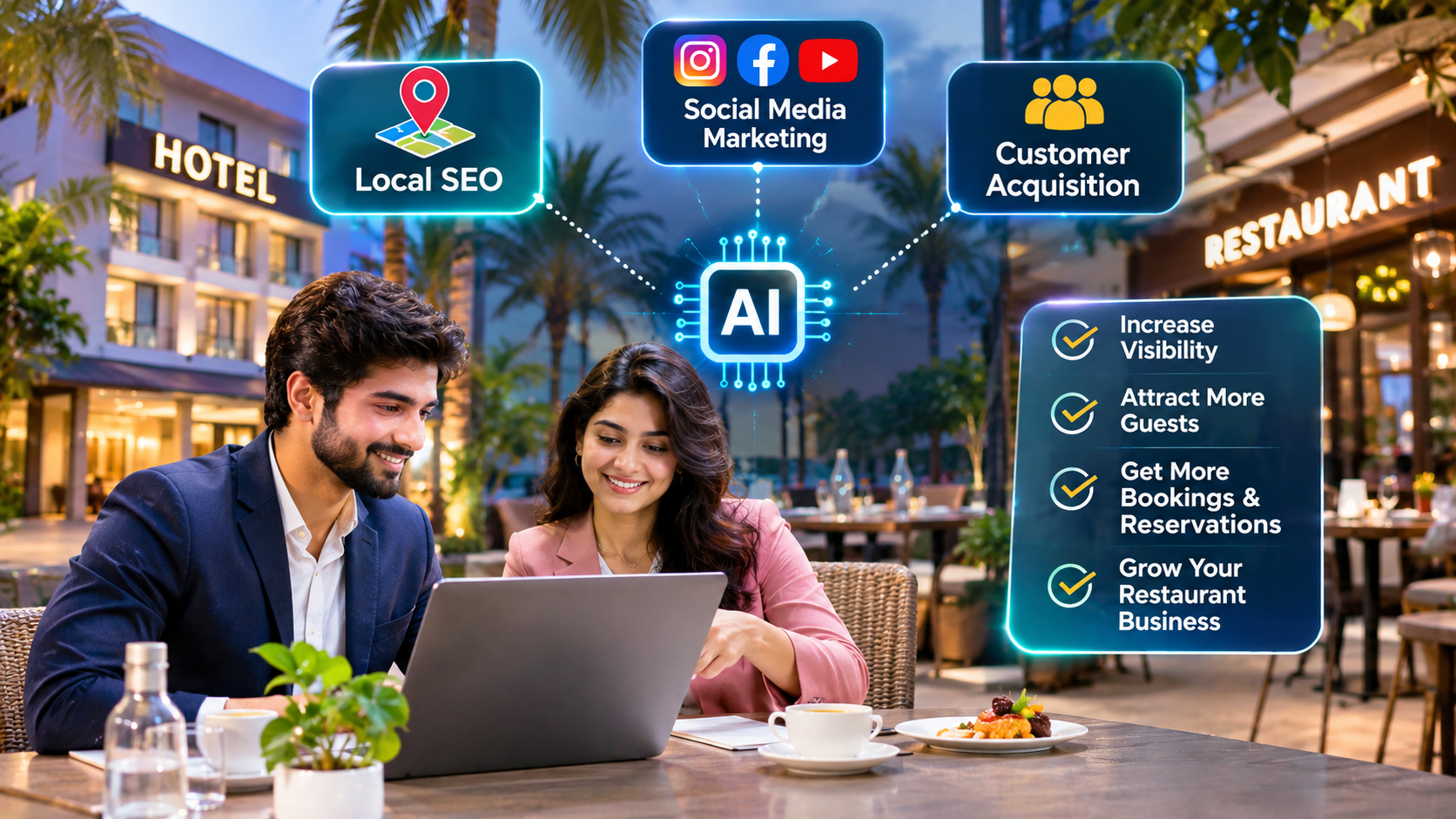
Today, customers search online before choosing a restaurant, booking a hotel or planning a dining experience. They compare locations, explore menus, check photographs, read customer reviews and evaluate available services before making decisions.
This creates an opportunity for hotels and restaurants to use Artificial Intelligence (AI), Local SEO and Social Media Marketing to reach potential customers and improve their customer acquisition process.
AI can help hospitality businesses create marketing content, understand customer interests, manage enquiries and automate repetitive tasks. Local SEO helps businesses appear in location-based searches, while social media helps showcase their food, rooms, services and customer experiences.
In this blog, we will explore how hotels and restaurants can use these digital marketing strategies to attract more customers and improve their online visibility.
1. Why Digital Marketing Is Important for Hotels and Restaurants
Digital marketing helps hotels and restaurants connect with people who are actively searching for accommodation, dining options and hospitality services.
Customers often search for nearby restaurants, hotels with specific facilities, family dining options and suitable places for special occasions.
A strong digital presence helps hospitality businesses reach these potential customers.
Some important benefits include:
-
Improving local online visibility.
-
Attracting nearby customers.
-
Increasing restaurant reservations.
-
Generating hotel booking enquiries.
-
Promoting special offers and services.
-
Building customer trust through reviews.
-
Increasing social media engagement.
-
Understanding customer preferences.
-
Improving marketing campaign performance.
For example, a restaurant in New Delhi can use Local SEO to reach people searching for restaurants in its neighbourhood. It can also use social media to showcase its menu, dining environment and special events.
Similarly, a hotel can promote its rooms, facilities and hospitality services through optimized website pages and social media campaigns.
2. Use AI for Digital Marketing in Hotels and Restaurants
Artificial Intelligence can simplify different marketing activities for hospitality businesses.
Hotels and restaurants regularly need promotional content, advertisements, customer communication and performance reports. Managing these activities manually can take considerable time.
AI tools can support these tasks and help marketing teams organize their work.
AI for Marketing Content Creation
Hotels and restaurants need fresh content to promote their services and attract customers.
AI writing tools can help prepare:
-
Restaurant descriptions.
-
Hotel service descriptions.
-
Social media captions.
-
Promotional messages.
-
Email marketing content.
-
Blog outlines.
-
Advertisement headlines.
-
Special offer announcements.
For example, a restaurant launching a new seasonal menu can use AI to prepare social media captions and promotional descriptions.
The marketing team can review the content and ensure that it accurately represents the menu and restaurant experience.
AI for Customer Research
Understanding customer preferences is important for hospitality businesses.
AI can help organize customer feedback, identify common questions and analyze available marketing information.
For example, a hotel may review customer feedback to understand which facilities visitors frequently appreciate and which services require improvement.
A restaurant can analyze feedback to identify common comments about menu options, service quality and dining experiences.
These insights can help businesses improve their marketing communication and customer experience.
AI for Marketing Personalization
Different customers have different interests and requirements.
Some customers may look for family dining, while others may prefer romantic dinners, business lunches or group celebrations.
AI can help businesses organize audience information and prepare relevant marketing messages.
For example, a restaurant promoting a family dining offer can prepare content specifically highlighting its family-friendly dining options.
Marketing messages should always reflect genuine services and available offers.
3. Local SEO Strategies for Hotels and Restaurants
Local SEO helps hotels and restaurants appear in search results when customers look for businesses in specific locations.
For hospitality businesses, local search visibility is especially important because many customers prefer nearby options.
Optimize Your Google Business Profile
A Google Business Profile helps customers discover important business information through Google Search and Maps.
Hotels and restaurants should maintain accurate business information, including:
-
Business name.
-
Address.
-
Contact number.
-
Website.
-
Business hours.
-
Categories.
-
Photographs.
-
Available services.
-
Reservation information.
For example, a restaurant should regularly update its opening hours, contact information and menu-related details.
Hotels should ensure that their property information, facilities and contact details are accurate.
Use Location-Based Keywords
Location-based keywords help businesses reach customers searching for hospitality services in particular areas.
Examples include:
-
Best restaurants in Rajouri Garden.
-
Hotels near Connaught Place.
-
Family restaurants in West Delhi.
-
Luxury hotels in New Delhi.
-
Rooftop restaurants near me.
Use these keywords naturally in website titles, headings, service descriptions and relevant blog articles.
Avoid inserting location keywords repeatedly without providing useful information.
Create Location-Specific Website Pages
Hotels and restaurants can create dedicated webpages describing their services and locations.
For example, a hotel can create pages for:
-
Hotel rooms and accommodation.
-
Conference and meeting facilities.
-
Restaurant and dining services.
-
Wedding and event facilities.
A restaurant can create pages for:
-
Menu and dining options.
-
Private dining.
-
Group reservations.
-
Special occasions.
-
Location and directions.
Each page should contain accurate information and clear contact or reservation options.
Collect and Manage Customer Reviews
Customer reviews influence how people evaluate hotels and restaurants.
Encourage genuine customers to share their experiences.
Businesses should:
-
Respond professionally to reviews.
-
Thank customers for positive feedback.
-
Address complaints politely.
-
Identify recurring customer concerns.
-
Use feedback to improve services.
AI can help prepare response drafts, but staff should review them to maintain a natural and respectful tone.
4. Use AI for Social Media Marketing
Social media marketing helps hotels and restaurants showcase their services through photographs, videos and engaging content.
Customers often want to see the food, rooms, interiors and overall atmosphere before making a reservation.
AI can help marketing teams plan and create this content more efficiently.
Create Attractive Food and Hotel Content
Visual content plays an important role in hospitality marketing.
Restaurants can share:
-
Food photography.
-
Menu highlights.
-
Chef introductions.
-
Kitchen preparation videos.
-
Customer dining experiences.
-
Special occasion promotions.
Hotels can showcase:
-
Room interiors.
-
Swimming pools.
-
Hotel restaurants.
-
Event spaces.
-
Property surroundings.
-
Guest experiences.
AI design and editing tools can assist with creating promotional graphics, improving content presentation and preparing video concepts.
However, photographs should accurately represent the actual property, rooms and food.
Use AI for Instagram Reels and Short Videos
Short videos can help hospitality businesses showcase their services in an engaging format.
Restaurants can create videos showing food preparation, popular dishes and restaurant interiors.
Hotels can publish videos highlighting room facilities, property tours and guest services.
AI can assist with:
-
Video scripts.
-
Captions.
-
Subtitles.
-
Content ideas.
-
Video editing.
-
Promotional concepts.
For example, a restaurant can create a short video introducing its signature dish and explaining its ingredients.
A hotel can prepare a virtual property tour to help potential guests understand the available facilities.
Maintain a Social Media Content Calendar
Consistency is important for maintaining an active social media presence.
Hotels and restaurants can prepare a weekly content calendar.
| Day | Content Idea |
|---|---|
| Monday | Menu or room highlights |
| Tuesday | Behind-the-scenes content |
| Wednesday | Customer experience |
| Thursday | Short promotional video |
| Friday | Special dining or stay offers |
| Saturday | Property or restaurant tour |
| Sunday | Weekend experience highlights |
AI can help generate content ideas and organize the publishing schedule.
The final content should be reviewed to ensure that all promotional information is accurate.
5. Use AI Chatbots to Generate More Customer Enquiries
Customers often have questions before making hotel bookings or restaurant reservations.
They may want information about room availability, menu options, facilities, pricing, dining hours and reservation procedures.
AI chatbots can help hospitality businesses respond to common questions and collect customer enquiries.
AI Chatbots for Hotels
A hotel chatbot can help answer questions about:
-
Room categories.
-
Available facilities.
-
Check-in and check-out timings.
-
Property location.
-
Booking procedures.
-
Dining services.
-
Event facilities.
For example, a customer visiting a hotel website can ask about available room categories.
The chatbot can provide approved information and guide the visitor towards the booking or enquiry process.
Actual room availability and confirmed bookings should be handled through the hotel's verified booking system.
AI Chatbots for Restaurants
Restaurant chatbots can help customers explore:
-
Menu information.
-
Restaurant timings.
-
Location.
-
Dining options.
-
Reservation procedures.
-
Group dining arrangements.
For example, a customer planning a birthday dinner can use the chatbot to ask about group seating and reservation procedures.
The restaurant team can then confirm the relevant details.
Benefits of AI Chatbots
AI chatbots can help hotels and restaurants:
-
Respond to common enquiries.
-
Provide basic business information.
-
Collect customer details.
-
Guide customers towards reservations.
-
Reduce repetitive manual communication.
-
Support customer service teams.
Always provide an option to speak with a staff member when customers need personal assistance.
6. Use AI for Customer Acquisition and Retention
Customer acquisition involves attracting new customers and encouraging them to use a business's services.
Hotels and restaurants can use AI-supported marketing strategies to improve their customer acquisition process.
Run Targeted Digital Advertising Campaigns
Hotels and restaurants can use digital advertisements to reach audiences interested in accommodation, dining and hospitality services.
For example:
A restaurant can promote a special dining experience to audiences in nearby locations.
A hotel can advertise its accommodation facilities to people researching stays in its destination.
AI can assist with audience research, advertisement copy and campaign analysis.
Create dedicated landing pages with relevant information and clear booking or enquiry options.
Use Email Marketing for Customer Communication
Email marketing can help hospitality businesses communicate with interested customers and existing guests.
Businesses can use email campaigns to share:
-
Special dining offers.
-
Seasonal menus.
-
Hotel packages.
-
Upcoming events.
-
Service announcements.
-
Customer feedback requests.
AI can help prepare email drafts and organize marketing campaigns.
Only send promotional emails to people who have appropriately agreed to receive them.
Use Customer Data to Improve Experiences
AI can help organize customer feedback and identify patterns in customer preferences.
For example, a hotel may identify recurring requests for specific facilities or services.
A restaurant may notice that customers frequently ask about vegetarian menu options.
These insights can help businesses improve their services and create more relevant marketing campaigns.
Customer information should be handled responsibly and protected according to applicable privacy requirements.
7. How Hotels and Restaurants Can Combine AI, Local SEO and Social Media
AI, Local SEO and Social Media Marketing can work together to create a complete customer acquisition strategy.
Step 1: Improve Your Online Presence
Create a professional website with accurate information about your hotel or restaurant.
Include contact details, location, photographs, services and booking or reservation options.
Step 2: Optimize Local SEO
Update your Google Business Profile, add location-based keywords and maintain accurate business information.
Encourage genuine customer reviews and respond to feedback.
Step 3: Create Social Media Content
Publish food photographs, room tours, short videos, customer experiences and promotional announcements.
Use AI tools to organize your content calendar and prepare creative ideas.
Step 4: Introduce AI Chatbots
Use chatbots to answer common questions and guide potential customers towards relevant services.
Step 5: Run Targeted Marketing Campaigns
Use digital advertising to reach potential customers interested in your location, dining options or accommodation services.
Step 6: Track Customer Enquiries
Monitor website enquiries, reservation requests, advertisement performance and social media engagement.
Step 7: Improve Your Strategy
Use actual customer feedback and marketing data to identify opportunities for improvement.
This integrated approach can help hospitality businesses create a more organized digital marketing system.
8. Measure Digital Marketing Performance
Hotels and restaurants should regularly monitor their digital marketing activities to understand which channels attract potential customers.
Important performance indicators include:
Local SEO Performance
-
Website visits from local searches.
-
Google Business Profile interactions.
-
Direction requests.
-
Website clicks.
-
Calls and enquiries.
Social Media Performance
-
Audience reach.
-
Post engagement.
-
Video views.
-
Profile visits.
-
Website clicks.
-
Customer messages.
Customer Acquisition Performance
-
Booking enquiries.
-
Restaurant reservation requests.
-
Cost per enquiry.
-
Enquiry-to-booking conversion rate.
-
Repeat customer activity.
AI Automation Performance
-
Chatbot conversations.
-
Customer questions answered.
-
Enquiries collected.
-
Response time.
-
Requests transferred to staff.
For example, if a restaurant receives significant social media engagement but few reservation enquiries, it should review its content, reservation process and calls to action.
Use actual performance data to make marketing decisions.
Conclusion
AI, Local SEO and Social Media Marketing provide hotels and restaurants with practical opportunities to improve online visibility and attract more customers.
Local SEO helps hospitality businesses appear in location-based searches, social media showcases their food, rooms and services, and AI supports content creation, customer communication and marketing automation.
When these strategies work together with an informative website and an organized enquiry management process, hotels and restaurants can build a stronger digital presence and improve customer acquisition.
At Upskill Now, learners can explore practical digital marketing and AI-related skills, including Local SEO, social media marketing, content creation, digital advertising and marketing automation.
The AI Digital Marketing Master Program covers relevant areas that help learners understand how AI tools and modern digital marketing strategies are used for business growth.
If you want to develop practical skills in AI and digital marketing, explore the courses available at Upskill Now and take the next step towards building your marketing knowledge.
SEO Keywords
-
AI for Hotels and Restaurants
-
Local SEO for Restaurants
-
Digital Marketing for Hotels
-
Social Media Marketing for Restaurants
-
Customer Acquisition for Hospitality Businesses
Frequently Asked Questions (FAQs)
1. How can hotels and restaurants use AI for digital marketing?
Hotels and restaurants can use AI for content creation, customer research, social media planning, advertisement copywriting, chatbot communication and marketing performance analysis. These applications help organize marketing activities and improve customer communication.
2. How does Local SEO help hotels and restaurants attract more customers?
Local SEO improves business visibility when people search for nearby hotels, restaurants and hospitality services. Accurate business information, location-based keywords, customer reviews and optimized website pages can help attract relevant local customers.
3. How can social media marketing increase restaurant and hotel bookings?
Social media helps businesses showcase their food, rooms, facilities and customer experiences. Engaging photographs, short videos, promotional content and clear reservation options can encourage potential customers to explore available services.
4. Can AI chatbots help hotels and restaurants generate customer enquiries?
Yes. AI chatbots can answer common questions, provide basic service information, collect customer details and guide visitors towards booking or reservation enquiries. Staff should handle complex questions and confirm actual availability.
5. Which digital marketing strategies are most useful for customer acquisition in the hospitality industry?
Useful strategies include Local SEO, social media marketing, targeted digital advertising, AI chatbots, content marketing and automated customer communication. Hotels and restaurants should select strategies according to their services, target audience and marketing objectives.
Contact Upskill Now
-
Address: A-3, Third Floor, Rajouri Garden, New Delhi – 110027, India
-
Contact Number: +91 99998 48160
-
Alternate Number: +91 97114 48765