How to Start a Career in Artificial Intelligence as a Beginner
Artificial Intelligence is becoming an important part of industries ranging from technology and healthcare to finance, marketing, education and e-commerce. As AI tools, automation and intelligent applications continue to become more common, beginners are increasingly interested in learning how to start an AI career and build practical skills for the future.
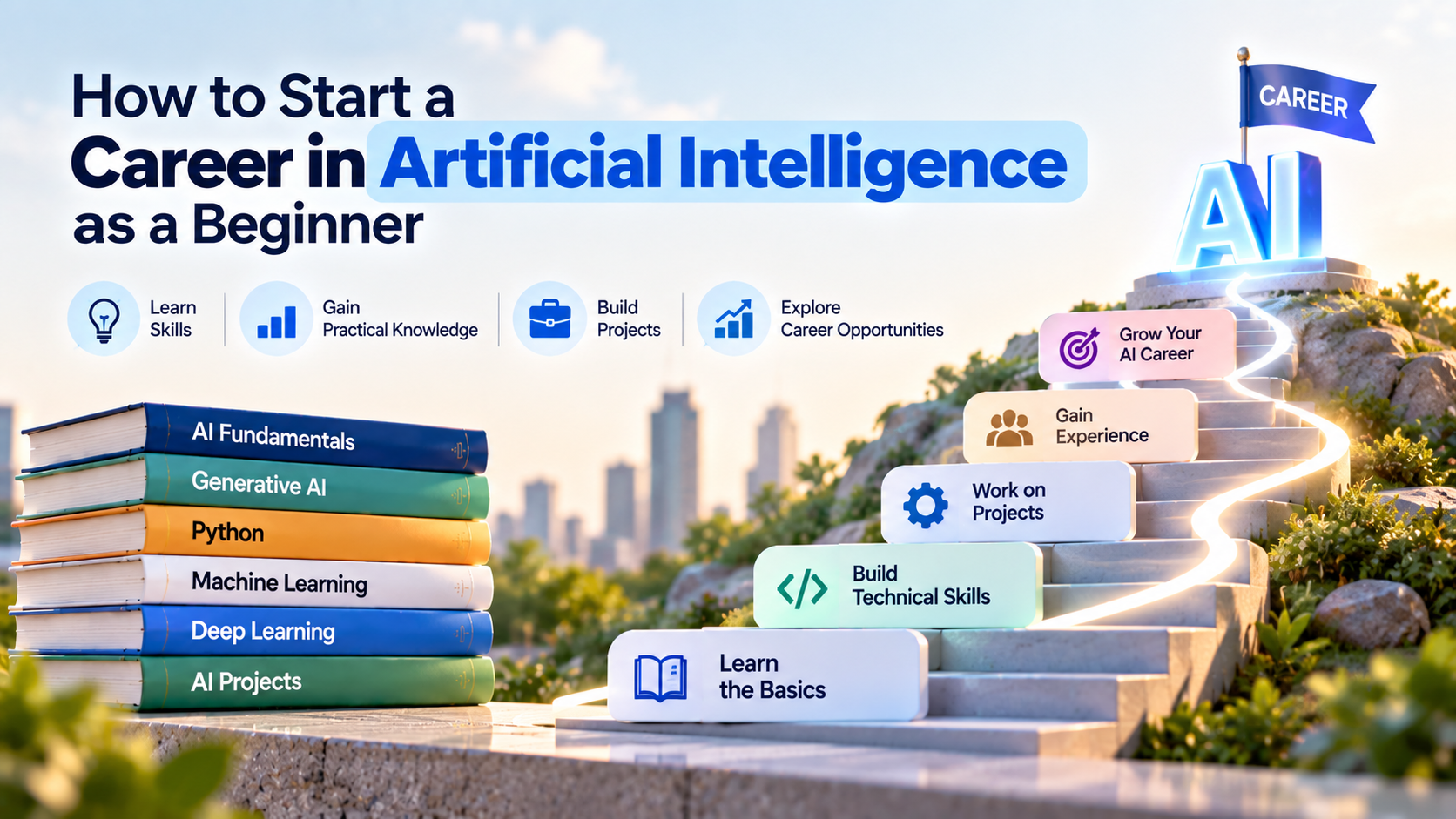
If you are wondering how to start an AI career for beginners, you do not need to master every advanced AI concept from day one. A structured learning path that starts with AI fundamentals, programming, Generative AI, practical projects and gradually moves toward Machine Learning can help you build a strong foundation.
AI Career for Beginners
Starting an AI career as a beginner is mainly about understanding what Artificial Intelligence is, identifying the area you want to work in and developing relevant skills through consistent practice. Instead of trying to learn everything simultaneously, beginners can follow a step-by-step AI career roadmap.
A practical beginner roadmap can include AI fundamentals, Generative AI, prompt engineering, Python, basic statistics, Machine Learning concepts, AI tools, automation and project development.
The learning path you choose should depend on your career objective. Someone interested in AI tools and business applications may follow a different path from someone who wants to become a Machine Learning Engineer or AI Developer.
What Is Artificial Intelligence?
Artificial Intelligence refers to technologies that enable computer systems to perform tasks that typically require human-like capabilities such as reasoning, pattern recognition, language understanding, decision-making and problem-solving.
AI applications are used for content generation, recommendation systems, chatbots, image recognition, automation, data analysis, search systems and many other business and technical applications.
For beginners, understanding the basic concepts of AI is more important than immediately learning complex algorithms. A strong conceptual foundation makes it easier to understand Machine Learning, Deep Learning, Generative AI and other areas later.
Why Start an AI Career?
AI is being integrated into workflows across many industries. Businesses use AI for automation, customer support, analytics, content creation, software development, marketing, forecasting and decision-making.
This means AI-related skills can be useful in both technical and non-technical career paths. Depending on your interests, you can work with AI as a developer, analyst, automation specialist, data professional, product professional or domain specialist.
However, learning AI should not be viewed only as learning a collection of tools. A sustainable AI career requires an understanding of how these technologies work, where they can be applied and how to evaluate their results.
Step 1: Understand AI Fundamentals
The first stage of an AI career roadmap should focus on the fundamentals. Learn what Artificial Intelligence means, how AI systems are used and how different AI technologies relate to one another.
Start by understanding concepts such as:
- Artificial Intelligence
- Machine Learning
- Deep Learning
- Generative AI
- Natural Language Processing
- Computer Vision
- AI automation
- AI agents
You do not need to become an expert in all these areas immediately. The purpose of this stage is to understand the AI ecosystem and identify the areas that match your interests and career goals.
Step 2: Learn Generative AI and AI Tools
Generative AI is one of the most accessible areas for beginners because many modern AI applications can be explored without advanced programming knowledge.
Beginners can experiment with AI tools for writing, research, image generation, data analysis, brainstorming, productivity, coding assistance and automation.
Tools such as ChatGPT, Claude and Gemini can also help beginners understand how natural-language interaction with AI systems works. The important skill is learning how to use these tools responsibly, write effective prompts, verify outputs and integrate AI into practical workflows.
Learning AI tools can therefore be a useful starting point while you gradually develop deeper technical knowledge.
Step 3: Learn Prompt Engineering
Prompt engineering involves designing clear instructions that help AI systems generate more useful and relevant outputs. It has become an important skill for people working with Generative AI.
Beginners should learn how to provide context, define objectives, specify output formats, add constraints and evaluate the response produced by an AI system.
For example, instead of asking an AI tool to simply “write an article,” you can provide the target audience, topic, structure, tone, word count and specific information that needs to be included.
Prompt engineering is particularly useful in content creation, marketing, research, customer support, education, software development and business automation.
Step 4: Learn Python for AI
If your goal is to build technical AI skills, Python is one of the most useful programming languages to learn. Beginners should start with Python fundamentals before moving into AI and Machine Learning libraries.
Important Python topics include:
- Variables and data types
- Conditional statements
- Loops
- Functions
- Lists, tuples and dictionaries
- Object-oriented programming
- File handling
- Exception handling
- Working with libraries
Once you are comfortable with Python, you can begin working with data and libraries commonly used in AI and Machine Learning.
Step 5: Build Basic Mathematics and Statistics Knowledge
You do not need advanced mathematics before starting AI, but basic mathematical and statistical concepts become increasingly useful as you move toward technical AI roles.
Beginners can gradually learn:
- Mean, median and mode
- Probability fundamentals
- Basic statistics
- Percentages and ratios
- Graphs and distributions
- Basic linear algebra
- Basic calculus concepts
These concepts can help you understand how Machine Learning models process data, measure performance and make predictions.
Step 6: Learn Machine Learning Fundamentals
After understanding the basics of AI and programming, beginners interested in technical AI careers can move toward Machine Learning.
Machine Learning focuses on developing systems that learn patterns from data and use those patterns to make predictions or decisions.
Start with fundamental concepts such as:
- Supervised learning
- Unsupervised learning
- Training and testing data
- Features and labels
- Model evaluation
- Regression
- Classification
- Clustering
- Overfitting and underfitting
Once these concepts become clear, you can gradually explore more advanced algorithms and applications.
Step 7: Explore Deep Learning
Deep Learning is an advanced area of Machine Learning that uses neural networks to process complex patterns in data.
Beginners should generally study Deep Learning after gaining a foundation in Python, statistics and Machine Learning. Topics can include neural networks, activation functions, training processes and model evaluation.
As your understanding improves, you can explore areas such as image classification, speech processing and natural language applications.
Step 8: Learn AI Automation
AI is not limited to model development. Automation is another important area where AI can be applied to business and professional workflows.
AI automation can involve connecting AI tools with applications and creating workflows that reduce repetitive manual work. Examples include automated content workflows, customer support systems, document processing, data summarisation and marketing automation.
Learning automation can be particularly useful for beginners who want to apply AI to real business problems without immediately becoming advanced AI developers.
Step 9: Build Practical AI Projects
Projects are one of the most important parts of an AI learning journey because they allow you to apply concepts instead of only studying theory.
Beginners can start with relatively simple projects such as:
- AI-powered chatbot
- Text classification system
- Recommendation system
- Sentiment analysis application
- Image classification project
- AI content assistant
- Document summarisation tool
- AI-powered automation workflow
As your skills improve, projects can become more sophisticated and can include APIs, databases, Machine Learning models, AI agents and automation systems.
Step 10: Create an AI Portfolio
A portfolio helps demonstrate what you can actually build. Instead of listing only courses and certificates, include projects that show how you have applied your knowledge.
Your portfolio can include GitHub repositories, project demonstrations, case studies, technical explanations and deployed applications where possible.
For every project, explain the problem, technology used, approach, challenges and final result. This gives potential employers a clearer understanding of your practical skills.
Build Job-Ready AI Skills
A structured learning program can help beginners follow a defined path instead of jumping between unrelated AI topics. A practical AI learning program can combine concepts such as Generative AI, prompt engineering, AI tools, automation and practical projects into a guided learning experience.
Upskill Now's current AI-focused programs include practical learning, industry projects, AI tools, internship exposure, certification and career support. Learners can explore an AI training program according to their background and career goals.
For beginners who want a structured starting point, an AI learning program can provide a combination of guided instruction and practical application.
Career Options After Learning AI
AI skills can be applied across different types of careers. The role you pursue will depend on the depth and combination of skills you develop.
Some possible career directions include:
- AI Engineer
- Machine Learning Engineer
- AI Automation Specialist
- Data Analyst
- Machine Learning Specialist
- NLP Engineer
- Computer Vision Engineer
- AI Product Specialist
- AI Consultant
- Generative AI Specialist
Not every role requires the same technical background. Technical engineering roles generally require stronger programming, mathematics and Machine Learning knowledge, while AI application and automation roles may focus more heavily on AI tools, workflows and business use cases.
AI Career Roadmap for Beginners
A simple AI career roadmap can help you stay focused instead of trying to learn every AI technology at once.
- Understand Artificial Intelligence fundamentals.
- Explore Generative AI and popular AI tools.
- Learn prompt engineering.
- Develop basic Python skills.
- Build foundational statistics knowledge.
- Study Machine Learning fundamentals.
- Explore Deep Learning if your career goal requires it.
- Learn AI automation and practical applications.
- Build several practical projects.
- Create a professional AI portfolio.
- Prepare your resume and LinkedIn profile.
- Apply for internships, entry-level roles or relevant projects.
The exact speed of this roadmap will depend on your previous knowledge, available study time and the type of AI career you want to pursue.
Common Mistakes Beginners Should Avoid
One common mistake is trying to learn every new AI tool as soon as it becomes popular. Tools can change quickly, so beginners should focus on transferable concepts and practical problem-solving skills alongside tool knowledge.
Another mistake is completing multiple courses without building projects. A certificate can document course completion, but practical projects help demonstrate how you apply what you have learned.
Beginners should also avoid comparing their progress with advanced AI developers. AI is a broad field, and learning can be approached progressively from fundamentals to specialised areas.
How Long Does It Take to Start Learning AI?
There is no single timeline that applies to every learner. Someone interested in AI tools and Generative AI may begin applying basic skills within a shorter period, while a learner targeting technical Machine Learning or AI engineering roles will need a longer learning path.
Consistency is more important than trying to complete everything quickly. Regular practice, projects and revision can help turn theoretical knowledge into practical ability.
Who Can Start an AI Career?
AI learning is not limited to computer science graduates. Students, graduates, working professionals, career changers, entrepreneurs and professionals from other fields can explore AI depending on their goals.
A non-technical learner can begin with Generative AI, AI tools, prompt engineering and automation before progressing toward programming and technical concepts if required.
Learners who want technical AI careers can gradually build skills in Python, statistics, Machine Learning, Deep Learning and AI development.
Conclusion
Starting an AI career for beginners does not require learning every Artificial Intelligence technology at once. The most practical approach is to build your knowledge progressively, starting with AI fundamentals and Generative AI before moving into programming, Machine Learning, automation and advanced areas according to your career goal.
Focus on practical skills, build meaningful projects and maintain a portfolio that demonstrates what you can do. With a structured learning path and consistent practice, beginners can gradually develop the technical and practical skills needed to explore different AI career opportunities.
Start Your AI Learning Journey
Upskill Now provides AI-focused learning options in Delhi and online, with programs covering areas such as Artificial Intelligence, Generative AI, Machine Learning and related digital skills. The institute lists practical projects, AI tools, internship exposure, certification, mentorship and career support as part of its learning approach.
For more information about the program, you can explore the AI Master Program offered by Upskill Now.
Contact Upskill Now
Address: A-3, Third Floor, Rajouri Garden, New Delhi – 110027
Phone: 9999848160 | 9711448765
Email: connect@upskillnow.in