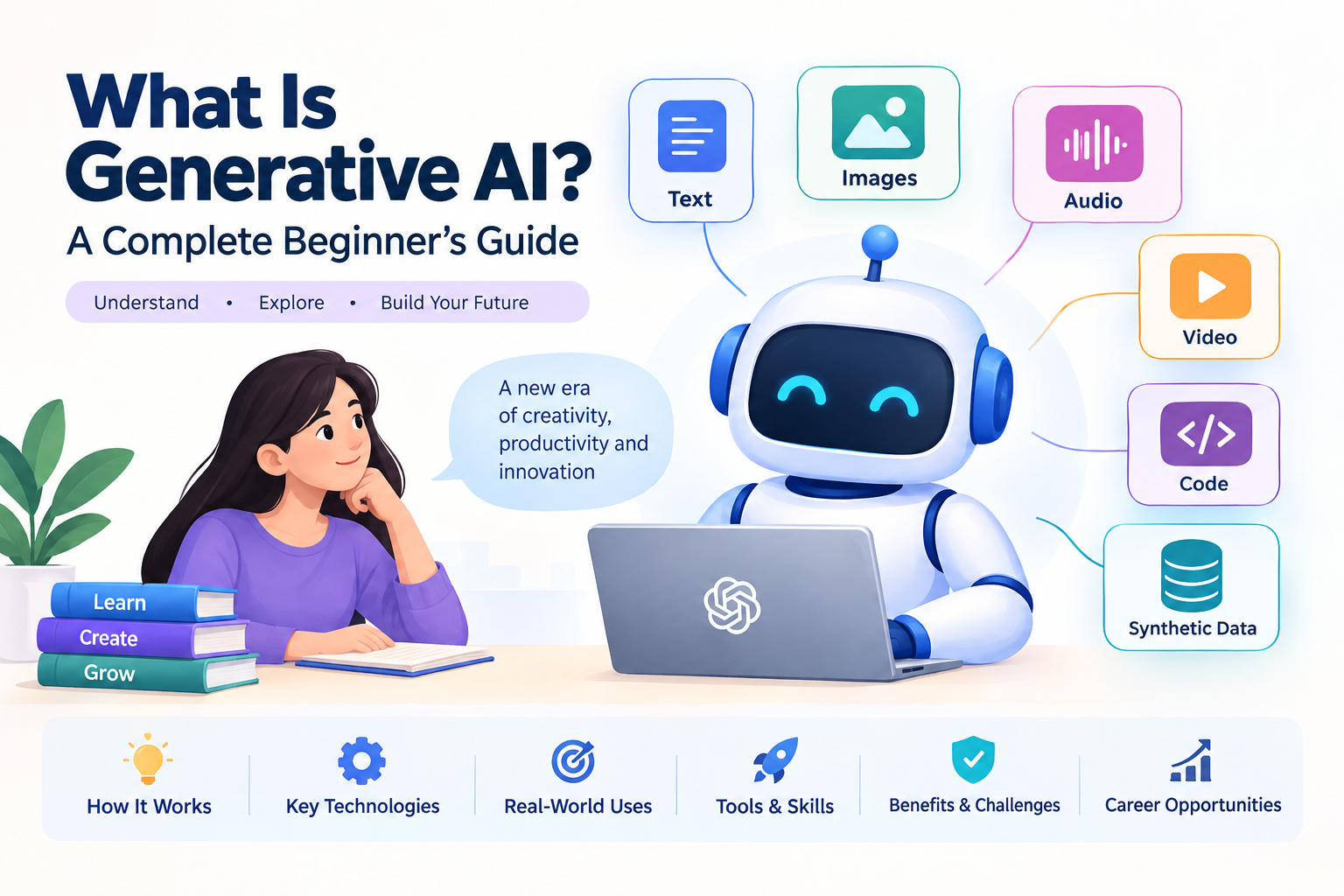
Generative AI is a type of artificial intelligence that can create new content—such as text, images, audio, video, computer code and synthetic data—by learning patterns from large amounts of existing data.
Unlike traditional AI systems that are often designed to classify, predict or analyze information, generative AI produces new outputs in response to a prompt, instruction or other input.
In simple terms, generative AI learns patterns from data and uses those patterns to generate new content.
Generative AI is behind many of today's AI applications, including conversational assistants, AI image generators, coding assistants and content-generation tools. It is also becoming increasingly important in education, software development, digital marketing, business automation and creative work.
This guide explains what generative AI is, how generative AI works, the technologies behind it, its applications, examples, benefits, limitations, AI tools, career opportunities and how beginners can start learning it.
What Is Generative AI?
Generative AI, also called GenAI or generative artificial intelligence, is a branch of artificial intelligence focused on creating new content from patterns learned during model training.
Depending on the model, generative AI can create:
-
Text
-
Images
-
Audio
-
Video
-
Computer code
-
Synthetic data
-
Other digital content
For example, a user can provide a prompt such as:
"Explain digital marketing to a beginner in simple language."
A generative AI model processes that instruction and produces a new response based on patterns it learned during training.
The important distinction is that generative AI is designed to generate, rather than only classify or predict.
Generative AI Meaning in Simple Words
The word generative means producing or creating something.
Traditional software generally follows predefined instructions. Traditional AI can also be designed to recognize patterns and make predictions—for example, determining whether an email is spam.
Generative AI adds another capability: creating an output based on learned patterns and a user's request.
Think of the difference like this:
|
Traditional AI |
Generative AI |
|
Is this email spam? |
Write a professional email |
|
Is this image a cat? |
Create an image of a cat |
|
What product might the customer buy? |
Write a product description |
|
What is the likely value? |
Generate a report explaining the data |
|
Classify this document |
Summarize this document |
This is a simplified comparison, because modern AI systems can perform both predictive and generative tasks.
How Does Generative AI Work?
Generative AI systems use machine learning, neural networks and large datasets to learn patterns in information.
A simplified workflow is:
Training Data → AI Model → Prompt/Input → Inference → Generated Output
Let's break this down.
Step 1: Training Data
Generative AI models learn from large collections of data.
Depending on the model, the training data can include:
-
Text
-
Images
-
Audio
-
Video
-
Code
-
Other structured or unstructured information
The model does not simply function as a searchable database. During training, it learns statistical relationships and patterns within the data.
Step 2: Model Training
During training, the model processes examples and adjusts its internal parameters to become better at its learning objective.
For language models, a simplified example is predicting the next token based on the surrounding context.
Repeated training allows the model to learn patterns involving language, concepts, structure and relationships.
Step 3: Understanding the Prompt
When a user enters an instruction, the model processes the input and its context.
For example:
"Write a 500-word beginner guide to SEO."
The system interprets the request and determines the type of output that would satisfy it.
Step 4: Generating the Output
The model generates an output based on the patterns represented in its learned parameters and the information supplied in the current context.
For text-generation systems, this generally involves predicting tokens sequentially.
For image-generation systems, the process is different and may involve models such as diffusion systems.
Step 5: Human Review
The generated result should not automatically be treated as correct.
AI systems can produce inaccurate information, omit important context or make errors. Human review is particularly important for medical, financial, legal, academic, technical and business-critical information.
What Technologies Power Generative AI?
Generative AI is not one single technology. It is an ecosystem involving several approaches and model architectures.
Large Language Models (LLMs)
Large Language Models, or LLMs, are AI models trained on large amounts of text and designed to process and generate language.
LLMs power many conversational AI and text-generation applications.
They can be used for:
-
Question answering
-
Writing
-
Summarization
-
Translation
-
Brainstorming
-
Coding assistance
-
Research assistance
LLMs are an important part of generative AI, but generative AI is broader than LLMs because it also includes systems that generate images, audio, video and other forms of content.
Transformer Architecture
Transformers are a neural-network architecture that became especially important for modern language models.
Transformers use attention mechanisms to help models process relationships between parts of an input sequence.
This architecture helped enable large-scale language models and many modern generative AI applications.
Generative Adversarial Networks (GANs)
Generative Adversarial Networks, or GANs, use two neural networks in competition:
-
A generator creates synthetic content.
-
A discriminator evaluates whether the content looks real.
Through training, the generator learns to produce increasingly realistic outputs.
GANs have been used for image generation, image enhancement and other synthetic-data applications.
Diffusion Models
Diffusion models are widely associated with modern image-generation systems.
In simplified terms, a diffusion model learns how to transform noisy data into structured output.
These models can be used to generate images from text prompts and support other forms of generative media.
Foundation Models
A foundation model is a large model trained on broad data that can serve as a base for multiple downstream applications.
Foundation models can support different tasks depending on how they are adapted or used.
Generative AI vs Traditional AI
Generative AI and traditional AI can overlap, but their typical objectives differ.
|
Factor |
Traditional AI |
Generative AI |
|
Primary purpose |
Prediction, classification or analysis |
Content generation |
|
Output |
Prediction, score, classification or recommendation |
Text, image, audio, video, code and more |
|
Example |
Detect fraudulent transactions |
Generate a business report |
|
Interaction |
Often task-specific |
Often prompt-driven |
|
Main strength |
Decision support and pattern recognition |
Content creation and synthesis |
Modern AI systems can combine both approaches.
For example, an AI application could analyze customer data and then generate a written summary of its findings.
Generative AI vs Machine Learning
Machine learning is a broader approach within artificial intelligence in which systems learn patterns from data.
Generative AI is a category of AI systems designed to generate new content.
A simple way to understand the relationship is:
Artificial Intelligence → Machine Learning → Generative AI
However, this diagram is only a simplified learning model. Generative AI uses machine learning techniques, but not every machine learning system is generative.
For example:
-
A fraud-detection model can use machine learning without generating content.
-
A recommendation system can use machine learning without generating content.
-
A text-generation model can use machine learning to generate new text.
What Types of Content Can Generative AI Create?
Generative AI can work across multiple content formats.
Text Generation
AI can generate:
-
Articles
-
Emails
-
Summaries
-
Product descriptions
-
Scripts
-
Reports
-
Stories
-
Explanations
Image Generation
AI image-generation systems can create visuals from descriptions.
Applications include:
-
Marketing creatives
-
Concept art
-
Illustrations
-
Product concepts
-
Social media graphics
Audio Generation
Generative AI can produce or transform audio, including:
-
Speech
-
Voice
-
Music
-
Sound effects
-
Narration
Video Generation
AI video systems can assist with:
-
Short videos
-
Marketing content
-
Animation
-
Visual storytelling
-
Video concepts
Code Generation
Generative AI can assist developers with:
-
Code generation
-
Debugging
-
Code explanations
-
Documentation
-
Test creation
-
Prototyping
Synthetic Data
Generative models can also produce synthetic datasets for certain research, testing and development use cases.
What Is Multimodal Generative AI?
Multimodal AI refers to systems capable of working with multiple types of information, such as text, images, audio and other inputs or outputs.
For example, a multimodal system may allow a user to:
-
Upload an image.
-
Ask a question about it.
-
Receive a text explanation.
-
Generate another output based on the analysis.
Multimodal AI is important because real-world information rarely exists in only one format.
Real-World Generative AI Examples
Generative AI is already being used in many everyday workflows.
Examples include:
|
Use Case |
What Generative AI Can Do |
|
Writing |
Draft and rewrite text |
|
Education |
Explain concepts and create practice material |
|
Coding |
Generate and explain code |
|
Design |
Generate visual concepts |
|
Marketing |
Create content and campaign variations |
|
Customer service |
Draft responses and summarize conversations |
|
Research |
Summarize and organize information |
|
Productivity |
Create documents, plans and summaries |
|
Video |
Generate or assist with video content |
|
Audio |
Generate speech and other audio |
The specific capabilities depend on the model and application.
Popular Generative AI Tools
The generative AI ecosystem includes tools for different tasks.
Conversational AI
Used for:
-
Questions and answers
-
Writing
-
Brainstorming
-
Research assistance
-
Content transformation
AI Image Generators
Used for:
-
Images
-
Illustrations
-
Design concepts
-
Marketing visuals
AI Coding Assistants
Used for:
-
Code generation
-
Debugging
-
Documentation
-
Software development
AI Video Tools
Used for:
-
Video creation
-
Editing
-
Animation
-
Visual storytelling
Rather than learning every tool, beginners should first understand the underlying concepts and use cases.
What Is Generative AI Used For?
Generative AI has applications across many industries.
Generative AI in Education
Students and educators can use AI for:
-
Concept explanations
-
Study assistance
-
Summarization
-
Practice questions
-
Brainstorming
-
Language learning
AI should support learning rather than replace independent thinking.
Generative AI in Software Development
Developers can use AI to:
-
Generate code
-
Explain existing code
-
Debug programs
-
Create documentation
-
Generate tests
-
Build prototypes
Generated code should always be reviewed and tested.
Generative AI in Healthcare
Potential applications include:
-
Research assistance
-
Documentation
-
Medical information summarization
-
Drug-discovery research
-
Administrative workflows
Healthcare applications require particularly strong validation, privacy protection and professional oversight.
Generative AI in Finance
Potential applications include:
-
Report generation
-
Document analysis
-
Customer communication
-
Research assistance
-
Workflow automation
Financial decisions should not rely blindly on AI-generated outputs.
Generative AI in Customer Service
Businesses can use AI to:
-
Answer common questions
-
Draft responses
-
Summarize conversations
-
Assist support agents
-
Retrieve relevant information
Generative AI in Business
Organizations can use generative AI for:
-
Research
-
Documentation
-
Marketing
-
Communication
-
Data analysis assistance
-
Workflow automation
-
Employee productivity
Generative AI in Digital Marketing
Digital marketing is one of the most practical areas for generative AI.
Marketers can use AI to support:
SEO
-
Content ideation
-
Keyword research assistance
-
Search-intent analysis
-
Content briefs
-
Meta descriptions
-
Internal-linking ideas
Content Marketing
-
Topic brainstorming
-
Article outlines
-
Content repurposing
-
Social media ideas
-
Email drafts
Paid Advertising
-
Ad-copy variations
-
Creative concepts
-
Campaign brainstorming
-
Audience research
Social Media
-
Caption ideas
-
Content calendars
-
Post variations
-
Creative concepts
The best approach is AI-assisted marketing, not blind AI-generated marketing. Human strategy, original insights, fact-checking and audience understanding remain essential.
What Is Prompt Engineering?
Prompt engineering is the practice of designing effective instructions for generative AI systems.
A basic prompt might be:
"Write about digital marketing."
A more useful prompt could specify:
"Act as a digital marketing strategist. Explain digital marketing to college students in simple English. Cover SEO, Google Ads, social media marketing and email marketing. Use examples and a comparison table."
The second prompt provides:
-
Role
-
Audience
-
Topic
-
Scope
-
Format
-
Context
Better prompts can make AI outputs more relevant and easier to refine.
What Are AI Hallucinations?
An AI hallucination occurs when a generative AI system produces information that is incorrect, fabricated or unsupported while presenting it as if it were reliable.
For example, an AI system might:
-
Invent a source
-
Provide an incorrect statistic
-
Attribute a quote to the wrong person
-
Describe a nonexistent study
-
Generate incorrect technical information
This is one reason users should verify important AI-generated information.
Generative AI should be treated as a powerful assistance tool, not an unquestionable source of truth.
What Is Retrieval-Augmented Generation (RAG)?
Retrieval-Augmented Generation, commonly called RAG, combines information retrieval with generative AI.
Instead of relying only on information represented in a model, a RAG system can retrieve relevant information from an external knowledge source and use that context when generating a response.
A simplified workflow is:
User Question → Retrieve Relevant Information → Add Context → Generate Answer
RAG can be useful for applications such as:
-
Company knowledge assistants
-
Customer-support systems
-
Document question answering
-
Internal search
-
Research systems
RAG is particularly useful when an application needs responses grounded in a specific collection of information.
What Are AI Agents?
An AI agent is a system designed to use AI to perform tasks or manage workflows with some degree of autonomy.
Generative AI can provide the reasoning or content-generation capabilities within an agentic system.
For example, an AI agent might:
-
Receive a user's objective.
-
Break the objective into tasks.
-
Retrieve information.
-
Use software tools.
-
Generate outputs.
-
Continue until the workflow is completed.
This makes AI agents different from a simple chatbot.
A chatbot may answer a question.
An agent may be designed to take actions toward completing a goal.
Benefits of Generative AI
Generative AI can provide several benefits when used responsibly.
Faster Content Creation
AI can help generate first drafts, ideas and variations quickly.
Increased Productivity
Repetitive tasks can be accelerated or partially automated.
Faster Prototyping
Teams can quickly experiment with concepts, designs and workflows.
Personalized Assistance
AI can adapt its responses to different instructions and contexts.
Coding Support
Developers can use AI to accelerate parts of the development process.
Accessibility
AI-powered translation, speech and content-generation tools can make information easier to access.
New Creative Possibilities
Creators can experiment with new forms of text, images, audio and video.
What Are the Limitations of Generative AI?
Generative AI is powerful, but it has important limitations.
Inaccurate Information
AI can produce incorrect answers.
Hallucinations
Models can generate plausible-sounding but unsupported information.
Bias
AI systems can reflect biases present in their training data or other system components.
Privacy Risks
Users should avoid sharing confidential or sensitive information unless they understand how the relevant system handles that data.
Security Risks
AI systems can introduce security concerns, particularly when connected to external tools or sensitive business systems.
Copyright and Intellectual Property
The legal and policy landscape around AI-generated and AI-assisted content continues to develop across jurisdictions.
Lack of Human Judgment
AI does not replace professional judgment in situations requiring expertise, responsibility or accountability.
Generative AI Ethics, Privacy and Copyright
Responsible AI use requires more than simply producing good outputs.
Important considerations include:
-
Data privacy
-
Security
-
Bias
-
Transparency
-
Copyright
-
Intellectual property
-
Misinformation
-
Human oversight
-
Responsible deployment
Organizations should establish clear policies for how employees use AI, particularly when confidential business or customer information is involved.
Is Generative AI Safe to Use?
Generative AI can be useful and relatively safe when used appropriately, but no AI system should be treated as risk-free.
Before using an AI tool, consider:
-
What information are you sharing?
-
How is your data handled?
-
Is the output being reviewed?
-
Is the task high-risk?
-
Does the information require verification?
-
Are there copyright or confidentiality concerns?
For important decisions, AI output should be reviewed by an appropriately qualified human.
What Skills Do You Need to Learn Generative AI?
The skills required depend on your career goal.
For AI Users
Start with:
-
AI fundamentals
-
Prompt engineering
-
AI tools
-
Critical thinking
-
Fact-checking
-
Responsible AI use
For AI-Powered Digital Marketers
Develop:
-
Digital marketing
-
SEO
-
Content strategy
-
AI tools
-
Prompt engineering
-
Automation
-
Analytics
For Technical AI Professionals
Develop deeper knowledge of:
-
Python
-
Mathematics
-
Statistics
-
Machine learning
-
Deep learning
-
Neural networks
-
NLP
-
Computer vision
-
APIs
-
Model deployment
-
Data engineering
The important point is that generative AI skills should be combined with domain expertise.
Generative AI Career Opportunities
Generative AI is influencing several technology and business roles.
Potential career paths include:
-
Generative AI Engineer
-
Machine Learning Engineer
-
AI Engineer
-
Prompt Engineer
-
AI Automation Specialist
-
AI Product Specialist
-
AI Consultant
-
Machine Learning Developer
-
AI-focused Software Developer
-
AI Digital Marketing Specialist
-
Data Scientist
-
NLP Engineer
Job titles and responsibilities vary considerably between organizations.
For beginners, it is usually better to develop a combination of AI fundamentals + technical or domain expertise rather than focusing only on a single AI tool.
How to Learn Generative AI as a Beginner
A practical learning roadmap can look like this:
Step 1: Learn AI Fundamentals
Understand:
-
Artificial intelligence
-
Machine learning
-
Deep learning
-
Generative AI
-
LLMs
-
Neural networks
Step 2: Learn Prompt Engineering
Practice creating structured prompts.
Step 3: Explore AI Tools
Experiment with different applications for:
-
Text
-
Images
-
Coding
-
Research
-
Productivity
Step 4: Learn Python
If you want to move toward technical AI development, Python is an important programming language to learn.
Step 5: Build Projects
Create practical projects such as:
-
AI chatbot
-
AI content workflow
-
AI research assistant
-
RAG application
-
AI automation workflow
-
AI-powered marketing assistant
Step 6: Develop Domain Expertise
Combine AI with your existing field.
For example:
Marketing + AI
Programming + AI
Data Science + AI
Business + AI
This combination can be more valuable than learning AI tools in isolation.
What Is the Future of Generative AI?
Generative AI is moving toward systems that can work across multiple modalities, use external tools and support increasingly complex workflows.
Several areas are likely to remain important:
-
Multimodal AI
-
AI agents
-
AI automation
-
Retrieval-augmented generation
-
On-device AI
-
AI-assisted software development
-
Personalized AI
-
Enterprise AI
-
Responsible AI
-
AI-powered robotics
However, the technology will continue to change quickly. Specific tools and models that are popular today may be replaced by newer systems.
For this reason, learning fundamentals, problem-solving and responsible AI use is more sustainable than learning only one tool.
Conclusion
Generative AI is a branch of artificial intelligence that enables machines to generate new content from patterns learned from data. It can create or assist with text, images, audio, video, code and other digital outputs.
Understanding generative AI requires more than knowing how to use an AI chatbot. Beginners should understand the fundamentals behind LLMs, transformer models, diffusion models, multimodal AI, prompting, RAG, AI agents and responsible AI use.
The technology is already influencing education, software development, digital marketing, business operations, research and creative work. As these systems become more capable, the ability to combine AI with human expertise, critical thinking and practical skills will become increasingly important.
If you are starting your AI journey, focus on the fundamentals first, experiment with real tools, build practical projects and gradually develop deeper technical or professional expertise.
Generative AI is not simply about asking machines to create content. It is about learning how to use intelligent systems to solve real problems more effectively.
Frequently Asked Questions
What is generative AI in simple terms?
Generative AI is artificial intelligence that can create new content such as text, images, audio, video and code based on patterns learned from data and instructions provided by users.
What is generative AI used for?
Generative AI is used for content creation, coding, education, marketing, research, customer service, business automation, design, productivity and many other applications.
How does generative AI work?
Generative AI models learn patterns from large datasets during training. When given an input or prompt, they use those learned patterns and the current context to generate an output.
Is ChatGPT generative AI?
ChatGPT is an AI application that uses generative AI capabilities. Generative AI is the broader technology category.
What are examples of generative AI?
Examples include AI systems that generate text, images, audio, video and computer code from user instructions.
What is an LLM?
An LLM, or Large Language Model, is an AI model trained on large amounts of text and designed to understand and generate language