
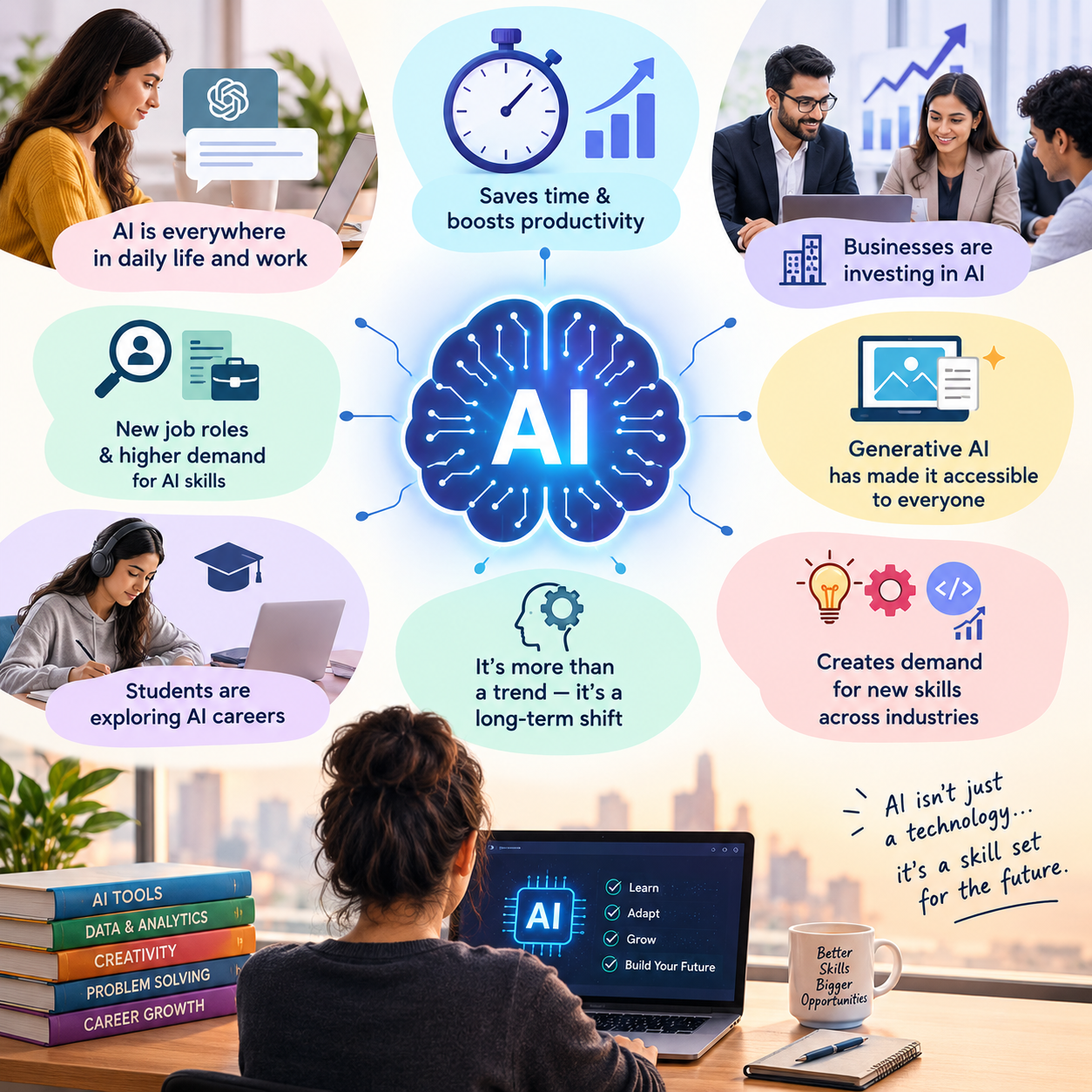
Artificial Intelligence (AI) has moved from being a futuristic concept to becoming a part of everyday life. From chatbots and AI-powered search to automated business processes and content creation, AI is changing the way people work, learn, create, and make decisions.
But why is AI suddenly everywhere? And why are AI courses, skills, and professionals in such high demand?
The answer lies in a combination of rapid technological development, business adoption, and the growing need for people who can work effectively with AI.
1. AI Is Becoming Part of Everyday Work
AI is no longer limited to technology companies. Businesses across industries are using AI for tasks such as:
-
Customer support
-
Data analysis
-
Marketing and advertising
-
Content creation
-
Sales forecasting
-
Recruitment
-
Software development
-
Financial analysis
-
Research and documentation
This widespread adoption has made AI relevant to professionals from almost every field.
A marketer, teacher, designer, developer, HR professional, or business owner can now use AI tools to improve productivity and automate repetitive tasks.
2. AI Can Save Time and Improve Productivity
One of the biggest reasons for the growing demand for AI is productivity.
Tasks that previously took hours can sometimes be completed much faster with AI assistance. For example, AI can help professionals generate drafts, summarize information, analyze large datasets, write code, create presentations, brainstorm ideas, and automate workflows.
The goal isn't necessarily to replace human work. In many situations, AI works as a productivity tool that allows people to focus more on creativity, strategy, communication, and decision-making.
3. Businesses Are Investing in AI
Companies are increasingly exploring AI because it can help them reduce repetitive work, understand customers better, improve operations, and create new products and services.
For businesses, AI is becoming a competitive factor.
Organizations that understand how to integrate AI into their workflows can potentially respond faster, personalize customer experiences, and make better use of their data.
This is also creating demand for employees who understand both AI technology and its practical business applications.
4. The Job Market Is Changing
AI is influencing the skills employers look for.
Traditional technical skills are still valuable, but professionals who know how to use AI tools effectively are gaining an additional advantage.
New and evolving roles are appearing around areas such as:
-
AI and Machine Learning
-
Data Science
-
Generative AI
-
AI Automation
-
Prompt Engineering
-
AI Product Management
-
AI-Powered Marketing
-
AI Research
-
AI Ethics and Governance
At the same time, many existing jobs are incorporating AI into their daily responsibilities.
This means that learning AI doesn't only mean becoming an AI engineer. It can also mean learning how AI can be applied to your existing career.
5. Generative AI Has Changed the Conversation
The rise of Generative AI has made artificial intelligence accessible to a much larger audience.
Tools can now generate text, images, presentations, code, audio, and other forms of content based on natural-language instructions.
This has changed how people think about technology.
You don't always need advanced programming knowledge to start using AI. A student can use it for learning, a business owner can use it for research and marketing, and a professional can use it for productivity.
As accessibility increases, demand for AI knowledge naturally increases as well.
6. AI Is Creating Demand for New Skills
The important question is no longer simply:
"Will AI take my job?"
A more practical question is:
"How can I use AI to become better at my job?"
Professionals are increasingly expected to understand how to work alongside AI systems.
This includes skills such as:
-
Writing effective prompts
-
Evaluating AI-generated information
-
Using AI productivity tools
-
Understanding data
-
Automating repetitive workflows
-
Applying AI to specific industries
-
Maintaining human oversight
The ability to combine human expertise with AI tools is becoming an increasingly valuable professional skill.
7. Students Are Also Exploring AI Careers
AI has become particularly attractive to students because it connects with multiple high-growth technology areas.
Students with backgrounds in computer science, mathematics, statistics, engineering, and related fields can explore areas such as machine learning, data science, robotics, computer vision, and natural language processing.
However, AI education isn't limited to technical students. Students from business, marketing, design, finance, and other disciplines can learn how AI applies to their respective fields.
8. AI Is More Than a Trend
AI may be trending because of the rapid growth of Generative AI, but the underlying technology is much broader.
Machine learning, natural language processing, computer vision, robotics, recommendation systems, and predictive analytics have already been used for years.
What has changed is the speed at which AI is becoming accessible and integrated into everyday products and workplaces.
Therefore, AI is not simply a short-term trend. It represents a broader technological shift that is changing how digital products and businesses operate.
9. Why Learning AI Can Be Valuable
Learning AI doesn't necessarily mean becoming an expert in programming or building complex machine-learning models.
For many people, the first step can simply be understanding:
What can AI do?
How does it work?
Where can I use it?
What are its limitations?
From there, learners can develop specialized skills based on their career goals.
For example:
Marketing + AI → AI-powered campaigns and content workflows
Coding + AI → AI-assisted software development
Data + AI → Data analysis and predictive modelling
Design + AI → AI-assisted creative workflows
Education + AI → Personalized learning and teaching support
Business + AI → Automation and decision-support systems
The Future: AI + Human Skills
The future of work is unlikely to be about AI alone. Human skills will co