
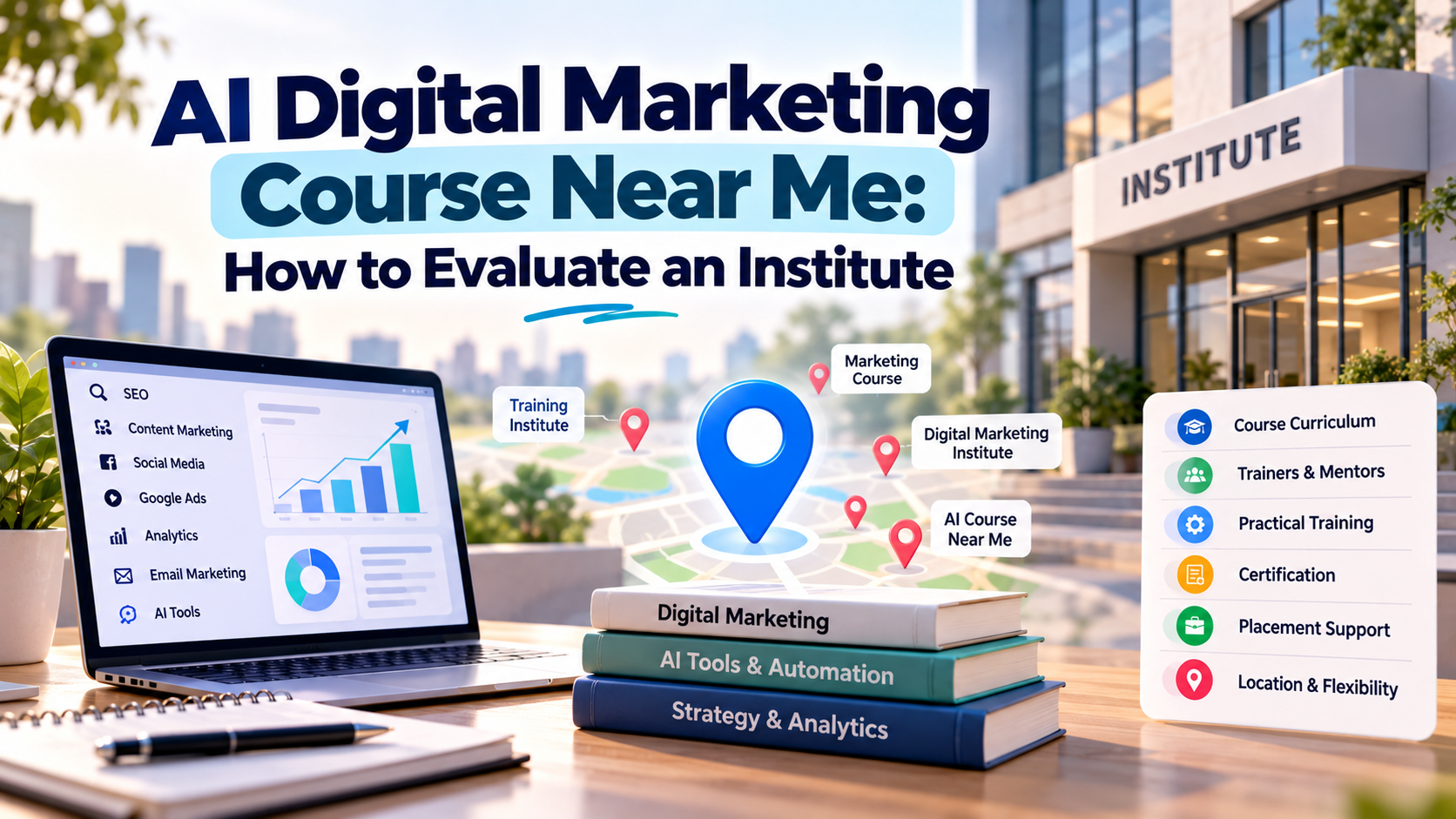
AI Digital Marketing Course Near Me: How to Evaluate an Institute
Searching for an “AI digital marketing course near me” can bring up dozens of institutes, training centres, academies, and online programs. With so many options available, choosing a course based only on location, advertisements, discounts, or placement claims can make the decision difficult.
An AI digital marketing course should ideally teach both digital marketing fundamentals and the practical use of artificial intelligence in marketing workflows. The right institute should help you understand SEO, content marketing, social media, paid advertising, analytics, automation, and AI-powered marketing tools through practical learning.
Before enrolling, it is important to evaluate the institute based on its curriculum, trainers, practical exposure, projects, tools, learning format, certifications, career support, and overall course structure.
Why Choose an AI Digital Marketing Course?
Digital marketing is no longer limited to creating social media posts or running advertisements. Modern marketers work with search engines, analytics platforms, advertising systems, customer data, content tools, automation platforms, and increasingly AI-powered applications.
AI can assist marketers with tasks such as content ideation, keyword research, campaign analysis, audience segmentation, personalisation, reporting, and marketing automation.
However, learning AI tools without understanding marketing fundamentals can create gaps in practical knowledge. A good course should therefore combine both areas instead of treating AI as a completely separate topic.
What Should an AI Digital Marketing Course Include?
One of the first things to check is the course curriculum. Avoid choosing an institute simply because its website lists a large number of AI tools. Tools can change quickly, while the underlying marketing skills remain important.
A well-structured course should cover digital marketing fundamentals along with practical AI applications. Important areas can include SEO, content marketing, social media marketing, Google Ads, analytics, email marketing, conversion optimisation, marketing automation, and AI-assisted workflows.
Look for a curriculum that explains not only how to use a tool but also why and when that tool should be used.
1. Check the Digital Marketing Fundamentals
Before evaluating the AI portion of a course, examine whether the institute teaches the fundamentals properly.
Topics such as search engine optimisation, keyword research, content strategy, social media marketing, paid advertising, email marketing, website optimisation, analytics, and conversion tracking provide the foundation for digital marketing.
If an institute focuses heavily on AI tools but gives limited attention to these fundamentals, learners may find it difficult to understand the reasoning behind marketing decisions.
2. Evaluate the AI Marketing Curriculum
The AI component of the course should go beyond simply introducing popular generative AI platforms.
Check whether the institute teaches practical applications such as AI-assisted content creation, prompt writing, SEO research, audience analysis, advertising copy development, campaign analysis, workflow automation, personalisation, and reporting.
It is also useful to check whether students are taught how to review and improve AI-generated output rather than accepting it without verification.
A structured AI digital marketing course should connect AI tools with actual marketing objectives instead of presenting them as isolated software demonstrations.
3. Look for Practical Training
Practical training is one of the most important factors to consider when comparing institutes.
Digital marketing is an execution-based field. Understanding a concept in a classroom is different from creating a campaign, optimising a website, analysing traffic, developing an SEO strategy, or preparing a performance report.
Ask whether the institute provides assignments, campaign exercises, website projects, SEO tasks, advertising practice, analytics exercises, content projects, or other practical activities.
The objective should be to give learners opportunities to apply what they have studied.
4. Examine the Projects and Portfolio Opportunities
A certificate can demonstrate that you completed a course, but a practical portfolio can help demonstrate what you can actually do.
Before joining an institute, ask what projects students complete during the program. Check whether the projects cover different areas of digital marketing instead of repeating the same type of assignment.
A useful portfolio could include an SEO project, content strategy, social media campaign, paid advertising exercise, analytics report, email marketing workflow, or AI-assisted marketing project.
When evaluating an AI marketing learning program, consider whether the projects allow you to demonstrate both marketing knowledge and the practical use of AI.
5. Check the Trainers and Mentors
The quality of instruction can significantly influence the learning experience. Look at the trainers listed by the institute and understand their professional background.
Instead of focusing only on titles or years of experience, check whether trainers have practical knowledge of the areas they teach.
It can also be useful to attend a demo class if the institute provides one. Pay attention to whether the trainer explains concepts clearly, demonstrates practical workflows, answers questions, and connects theory with real marketing situations.
6. Compare Online and Classroom Learning
When searching for an AI digital marketing course near you, you may find both classroom and online options.
Classroom learning can provide direct interaction with trainers and other learners. Online learning can offer flexibility and may be useful for students or working professionals with different schedules.
The format itself should not be the only deciding factor. Check the quality of live instruction, practical sessions, recordings, assignments, doubt support, mentorship, and access to learning resources.
If you prefer classroom learning, also consider the actual travel time rather than selecting an institute simply because it appears close to your location.
7. Ask About Tools and Platforms
Digital marketing involves working with multiple platforms. A course should ideally provide opportunities to understand the tools relevant to the skills being taught.
Depending on the curriculum, these may include analytics platforms, search tools, advertising platforms, content management systems, email marketing tools, SEO platforms, social media management tools, and AI applications.
However, the number of tools listed by an institute should not be the main factor in your decision. Understanding the marketing purpose behind each tool is more valuable than simply learning how to navigate dozens of platforms.
8. Review the Course Duration and Schedule
Compare the total duration of the course with the amount of content being offered. A very short course that claims to cover every area of digital marketing and AI may not provide enough time for meaningful practical work.
Check how many hours are dedicated to live classes, assignments, practical sessions, projects, doubt-clearing sessions, and independent practice.
Also check whether the schedule fits your college, job, internship, or other responsibilities.
9. Understand the Certification
Certification can be useful as evidence of course completion, but it should not be the only reason to select an institute.
Ask what certificate you receive, who issues it, what assessments are involved, and whether the certificate represents actual coursework and project completion.
More importantly, look at what skills and portfolio work you will have after completing the program.
10. Evaluate Placement and Career Support Carefully
Many institutes advertise placement assistance, career support, interviews, or hiring opportunities. Before enrolling, understand exactly what these terms mean.
Ask whether the institute provides resume support, interview preparation, mock interviews, career counselling, internship opportunities, job referrals, or connections with employers.
If an institute makes specific placement claims, ask for clear information about eligibility, the period covered by the claim, the roles involved, and what type of support is actually provided.
Do not evaluate a course only on the basis of a headline placement percentage. Consider the training and career-support process behind the claim.
11. Read Reviews Carefully
Reviews can provide useful information, but they should be evaluated carefully.
Look for detailed reviews that discuss teaching quality, projects, trainer support, practical sessions, learning material, and overall experience.
Do not rely exclusively on testimonials displayed on an institute's own website. When possible, compare information from multiple sources and look for recurring patterns in student experiences.
12. Compare Fees and What You Actually Receive
Course fees can vary significantly between institutes. Instead of comparing only the headline price, compare what is included in the fee.
Check whether live classes, recordings, assignments, projects, mentorship, tools, study material, certifications, internships, and career support are included.
A lower course fee does not necessarily mean better value, just as a higher fee does not automatically indicate better training. Compare the actual learning experience and deliverables.
Red Flags to Watch Out For
While searching for an AI digital marketing course near you, be cautious of institutes that make broad promises without providing clear details.
Some warning signs include an unclear curriculum, excessive focus on certificates, unrealistic career promises, limited practical work, unclear fee structures, vague placement information, and claims about mastering a very large number of tools in a short period.
An institute should be able to clearly explain what you will learn, how you will practise it, what projects you will complete, and what support you receive during and after the program.
How to Shortlist the Right Institute
Start by creating a shortlist of several institutes rather than immediately enrolling in the first result you find online.
Compare their curriculum, practical training, projects, trainers, class format, schedule, certifications, career support, fees, and reviews.
Then attend demo classes where available and ask specific questions about the areas that matter most to you.
If your goal is to build a career in digital marketing, focus on whether the course can help you develop practical skills and a portfolio that demonstrates those skills.
Why Location Should Not Be the Only Factor
The phrase “near me” is useful when searching for local training, but proximity should not be the only selection criterion.
An institute that is slightly farther away may offer a different curriculum, stronger practical exposure, better mentorship, or a learning format that suits your requirements more closely.
Similarly, an online course may provide access to structured learning without requiring daily travel.
Therefore, consider location alongside curriculum, teaching quality, practical training, projects, schedule, fees, and career support.
Who Should Consider an AI Digital Marketing Course?
An AI-focused digital marketing program can be relevant for students, graduates, working professionals, entrepreneurs, freelancers, and individuals looking to build or strengthen their marketing skills.
Students can use the training to build practical projects and understand different digital marketing roles. Working professionals can use AI tools to improve existing marketing workflows, while entrepreneurs can learn how digital channels and AI-assisted tools can support their own business activities.
The right course depends on your existing knowledge, career objective, available time, preferred learning format, and the level of practical training you need.
Build Skills Beyond AI Tools
AI tools are changing quickly, so learning a specific tool should not be the entire objective of an AI digital marketing course.
Developing skills in strategy, audience research, SEO, content, analytics, advertising, communication, creativity, and problem-solving can help you adapt when new technologies and platforms emerge.
The strongest learning approach combines these fundamentals with the ability to use AI responsibly and effectively.
A practical AI digital marketing training program should therefore help learners understand both the technology and the marketing principles behind it.
Conclusion
Finding an AI digital marketing course near you is easy, but evaluating the right institute requires more than checking its location or promotional offers.
Look closely at the curriculum, AI integration, practical training, projects, trainers, tools, learning format, certification, career support, reviews, fees, and overall learning experience.
Most importantly, choose a program that helps you develop practical digital marketing knowledge rather than simply teaching a collection of AI tools.
A strong combination of digital marketing fundamentals, AI skills, hands-on projects, analytical thinking, and continuous learning can help you prepare for the changing requirements of modern marketing roles.
Contact Upskill Now
A-3, Third Floor, Rajouri Garden, New Delhi – 110027
Phone: 9999848160 | 9711448765
Email: connect@upskillnow.in