
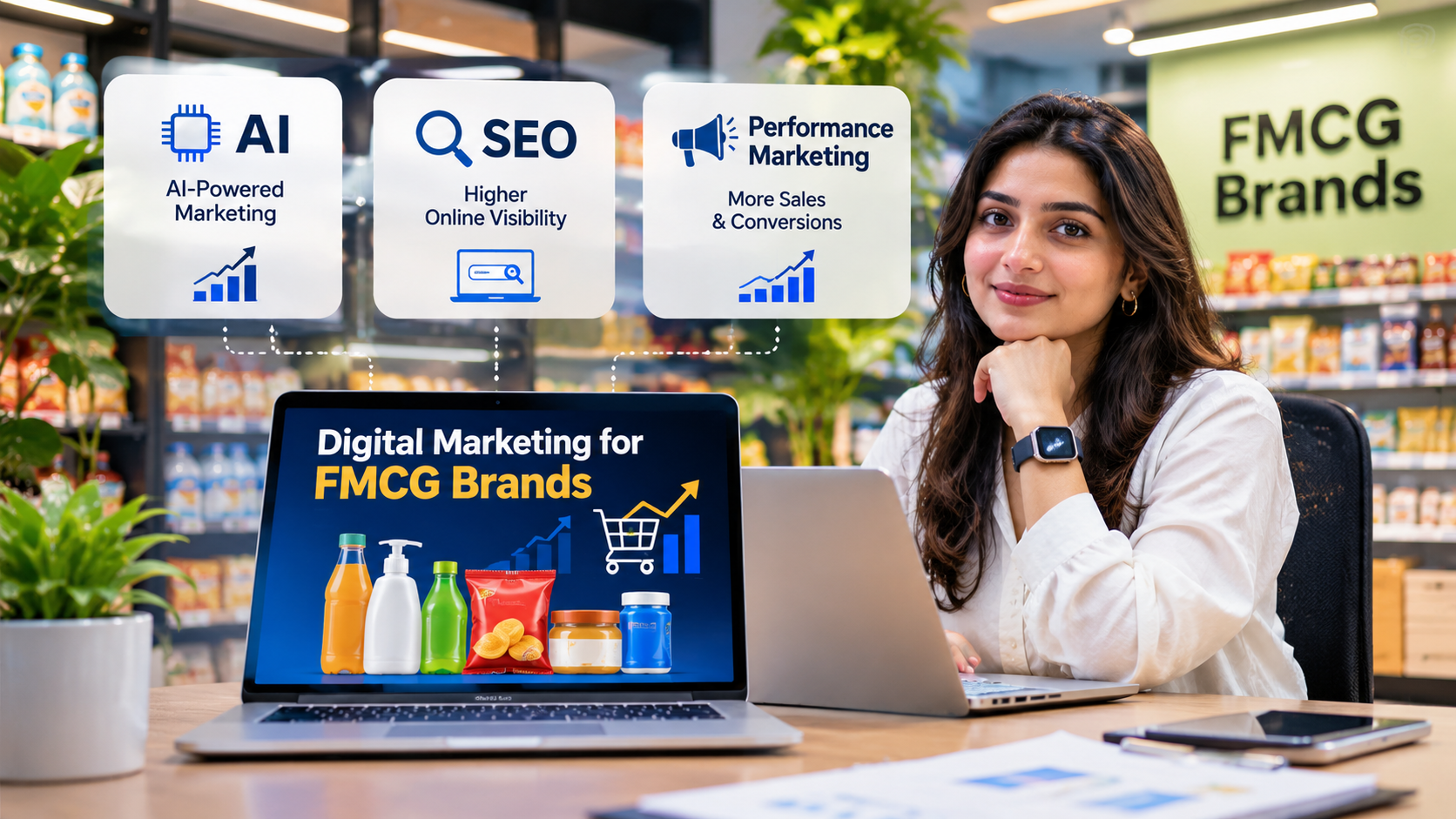
With changing customer behaviour and increasing online competition, traditional marketing alone may not be enough to reach every potential customer. FMCG brands need digital marketing strategies that help them connect with consumers, communicate product benefits and encourage purchases.
Artificial Intelligence (AI), Search Engine Optimisation (SEO) and performance marketing are important parts of modern digital marketing. These approaches can help businesses understand customer interests, improve online visibility, manage advertising campaigns and measure marketing performance.
Effective Digital Marketing Strategies for FMCG Brands combine useful content, audience understanding, relevant advertising and consistent performance analysis.
In this blog, we will explore how FMCG businesses can use AI, SEO and performance marketing to attract customers and increase sales.
1. Understanding Digital Marketing for FMCG Brands
Digital marketing helps FMCG brands promote products and communicate with customers through online channels.
Unlike some other industries, FMCG businesses often need to reach a large audience while also encouraging repeat purchases. Their marketing activities should communicate product benefits clearly and make it easy for customers to discover relevant products.
Important digital marketing activities include:
-
Search engine optimisation
-
Social media marketing
-
Content marketing
-
Paid advertising
-
Email marketing
-
Customer engagement
-
Performance tracking
For example, a packaged food brand can publish useful content about its product range, improve its website pages for relevant searches and run targeted advertising campaigns to attract potential customers.
The objective is to create a consistent customer journey, from discovering a product to considering and purchasing it.
Businesses looking to strengthen their digital marketing knowledge can explore the Upskill Now website for relevant learning opportunities.
2. How AI Can Improve FMCG Marketing Strategies
Artificial Intelligence can help FMCG businesses organise marketing activities, analyse available data and create relevant customer communication.
AI in FMCG Marketing can support different tasks, including content creation, customer analysis, campaign planning and marketing automation.
AI-Powered Customer Analysis
Understanding customers is important for FMCG brands because different audiences may have different product preferences.
AI can help businesses analyse available customer information and identify patterns related to:
-
Product interests
-
Purchase behaviour
-
Customer feedback
-
Frequently viewed products
-
Campaign engagement
-
Shopping preferences
For example, a personal care brand may analyse customer feedback to understand which product features receive the most attention.
These insights can help the marketing team improve product communication and plan more relevant campaigns.
AI for Marketing Content Creation
FMCG brands regularly need content for product launches, promotional campaigns, social media and websites.
AI writing tools can help prepare:
-
Product descriptions
-
Social media captions
-
Advertising copy drafts
-
Blog outlines
-
Email campaign content
-
Promotional messages
-
Frequently asked questions
For example, a beverage brand launching a new product can use AI to prepare different social media caption ideas highlighting its verified product features.
All AI-generated content should be reviewed to ensure that product information and advertising claims are accurate.
AI for Personalised Marketing
Customers may be interested in different product categories, offers and information.
AI can help businesses organise available customer preferences and develop more relevant marketing messages.
For example, a household products business may create different campaigns for customers interested in cleaning products and customers interested in personal care products.
Personalisation should be based on appropriate data and should respect customer privacy.
AI Chatbots for Customer Engagement
FMCG customers may have questions about product availability, ingredients, packaging, usage instructions and order information.
AI-powered chatbots can help answer common questions and direct customers to relevant product information.
Businesses can use chatbots to:
-
Answer frequently asked questions
-
Share product details
-
Guide visitors through product categories
-
Collect customer enquiries
-
Provide basic order assistance
Accurate information and access to human support are important when chatbot responses cannot resolve a customer's query.
3. FMCG SEO Strategies to Improve Website Visibility
Search Engine Optimisation helps FMCG brands improve their visibility when customers search for products or related information online.
FMCG SEO Strategies focus on improving website content, product pages, keyword relevance and technical website performance.
Keyword Research for FMCG Products
Keyword research helps brands understand the words and phrases customers use when searching for products.
FMCG businesses can research keywords related to:
-
Product categories
-
Product ingredients
-
Product features
-
Packaging sizes
-
Product uses
-
Customer questions
-
Product comparisons
For example, a packaged food company can identify relevant searches related to its product category and create website content that answers common customer questions.
Choose keywords that match the actual products and information available on the website.
Optimising Product Pages
Product pages should provide clear and useful information to customers and search engines.
Important optimisation activities include:
-
Writing descriptive product titles
-
Creating original product descriptions
-
Using relevant keywords naturally
-
Adding clear product images
-
Writing useful image alt text
-
Organising content with proper headings
-
Providing accurate product information
For example, a personal care product page should clearly explain its verified ingredients, packaging details, intended use and other relevant product information.
Avoid repeating keywords unnecessarily or making unsupported product claims.
Creating Helpful FMCG Blog Content
Blog content can help brands answer customer questions and attract relevant website visitors.
Useful content topics may include:
-
How to Choose Suitable Household Products
-
Understanding Food Product Labels
-
Tips for Selecting Personal Care Products
-
How to Store Packaged Products
-
Understanding Different Product Categories
AI can help prepare blog outlines and content drafts, while human review ensures that the information remains accurate and useful.
Technical SEO for FMCG Websites
A website should be easy to access, navigate and use.
Important technical SEO activities include:
-
Improving website loading speed
-
Making pages mobile-friendly
-
Fixing broken links
-
Organising website navigation
-
Creating a logical URL structure
-
Using appropriate page titles and meta descriptions
-
Improving internal linking
A well-organised website makes it easier for customers to discover products and find relevant information.
4. FMCG Performance Marketing to Increase Sales
Performance marketing focuses on measurable marketing activities and business outcomes. It helps FMCG brands understand how their advertising campaigns perform and where improvements may be needed.
FMCG Performance Marketing can include paid search campaigns, social media advertising, product promotions and retargeting activities.
Paid Advertising Campaigns
Paid advertising can help FMCG brands reach potential customers who are interested in relevant product categories.
Brands can create campaigns based on:
-
Product categories
-
Customer interests
-
Geographic locations
-
Campaign objectives
-
Relevant audience segments
-
Product promotions
For example, a packaged snacks brand launching a new product can run an advertising campaign to introduce the product to a relevant audience.
Campaign messaging should clearly communicate genuine product features and any applicable offer conditions.
Retargeting Potential Customers
Some customers visit a product page or interact with an advertisement without completing a purchase.
Retargeting campaigns can help businesses reconnect with eligible audiences who have previously interacted with their website or marketing content.
For example, a customer who viewed a household product page may later see a relevant advertisement reminding them about the product.
Retargeting should follow applicable advertising platform policies and customer privacy requirements.
Measuring Advertising Performance
FMCG businesses should regularly review campaign results to understand whether their advertising activities are meeting their objectives.
Important performance indicators include:
-
Impressions
-
Reach
-
Click-through rate
-
Cost per click
-
Cost per acquisition
-
Conversion rate
-
Return on advertising spend
For example, if an advertising campaign receives many clicks but generates few purchases, the business should review the product page, pricing information, customer experience and campaign relevance.
Optimising Marketing Budgets
Performance data can help businesses understand which campaigns and audience segments are producing useful results.
Marketing teams can compare campaign performance and adjust budgets based on their objectives.
Instead of increasing advertising expenditure without analysis, brands should review results regularly and make informed changes.
5. Social Media Marketing Strategies for FMCG Brands
Social media allows FMCG brands to showcase products, communicate with customers and build brand awareness.
A consistent social media strategy can support product discovery and customer engagement.
Create Product-Focused Content
Brands can publish content that explains product features and demonstrates how products fit into everyday activities.
Useful content formats include:
-
Product demonstrations
-
Product introduction videos
-
Educational posts
-
Packaging showcases
-
Customer questions and answers
-
Seasonal promotional content
Use Short-Form Videos
Short videos can help businesses present product information in an engaging format.
For example, a household cleaning products brand can create a short video demonstrating the correct use of a product, using accurate instructions.
Encourage Customer Engagement
Brands can encourage customers to interact through questions, feedback and product-related discussions.
Customer comments and questions can also provide useful information for future marketing content.
6. How FMCG Brands Can Combine AI, SEO and Performance Marketing
AI, SEO and performance marketing work best when they support a common business objective.
A connected strategy can help FMCG businesses improve customer discovery, attract relevant website visitors and measure campaign outcomes.
Consider the following practical approach:
Step 1: Research Customer Interests
Use available customer feedback, website information and marketing data to understand product interests and common questions.
Step 2: Create Useful Content
Prepare product descriptions, educational articles and social media content based on customer needs.
AI can assist with content planning and initial drafts.
Step 3: Improve Website SEO
Optimise product pages and publish relevant content using suitable keywords and clear website navigation.
Step 4: Run Performance Marketing Campaigns
Promote relevant products through suitable advertising campaigns and define measurable objectives.
Step 5: Analyse Results
Review website traffic, customer engagement, advertising costs and conversions.
Use the findings to improve future content and campaigns.
7. Common Digital Marketing Mistakes FMCG Brands Should Avoid
Even well-planned marketing campaigns may produce poor results if businesses overlook important details.
Using Unclear Product Information
Product descriptions and advertising messages should be accurate and easy to understand. Avoid unsupported claims.
Ignoring Mobile Users
Many customers browse products through mobile devices. Websites should be responsive and easy to navigate on smaller screens.
Focusing Only on Website Traffic
More visitors do not automatically mean more sales. Brands should also measure enquiries, purchases and other relevant business outcomes.
Publishing Repetitive Content
Repeated promotional messages may reduce audience interest. Use a balanced content plan that includes product information, education and customer-focused communication.
Not Reviewing Campaign Performance
Marketing campaigns should be monitored regularly. Businesses should identify what is working and make improvements based on actual results.
8. Developing Digital Marketing Skills for FMCG Businesses
FMCG marketing requires knowledge of SEO, content creation, advertising, analytics and customer engagement.
Marketing professionals can develop these skills through structured learning and practical projects.
A useful learning approach includes:
-
Understand digital marketing fundamentals.
-
Learn keyword research and on-page SEO.
-
Practise writing product descriptions and marketing content.
-
Study paid advertising and campaign planning.
-
Learn how to analyse marketing performance.
-
Practise using AI for content and marketing workflows.
-
Create sample campaigns for FMCG product categories.
At Upskill Now, learners can explore the Digital Marketing course to develop relevant knowledge of digital marketing and AI-assisted marketing activities. They can also review the available professional courses to explore other learning opportunities.
Conclusion
Digital marketing plays an important role in helping FMCG brands improve product visibility, connect with customers and increase sales.
AI can support customer analysis, content creation and marketing automation. SEO helps businesses improve their website visibility, while performance marketing makes it possible to measure advertising results and optimise campaigns.
The most effective Digital Marketing Strategies for FMCG Brands combine these approaches with accurate product information, useful content and regular performance analysis.
Businesses should begin with clear marketing objectives, understand their customers and improve their campaigns based on measurable results.
If you want to develop practical skills in SEO, AI and digital marketing, explore the learning opportunities at Upskill Now. Visit the Upskill Now About Us page to learn more, or contact the team for course-related information.
Frequently Asked Questions (FAQs)
1. What are the best digital marketing strategies for FMCG brands?
Important strategies include SEO, AI-assisted marketing, social media marketing, paid advertising, content creation and performance analysis. Businesses should select strategies according to their products and marketing objectives.
2. How can AI help FMCG brands increase sales?
AI can help analyse available customer data, prepare marketing content, organise customer communication and identify campaign performance patterns. These activities can support better marketing decisions.
3. Why is SEO important for FMCG companies?
SEO helps FMCG companies improve website visibility when customers search for relevant products and information. Optimised product pages and useful content can help attract relevant organic visitors.
4. What is performance marketing in the FMCG industry?
Performance marketing involves running measurable advertising campaigns and evaluating results such as clicks, conversions, acquisition costs and return on advertising spend.
5. How can small FMCG businesses start digital marketing?
Small FMCG businesses can begin by creating a clear website, optimising product pages, publishing useful social media content and testing focused advertising campaigns. They should monitor results and improve their strategy gradually.
Contact Upskill Now
-
Address: A-3, Third Floor, Rajouri Garden, New Delhi – 110027, India
-
Contact Number: +91 99998 48160
-
Alternate Number: +91 97114 48765