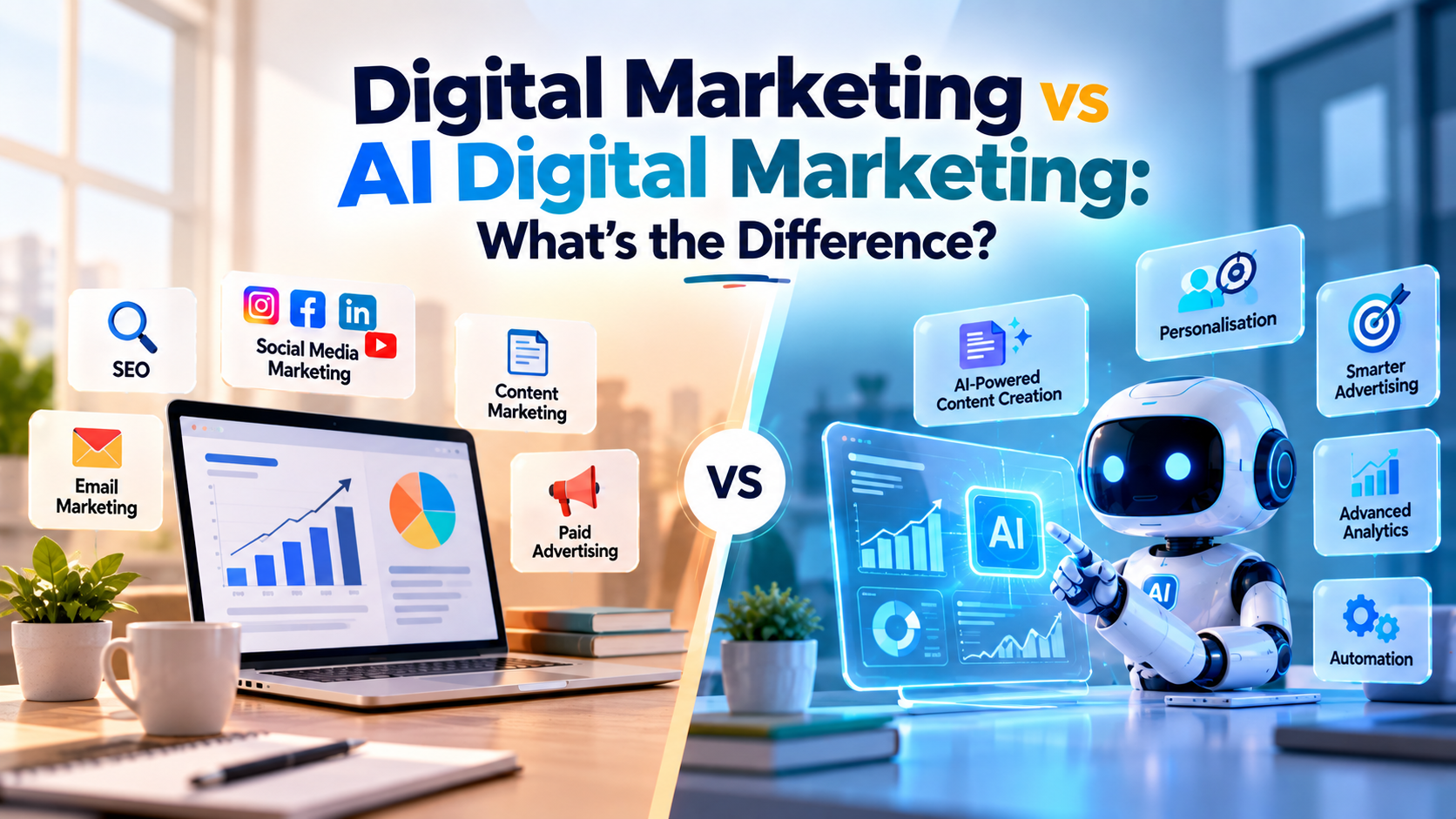
Digital Marketing vs AI Digital Marketing: What's the Difference?
Digital marketing has become an essential part of how businesses attract customers, build brand awareness, and generate leads online. From search engines and social media to email campaigns and paid advertising, digital channels allow businesses to reach specific audiences and measure their marketing activities.
However, the way digital marketing is being planned and executed is changing rapidly with the introduction of artificial intelligence. AI can assist marketers with content creation, customer analysis, SEO research, personalisation, campaign optimisation, reporting, and repetitive marketing tasks.
This has created an important question for students, professionals, and businesses: what is the difference between traditional digital marketing and AI-powered digital marketing?
Understanding this difference can help you identify which skills are important today and how AI can be incorporated into existing marketing strategies.
What Is Digital Marketing?
Digital marketing refers to promoting products, services, or brands through online channels. It includes activities such as search engine optimisation, social media marketing, content marketing, email marketing, paid advertising, and website optimisation.
A digital marketer normally studies the target audience, develops a marketing strategy, creates campaigns, publishes content, manages advertising platforms, and analyses campaign performance.
The goal is not simply to generate online visibility. Effective digital marketing connects the right audience with relevant content, products, or services and guides potential customers through the buying journey.
What Is AI in Digital Marketing?
AI in digital marketing means using artificial intelligence technologies to support different stages of the marketing process. Instead of relying entirely on manual research, content creation, analysis, and optimisation, marketers can use AI-powered tools to process information and assist with marketing decisions.
AI can help marketers generate content ideas, analyse customer behaviour, identify patterns in campaign data, personalise communication, create multiple versions of advertisements, and automate repetitive activities.
For example, a marketer could use AI to create several variations of an advertising message, analyse which audience segments are interacting with a campaign, or turn a long-form article into multiple social media posts.
An important point is that AI does not automatically replace digital marketing strategy. Human marketers still need to define objectives, understand customers, maintain brand identity, review information, and decide which recommendations should actually be implemented.
Digital Marketing vs AI Digital Marketing
The biggest difference between digital marketing and AI digital marketing is the role technology plays in the workflow.
Traditional digital marketing relies more heavily on manual research, planning, content development, campaign management, and performance analysis. AI digital marketing adds intelligent tools to these processes to help marketers work with larger amounts of information and complete certain tasks more efficiently.
In simple terms, digital marketing defines the marketing activities, while AI can provide additional intelligence, automation, and assistance within those activities.
1. Content Creation
Content marketing is an important part of digital marketing. Traditionally, marketers research a topic, create an outline, write content, edit it, prepare visuals, and publish it across different channels.
With AI digital marketing, AI tools can assist with brainstorming, outlines, content variations, captions, email drafts, product descriptions, and other forms of marketing content.
This does not mean that marketers should publish every AI-generated output without review. Human editing remains important for accuracy, originality, brand voice, relevance, and quality.
For marketers who want to develop practical skills in this area, an AI digital marketing course can provide a structured way to understand how AI tools fit into content and marketing workflows.
2. SEO and Search Marketing
Search engine optimisation has traditionally required marketers to conduct keyword research, analyse competitors, understand search intent, optimise website pages, and monitor search performance.
AI can assist with several of these activities by identifying content ideas, organising keywords, analysing large amounts of information, suggesting content structures, and helping marketers discover potential optimisation opportunities.
However, SEO still requires human understanding. Search intent, audience expectations, website quality, topical expertise, and the usefulness of content cannot be reduced to a single automated recommendation.
3. Audience Research and Customer Understanding
Understanding the target audience is fundamental to digital marketing. Marketers traditionally analyse customer surveys, website behaviour, campaign reports, social media interactions, and other sources of information.
AI can process large amounts of customer and campaign data and help identify patterns or audience segments. This can make it easier for marketers to understand different customer groups and create more relevant marketing messages.
For example, a business could identify differences between first-time visitors, returning customers, high-engagement users, and customers who have stopped interacting with its campaigns.
4. Personalisation
Traditional digital marketing often creates campaigns for broad audience segments. AI digital marketing can take personalisation further by using available customer information and behavioural signals to support more relevant communication.
Personalisation can be applied to emails, website experiences, product recommendations, advertising messages, and customer journeys.
The objective is to make communication more relevant rather than simply increasing the number of messages being sent.
5. Digital Advertising
Paid advertising requires marketers to select audiences, create advertisements, establish budgets, monitor performance, and make optimisation decisions.
Modern advertising platforms increasingly incorporate AI and machine learning features that can assist with audience targeting, bidding, creative testing, and campaign optimisation.
Instead of manually adjusting every campaign element, marketers can increasingly focus on setting clear objectives, supplying appropriate creative assets, reviewing performance, and making strategic decisions.
6. Social Media Marketing
Traditional social media marketing involves researching topics, creating posts, preparing captions, scheduling content, responding to audiences, and measuring engagement.
AI can support these activities by generating content ideas, adapting content for different platforms, identifying patterns in engagement data, and helping marketers repurpose existing content.
However, social media still depends heavily on human creativity, cultural understanding, communication, and community interaction. AI can assist with production, but authentic brand communication requires human direction.
7. Email Marketing
Email marketing traditionally involves creating subject lines, writing email content, organising subscriber lists, scheduling campaigns, and analysing open rates, clicks, and conversions.
AI can assist marketers with generating subject-line variations, creating personalised messages, analysing engagement patterns, and identifying opportunities for audience segmentation.
This allows marketing teams to experiment with more variations while spending less time on repetitive tasks.
8. Marketing Analytics
Analytics is one of the areas where the difference between traditional and AI-assisted marketing can become particularly noticeable.
Traditional digital marketing requires marketers to review dashboards, reports, conversion data, traffic sources, campaign performance, and other metrics manually.
AI can help identify patterns, highlight unusual changes, summarise performance information, and support predictive analysis. This can help marketers spend more time interpreting results and deciding what action to take.
Key Skills for AI Digital Marketing
AI is changing the tools marketers use, but it does not eliminate the need for fundamental digital marketing knowledge. In fact, understanding the basics becomes even more important because marketers need to know whether an AI-generated recommendation makes sense.
Important skills include SEO, content marketing, social media marketing, paid advertising, analytics, email marketing, audience research, and marketing strategy.
Alongside these fundamentals, marketers can develop skills such as prompt writing, AI-assisted content creation, AI-powered research, data interpretation, workflow automation, and AI-supported campaign optimisation.
Learning these areas together creates a more practical AI-powered digital marketing skill set rather than treating AI as a separate technology.
Does AI Digital Marketing Replace Digital Marketing?
No. AI digital marketing is better understood as an evolution of digital marketing rather than a completely separate field.
The core principles of marketing remain important: understanding customers, creating valuable offers, communicating clearly, building trust, selecting suitable channels, and measuring business results.
AI adds another layer to these activities. It can help marketers analyse information, automate repetitive work, create variations, and identify potential opportunities faster.
The marketer remains responsible for deciding what the brand should communicate, who it should communicate with, why the message matters, and whether the final output meets the required standards.
Which Approach Should Beginners Learn?
Beginners should first understand the fundamentals of digital marketing before relying heavily on AI tools.
Learning SEO without understanding search intent, or using AI content tools without knowing what makes useful content, can lead to ineffective marketing. Similarly, using AI advertising features without understanding audiences, budgets, conversions, and campaign objectives can make it difficult to evaluate results.
A practical learning path should therefore combine digital marketing fundamentals with AI applications.
Once the basics are clear, learners can experiment with AI for research, content, SEO, advertising, social media, analytics, and automation. This approach makes AI a useful part of the marketing workflow instead of treating it as a shortcut for learning marketing.
Benefits of Combining Digital Marketing with AI
Combining digital marketing knowledge with AI tools can provide several practical advantages.
First, AI can reduce the time required for repetitive activities. Marketers can use that additional time for strategy, creative thinking, customer research, and campaign planning.
Second, AI can help marketers work with larger amounts of information. Instead of manually reviewing every data point, marketers can use AI-assisted analysis to identify patterns that deserve closer attention.
Third, AI can make experimentation easier. Marketers can create multiple versions of content, advertisements, subject lines, and messages and then evaluate their performance.
Finally, AI can support personalisation at a scale that would be difficult to manage manually.
Challenges of AI Digital Marketing
AI also introduces challenges that marketers need to understand.
AI-generated content may contain inaccurate or unsuitable information, while generic outputs can make different brands sound similar. AI systems can also produce recommendations based on incomplete or poor-quality information.
Data privacy is another important consideration when marketing systems use customer information. Businesses need to understand how data is collected, stored, processed, and used.
Over-automation can also become a problem. Marketing decisions should not be handed over to technology without appropriate human review, especially when those decisions affect customers, brand reputation, or business spending.
How Digital Marketers Can Prepare for the AI Era
Digital marketers do not need to learn every AI tool available. A better approach is to understand the marketing problem first and then identify where AI can provide useful support.
Start by strengthening core digital marketing knowledge. Then learn how AI can be applied to specific areas such as SEO, content creation, paid advertising, analytics, email marketing, and social media.
Practical experimentation is also important. Instead of simply learning what an AI tool can do, marketers should use it to complete real marketing tasks and evaluate the quality of the results.
The combination of marketing strategy, analytical thinking, creativity, and AI literacy can help professionals adapt as marketing technology continues to evolve.
Digital Marketing vs AI Digital Marketing: A Simple Summary
Digital marketing focuses on using online channels to reach, engage, and convert customers. AI digital marketing uses artificial intelligence to enhance many of those activities through automation, data analysis, content assistance, personalisation, and optimisation.
The difference is therefore not about choosing digital marketing or AI digital marketing as completely separate options. AI is becoming part of the digital marketing toolkit, while the underlying principles of marketing continue to guide how those tools are used.
For students and professionals, the practical opportunity is to learn both: understand how digital marketing works and then learn how AI can make specific marketing workflows more efficient and data-driven.
Conclusion
Digital marketing and AI digital marketing are closely connected. Traditional digital marketing provides the strategy, channels, audience understanding, and marketing fundamentals, while AI adds capabilities that can support research, content creation, personalisation, analytics, automation, SEO, advertising, and campaign optimisation.
The future of digital marketing is not simply about using more AI tools. It is about knowing where AI can add value while maintaining human creativity, strategic thinking, quality control, and customer understanding.
For anyone planning a career in marketing, developing strong digital marketing fundamentals alongside practical AI skills can create a more adaptable approach to the changing marketing landscape.
Contact Upskill Now
A-3, Third Floor, Rajouri Garden, New Delhi – 110027
Phone: 9999848160 | 9711448765
Email: connect@upskillnow.in