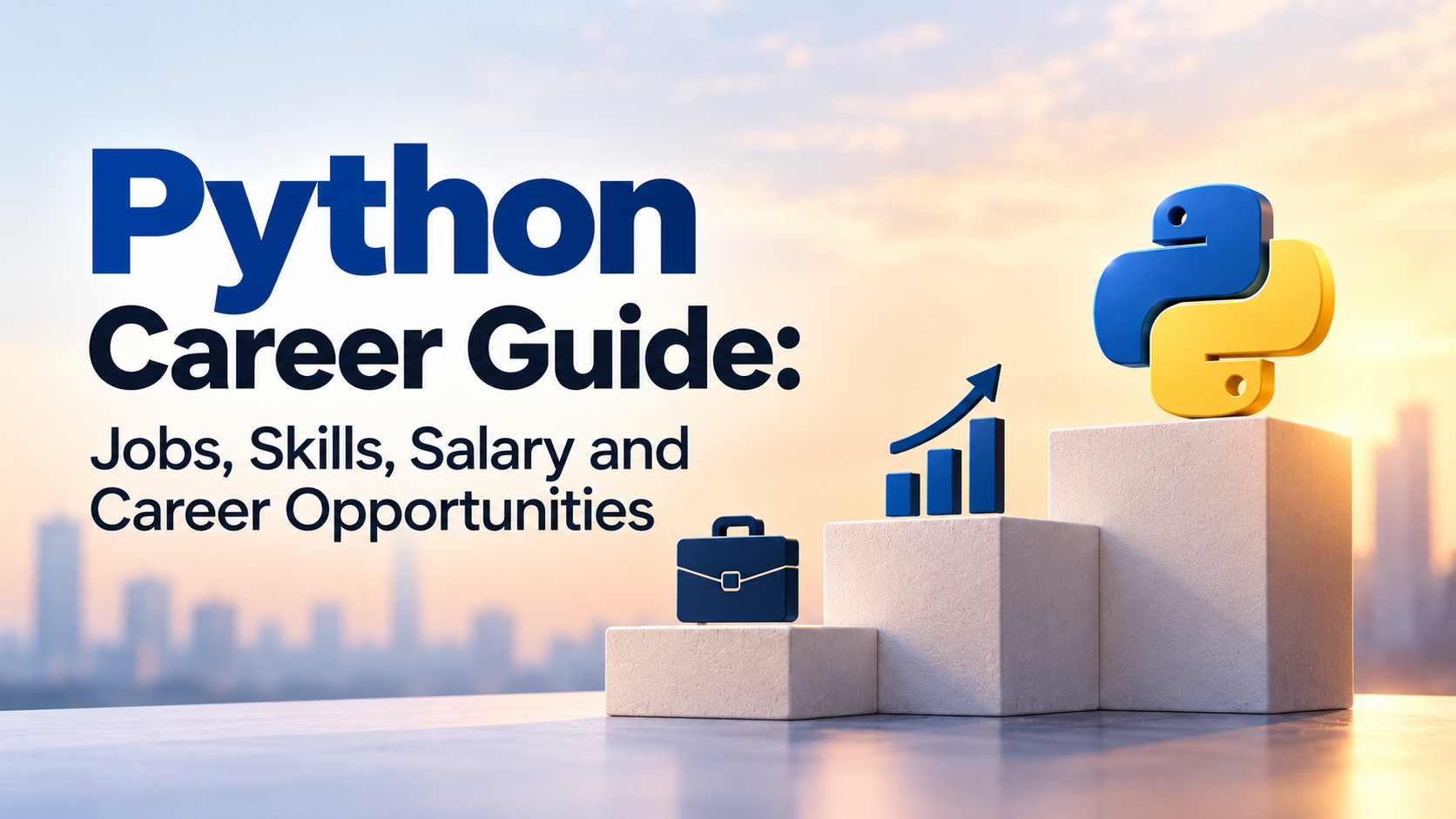
Python Career Guide: Jobs, Skills, Salary and Career Opportunities
Python has become one of the most useful programming languages for students and professionals because it can be applied across software development, automation, data analytics, artificial intelligence, machine learning, backend development, testing, and technical applications. This wide range of applications creates several possible Python career paths, but learning Python syntax alone is not enough to qualify for most technical roles.
A practical Python career plan should answer four questions: which role you want to target, which skills that role actually requires, which projects can demonstrate those skills, and what you should learn after Python fundamentals.
This guide explains Python career opportunities, common job roles, required skills, salary considerations, project expectations, career paths, and a practical roadmap for students and beginners planning to build a career with Python.
Why Choose Python for a Career?
Python is used across several areas of technology, which means learning the language does not force you into one career path.
- Software development
- Backend development
- Data analytics
- Data science
- Artificial intelligence
- Machine learning
- Automation
- Testing
- Scientific computing
- Technical scripting
This flexibility is particularly useful for students who have not yet decided on a specialization. A strong Python foundation can be extended in different directions once the learner understands which type of work they enjoy.
Python Career Opportunities at a Glance
| Career Path | Python Role | Important Additional Skills |
|---|---|---|
| Software Development | Build applications and software systems | OOP, databases, Git, testing, APIs |
| Backend Development | Build APIs and server-side applications | Django or Flask, SQL, REST APIs, deployment |
| Data Analytics | Analyse and transform data | SQL, statistics, pandas, visualization |
| Data Science | Analyse data and build predictive models | Statistics, machine learning, visualization |
| AI and ML | Develop and integrate intelligent systems | Machine learning, deep learning, model evaluation |
| Automation | Automate repetitive processes | APIs, scripting, file handling, task automation |
| Testing | Automate software testing | Testing frameworks, APIs, debugging, CI/CD |
Python Developer
A Python Developer uses Python to build applications, scripts, backend systems, automation tools, APIs, and other software components.
The title can cover different types of work depending on the company. One Python Developer may work primarily with backend APIs, while another may work on automation or internal business applications.
Skills to Develop
- Python fundamentals
- Functions and modules
- Object-oriented programming
- Data structures
- Exception handling
- File handling
- Databases and SQL
- Git and GitHub
- APIs
- Testing
For a beginner, this is often one of the broadest Python career paths because the same programming foundation can later lead toward backend development, automation, or other specializations.
Python Career Foundation: What Beginners Should Learn First
Before choosing an advanced specialization, beginners should develop a reliable Python foundation. This means learning how variables, data types, operators, conditions, loops, collections, functions, files, exceptions, and object-oriented programming work together.
A structured Python programming course can be useful at this stage because beginners often know individual concepts but are unsure how to connect them into complete applications.
Projects are particularly important. A Student Management System, Expense Tracker, Library Management System, Employee Database application, or Weather Information application can demonstrate whether a learner can apply programming concepts rather than simply reproduce examples from a tutorial.
Python Backend Developer
Backend developers work on the server-side part of applications. Their responsibilities can include building APIs, processing requests, interacting with databases, implementing authentication, validating data, and connecting different parts of an application.
Python is used for backend development through frameworks and tools such as Django and Flask.
Skills for Python Backend Development
- Python programming
- Object-oriented programming
- REST APIs
- SQL and databases
- Authentication and authorization
- Web frameworks
- Git and GitHub
- Testing
- Deployment fundamentals
A useful backend project might include user registration, authentication, database operations, API endpoints, validation, and error handling rather than simply displaying a static webpage.
Python Data Analyst
A Data Analyst uses data to answer questions and support decisions. Python is one tool within a larger analytical toolkit.
Data analysts may work with spreadsheets, SQL databases, dashboards, statistical techniques, and Python libraries.
Important Skills
- Python
- SQL
- Excel or spreadsheet tools
- Statistics
- Data cleaning
- Data visualization
- Pandas and NumPy
- Business understanding
One important distinction is that becoming a Data Analyst does not require immediately learning advanced machine learning. If the job involves understanding sales trends, customer behaviour, operational performance, or business metrics, strong analytical and communication skills can be more important than complex predictive models.
Python Data Scientist
A Data Scientist generally works with data to identify patterns, develop analytical models, and support prediction or decision-making.
Compared with an entry-level analytics role, the skill requirements can extend further into statistics and machine learning.
Skills to Build
- Python
- Statistics
- Probability
- Data cleaning
- Exploratory data analysis
- Data visualization
- Machine learning
- Model evaluation
- SQL
Strong data science work requires more than achieving a high model score. You should be able to explain the dataset, assumptions, preprocessing decisions, evaluation method, and limitations of the result.
Python Machine Learning Engineer
A Machine Learning Engineer combines machine learning knowledge with software engineering practices. The role can involve training models, preparing data pipelines, integrating models into applications, monitoring systems, and improving production performance.
This makes the role different from simply completing machine learning notebooks.
Important Skills
- Python
- Machine learning algorithms
- Data preprocessing
- Model evaluation
- Software engineering
- APIs
- Databases
- Version control
- Deployment
- Cloud and infrastructure concepts
If your goal is machine learning engineering, spending time on software development fundamentals is just as important as learning machine learning algorithms.
Python AI Developer
AI development is a broad field that can include machine learning, natural language processing, computer vision, recommendation systems, intelligent automation, and generative AI applications.
Python is widely used because it provides access to a large ecosystem of AI and machine learning tools.
However, “AI Developer” should not be treated as a shortcut career title. A strong AI developer still needs programming fundamentals, data handling, model understanding, evaluation, debugging, and application development skills.
Python Automation Engineer
Automation is one of the most practical uses of Python. Companies can use scripts and applications to reduce repetitive manual tasks and improve consistency.
Automation projects can involve:
- File management
- Report generation
- Data processing
- API interactions
- Scheduled tasks
- Testing workflows
- Spreadsheet processing
- System administration tasks
A beginner can start with a small File Organizer or report-generation script and gradually build more complex automation workflows.
Python Testing and QA Automation
Python can also be used for software testing and test automation.
Test automation involves writing programs that check whether software behaves as expected. This can reduce repetitive manual testing and make it easier to run tests whenever an application changes.
Skills to Learn
- Python
- Testing concepts
- Unit testing
- API testing
- Automation frameworks
- Debugging
- Git
- Continuous integration concepts
This can be a useful path for students who enjoy finding problems and thinking about how software can fail under different conditions.
Python Career Paths Compared
| Path | Python Importance | Main Additional Focus | Best Fit For |
|---|---|---|---|
| Python Developer | High | Software development | Application builders |
| Backend Developer | High | APIs, databases, frameworks | Web application development |
| Data Analyst | High | SQL, statistics, visualization | People interested in insights and business data |
| Data Scientist | High | Statistics and machine learning | Analytical and quantitative work |
| ML Engineer | High | ML plus software engineering | Production machine learning |
| Automation Engineer | High | Scripting and integrations | Process automation |
| QA Automation | High | Testing and automation | Software quality and testing |
What Skills Do You Need for a Python Career?
A career-ready Python skill set should contain more than language syntax.
1. Python Fundamentals
Learn variables, data types, operators, conditions, loops, collections, functions, modules, files, and exceptions.
2. Object-Oriented Programming
Understand classes, objects, inheritance, polymorphism, encapsulation, and when object-oriented design is actually useful.
3. Data Structures and Problem Solving
Learn how to select appropriate data structures and break a larger problem into smaller steps.
4. Databases
Learn SQL and understand how applications store, retrieve, update, and manage persistent data.
5. APIs
Understand how applications communicate with external services and how to work with structured responses.
6. Git and GitHub
Version control is an important part of collaborative software development and project management.
7. Testing and Debugging
Learn how to identify errors, reproduce problems, test expected behaviour, and improve code reliability.
8. Communication
Technical professionals need to explain their decisions, document projects, understand requirements, and communicate problems clearly.
Python Skills by Career Goal
| Skill | Developer | Data Analyst | Data Scientist | ML Engineer |
|---|---|---|---|---|
| Core Python | Essential | Essential | Essential | Essential |
| SQL | Important | Very important | Important | Important |
| Statistics | Basic to moderate | Important | Very important | Important |
| Machine Learning | Role dependent | Optional | Very important | Very important |
| APIs | Important | Useful | Useful | Important |
| Git | Essential | Useful | Important | Essential |
Python Projects That Can Strengthen Your Career Profile
Projects provide evidence that you can apply programming knowledge. The best projects should match the role you are targeting.
For Python Developer Roles
- Student Management System
- Library Management System
- Employee Database Management System
- Expense Tracker
For Data Analytics Roles
- Sales Data Analysis
- Customer Behaviour Analysis
- Student Performance Analysis
- Business Dashboard Data Analysis
For Machine Learning Roles
- House Price Prediction
- Customer Churn Prediction
- Customer Segmentation
- Recommendation System
For Automation Roles
- Automated File Organizer
- Report Generator
- Spreadsheet Automation
- API Data Collection Tool
When building projects, avoid stopping at the first working version. Add validation, error handling, persistent storage, documentation, and meaningful improvements. These additions make it easier to demonstrate that you understand the development process rather than simply following a tutorial.
How Upskill Now Can Fit into a Python Career Roadmap
Upskill Now's current Python program is structured around a progression from Python fundamentals and programming logic to data structures, object-oriented programming, file handling, exception management, databases, automation, APIs, and practical projects.
This foundation is relevant because students often try to specialize too early. Someone interested in AI, for example, still needs to understand Python programming, functions, data structures, debugging, and data handling before advanced machine learning becomes useful.
The program includes practical projects such as Student Management System, Expense Tracker, Library Management System, Employee Database Management, Python Calculator, Automated File Organiser, Weather Information Application, and a final capstone. These projects can help learners practise different levels of application development before choosing a more specialized direction.
Python Career Roadmap for Beginners
A practical roadmap can be divided into stages rather than trying to learn everything at once.
| Stage | What to Learn | Checkpoint |
|---|---|---|
| 1 | Python fundamentals | Write small programs independently |
| 2 | Functions and data structures | Build programs with reusable logic |
| 3 | OOP, files and exceptions | Build structured applications |
| 4 | SQL, databases and APIs | Connect applications with external data |
| 5 | Projects and Git | Create a portfolio |
| 6 | Specialization | Prepare for a specific role |
How Long Does It Take to Become Job-Ready with Python?
There is no universal timeline because “job-ready” depends on the role, previous programming experience, practice time, and project complexity.
A beginner needs enough time to move beyond syntax and become comfortable solving problems independently. Someone targeting a Python Developer role will need a different preparation path from someone targeting data analytics or machine learning.
A practical way to measure progress is through capabilities rather than calendar time:
- Can you build a small application without following a tutorial?
- Can you debug common errors?
- Can you work with files or databases?
- Can you use an API?
- Can you explain your project architecture?
- Can you use Git to manage your work?
- Can you solve basic programming problems independently?
If you cannot yet do these things, spending more time building fundamentals may be more valuable than rushing toward advanced frameworks.
Python Career Salary: What Determines Earning Potential?
Python salaries vary substantially depending on experience, location, organization, specialization, responsibilities, and the wider skill set of the candidate. A programming language by itself does not determine salary.
For example, two people may both know Python but have very different profiles. One may know basic syntax and have completed small academic exercises. Another may have experience with backend development, databases, APIs, Git, testing, deployment, and production-oriented projects.
Similarly, a Python developer, data analyst, data scientist, and machine learning engineer may have different compensation structures because their responsibilities and required skills are different.
For this reason, beginners should focus less on a single salary number and more on building skills that qualify them for progressively more valuable responsibilities.
What Employers Look for in a Python Fresher
For entry-level candidates, employers may evaluate a combination of technical knowledge, practical work, problem-solving ability, and communication.
- Strong Python fundamentals
- Basic data structures and algorithms
- Object-oriented programming
- SQL and database knowledge
- Git and GitHub familiarity
- Relevant projects
- Debugging ability
- Understanding of APIs
- Clear communication
- Ability to explain project decisions
A candidate does not need to know every Python library. It is usually more useful to understand a smaller set of relevant tools deeply enough to build and explain working projects.
How to Make a Python Resume Stronger
Instead of listing “Python” as a standalone skill and leaving it at that, connect your skill to actual work.
For example, describe a project by explaining what you built, what technologies were used, what problem it solved, and what functionality you implemented.
A stronger project description can mention features such as database integration, CRUD operations, API integration, authentication, data processing, automation, or error handling when those features were genuinely implemented.
Should You Learn Python Before Choosing a Specialization?
For many students, yes. A basic Python foundation can help you discover which type of technical work you actually enjoy.
If you enjoy working with datasets and finding patterns, data analytics may be a good direction. If you enjoy building applications and APIs, backend development may be more suitable. If you enjoy repetitive task automation, scripting may be appealing. If you enjoy mathematical models and prediction, machine learning may be worth exploring.
The specialization should emerge from both your interests and the skills required by the role you want to pursue.
Common Python Career Mistakes
- Learning Python syntax without building projects
- Trying to learn every library at once
- Choosing a career path only because it is currently popular
- Ignoring SQL and databases
- Ignoring Git and version control
- Putting copied tutorial projects on a resume without understanding them
- Focusing only on certificates instead of demonstrable skills
- Trying to learn advanced AI before mastering programming fundamentals
- Using salary claims as the only measure of career potential
A better strategy is to build a foundation, choose a target role, identify the missing skills, and then build projects specifically designed to demonstrate those skills.
Which Python Career Path Should You Choose?
The best path depends on the type of work you want to perform.
| If You Enjoy | Consider |
|---|---|
| Building applications | Python Developer / Backend Developer |
| Working with numbers and business data | Data Analyst |
| Statistics and predictive models | Data Scientist |
| AI and intelligent applications | AI / ML Developer |
| Automating repetitive tasks | Automation Engineer |
| Finding software defects | QA Automation |
Conclusion
A Python career can lead to several different technology paths, including software development, backend development, data analytics, data science, artificial intelligence, machine learning, automation, and testing.
The important point is that Python is a foundation rather than a complete career plan. After learning the language, you need to add the skills required for your target role. A backend developer may need APIs, databases, frameworks, testing, and deployment. A data analyst may need SQL, statistics, visualization, and business analysis. A machine learning engineer may need machine learning, software engineering, deployment, and data pipelines.
If you are starting from the beginning, focus first on strong Python fundamentals and practical projects. Upskill Now's structured Python program can provide a foundation covering programming logic, data structures, object-oriented programming, file handling, exception management, databases, automation, APIs, and practical projects before you move into a specialized career direction.
The strongest Python career strategy is not to learn everything. It is to learn the right combination of skills for the role you want, build projects that demonstrate those skills, and continue developing beyond the language itself.
Contact Upskill Now
A-3, Third Floor, Rajouri Garden, New Delhi – 110027
Phone: 9999848160 | 9711448765
Email: connect@upskillnow.in