
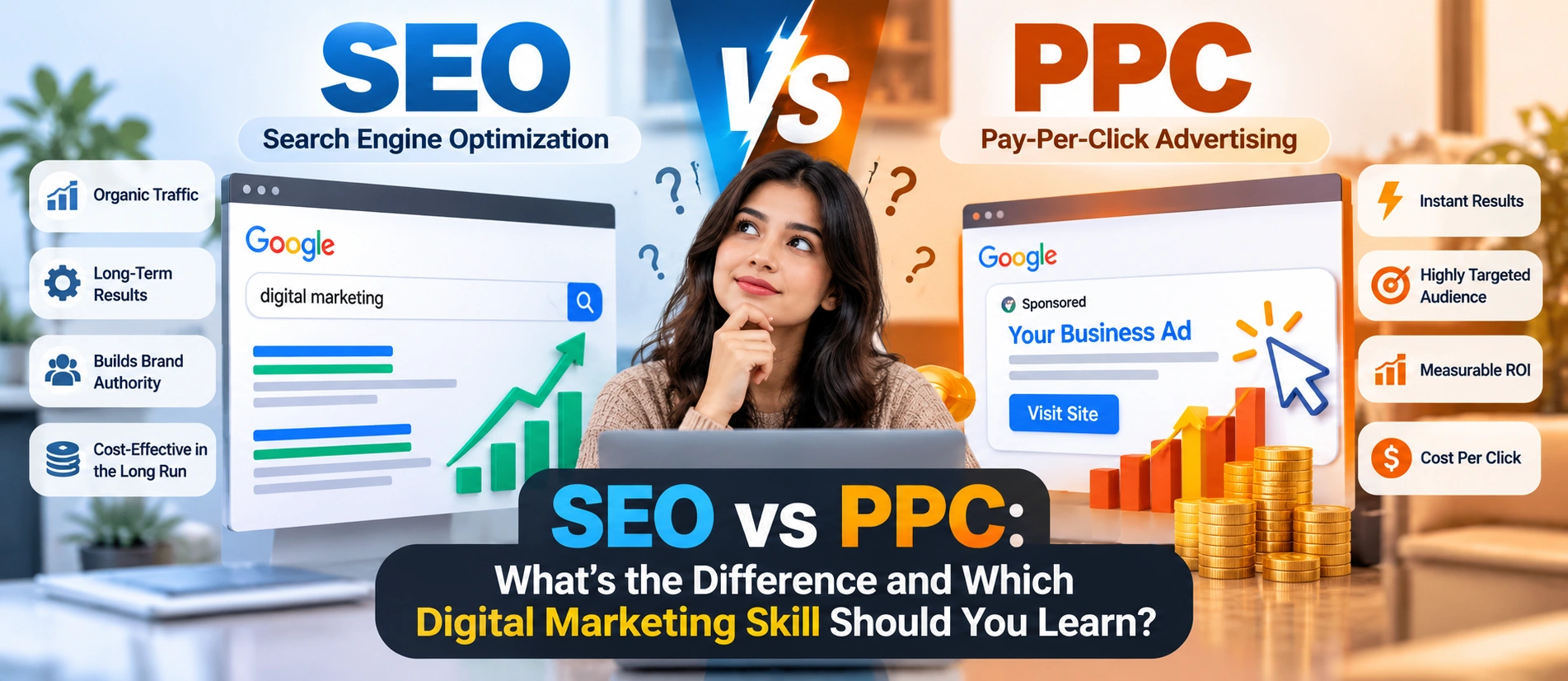
If you are planning to start a career in digital marketing, you may wonder: What is the difference between SEO and PPC? Should I learn SEO or PPC? Which skill has better career opportunities?
Both SEO and PPC can help businesses increase online visibility, generate traffic, and reach potential customers. However, they work in different ways and require different skill sets.
In this guide, we will explain SEO vs PPC, their differences, skills, benefits, career opportunities, and what beginners should consider when learning digital marketing.
What Is SEO?
SEO (Search Engine Optimization) is the process of improving a website so that it can appear more prominently in organic search engine results.
SEO focuses on attracting unpaid or organic traffic from search engines such as Google.
For example, if someone searches for:
“Best digital marketing courses in India”
websites that have optimized their content and SEO strategy may appear in the organic search results.
SEO generally involves:
-
Keyword research
-
Search intent analysis
-
On-page SEO
-
Technical SEO
-
Off-page SEO
-
Content optimization
-
Internal linking
-
Link building
-
Local SEO
-
Website performance
-
SEO analytics
The objective is to make a website more useful, relevant, accessible, and visible to search engines and users.
What Is PPC?
PPC (Pay-Per-Click) is a form of online advertising where advertisers typically pay when someone clicks on an advertisement.
PPC allows businesses to display advertisements on platforms such as search engines and social media networks.
For example, a company may create a Google Ads campaign targeting searches related to its products or services.
PPC marketing can involve:
-
Keyword targeting
-
Search advertising
-
Display advertising
-
Shopping campaigns
-
Video advertising
-
Social media advertising
-
Audience targeting
-
Ad copywriting
-
Conversion tracking
-
Campaign optimization
-
Budget management
The goal of PPC is generally to reach a specific audience and generate measurable actions such as website visits, leads, registrations, or purchases.
SEO vs PPC: Key Difference
The main difference between SEO and PPC is how traffic is acquired.
| SEO | PPC |
|---|---|
| Focuses on organic search visibility | Focuses on paid advertising |
| Traffic comes from organic rankings | Traffic comes from advertisements |
| Usually requires ongoing optimization | Requires advertising budget |
| Results can take time to develop | Campaigns can start generating traffic quickly |
| Focuses heavily on content and website optimization | Focuses heavily on campaigns and advertising |
| Organic visibility can continue after optimization | Traffic generally depends on active campaigns |
Both approaches can be part of the same digital marketing strategy.
SEO vs PPC: How Do They Work?
How SEO Works
SEO involves improving different parts of a website to make it more relevant and useful for search queries.
A typical SEO process includes:
Step 1: Keyword Research
Marketers identify keywords and search queries that are relevant to the business and its target audience.
Step 2: Search Intent
The marketer analyzes what users are trying to find when they search for a particular keyword.
Step 3: Content Optimization
Existing content may be improved or new content may be created to answer users' questions.
Step 4: Technical Optimization
Technical elements such as website structure, indexing, mobile usability, and page performance may be optimized.
Step 5: Authority Building
Businesses may work on earning relevant links, mentions, and other signals that support website authority.
Step 6: Measurement
SEO performance can be measured using organic traffic, rankings, conversions, engagement, and other relevant metrics.
How PPC Works
PPC follows a different process.
Step 1: Define the Campaign Goal
The marketer decides whether the campaign is intended to generate leads, sales, traffic, registrations, or another measurable action.
Step 2: Identify the Target Audience
The advertiser defines relevant keywords, audiences, locations, demographics, interests, or other targeting parameters depending on the platform.
Step 3: Create Advertisements
The marketer creates headlines, descriptions, images, videos, or other advertising assets.
Step 4: Set the Budget
The advertiser determines how much they are willing to spend.
Step 5: Launch the Campaign
The campaign is launched after targeting, creative assets, tracking, and settings are configured.
Step 6: Analyze and Optimize
Performance data is used to evaluate clicks, conversions, cost, and other campaign metrics and make adjustments.
SEO Skills You Should Learn
If you want to develop SEO skills, focus on the following areas.
1. Keyword Research
Learn how to identify relevant keywords based on search volume, competition, intent, and business relevance.
2. On-Page SEO
Understand:
-
Title tags
-
Meta descriptions
-
Headings
-
URLs
-
Internal links
-
Content structure
-
Image optimization
3. Technical SEO
Technical SEO may include:
-
Website crawling
-
Indexing
-
Site architecture
-
XML sitemaps
-
Robots.txt
-
Mobile usability
-
Page performance
-
Structured data
4. Content Optimization
Learn how to create useful, relevant, search-focused content that satisfies user intent.
5. Off-Page SEO
Understand link building, digital PR, brand mentions, and other methods of building website authority.
6. SEO Analytics
Learn how to analyze organic traffic, search performance, conversions, and other SEO metrics.
PPC Skills You Should Learn
PPC requires a different set of skills.
1. Keyword Research
PPC specialists need to identify relevant search terms and understand the commercial intent behind them.
2. Campaign Setup
You should understand campaign structures, ad groups, targeting, bidding, budgets, and conversion tracking.
3. Ad Copywriting
Creating clear and relevant advertising messages is an important PPC skill.
4. Audience Targeting
PPC professionals need to understand how to reach specific audiences using available targeting options.
5. Conversion Tracking
Tracking leads, sales, sign-ups, and other desired actions helps marketers measure campaign performance.
6. Campaign Optimization
PPC specialists analyze campaign data and adjust targeting, bids, budgets, keywords, and advertisements.
7. Data Analysis
Understanding metrics such as clicks, impressions, CTR, conversion rate, cost per conversion, and return on advertising spend can help with campaign optimization.
Benefits of Learning SEO
Learning SEO can provide several advantages for digital marketing professionals.
Long-Term Organic Visibility
SEO focuses on building organic search visibility over time.
Content Marketing Skills
SEO teaches you how to understand search intent and create content for specific audiences.
Website Optimization
SEO provides knowledge about websites, technical optimization, content structure, and user experience.
Freelancing Opportunities
SEO is a service that can be offered to businesses, agencies, and individual clients.
Useful Across Industries
Almost every industry with an online presence can potentially benefit from search optimization.
Benefits of Learning PPC
PPC also provides valuable digital marketing skills.
Faster Campaign Launch
Paid campaigns can begin delivering traffic after they are launched and approved.
Precise Targeting
Advertising platforms offer various targeting capabilities depending on the campaign type.
Measurable Results
PPC campaigns can be tracked using metrics such as clicks, conversions, costs, and revenue.
Performance Marketing Skills
PPC provides a strong foundation for understanding paid acquisition and campaign performance.
Business-Focused Marketing
PPC can be directly connected to measurable business objectives such as leads, sales, and registrations.
SEO vs PPC: Which Skills Are More Important?
Instead of treating SEO and PPC as competing skills, digital marketers can learn how the two approaches complement each other.
SEO can help build organic visibility, while PPC can help businesses reach audiences through paid advertising.
A digital marketing professional who understands both can develop a broader understanding of:
-
Search behavior
-
Keywords
-
Content
-
Advertising
-
Analytics
-
Conversion optimization
-
Customer acquisition
-
Marketing strategy
For beginners, the right starting point depends on their interests and career goals.
which skill are most important
SEO vs PPC for Beginners
If you enjoy content, research, websites, writing, and long-term organic growth, SEO may be an area you want to explore.
If you enjoy advertising, data analysis, campaign management, budgets, testing, and measurable performance, PPC may be more suitable to explore.
However, you do not necessarily need to choose only one.
Learning the fundamentals of both SEO and PPC can provide a broader digital marketing skill set.
SEO vs PPC Career Opportunities
Both SEO and PPC can lead to different digital marketing career paths.
SEO Career Roles
Possible roles include:
-
SEO Executive
-
SEO Specialist
-
SEO Analyst
-
Technical SEO Specialist
-
SEO Content Specialist
-
SEO Manager
-
Digital Marketing Specialist
PPC Career Roles
Possible roles include:
-
PPC Executive
-
PPC Specialist
-
Google Ads Specialist
-
Performance Marketing Specialist
-
Paid Media Specialist
-
Paid Search Specialist
-
Performance Marketing Manager
Career opportunities depend on skills, practical experience, portfolio, location, specialization, and employer requirements.
SEO vs PPC: Which One Should You Learn?
There is no universal answer because the right skill depends on your interests and career objectives.
Consider SEO if you want to develop skills related to:
-
Organic search
-
Content
-
Keywords
-
Websites
-
Technical optimization
-
Long-term traffic growth
-
Search analytics
Consider PPC if you are interested in:
-
Online advertising
-
Campaign management
-
Paid traffic
-
Audience targeting
-
Conversion tracking
-
Performance analysis
-
Advertising optimization
If your goal is to become a well-rounded digital marketer, learning both SEO and PPC can help you understand two major areas of online customer acquisition.
How to Learn SEO and PPC
A structured digital marketing course can help beginners learn SEO and PPC in a logical sequence.
A comprehensive course should ideally include:
-
Digital marketing fundamentals
-
SEO
-
Keyword research
-
Content marketing
-
Google Ads
-
Social media marketing
-
Analytics
-
Conversion optimization
-
Lead generation
-
Practical projects
-
AI tools for digital marketing
Practical learning is particularly useful because SEO and PPC require more than theoretical knowledge. Working on websites, campaigns, keywords, advertisements, analytics, and projects can help learners build practical experience.
Learn Digital Marketing with Upskill Now
If you want to develop digital marketing skills, Upskill Now can be explored as a learning option for areas such as SEO, paid advertising, social media marketing, content marketing, analytics, and AI-powered digital marketing.
Before choosing a course, compare the syllabus, practical projects, tools covered, learning format, trainer experience, and career support with your personal learning goals.
Conclusion
SEO and PPC are two important digital marketing skills, but they work differently.
SEO focuses on improving organic search visibility through content, technical optimization, keywords, website improvements, and authority-building activities.
PPC focuses on paid advertising campaigns, audience targeting, advertising creatives, budgets, conversion tracking, and performance optimization.
If you are interested in content, search engines, websites, and organic growth, explore SEO.
If you are interested in advertising, campaigns, analytics, and measurable paid performance, explore PPC.
For a broader digital marketing career foundation, learning both SEO and PPC, along with content marketing, social media marketing, analytics, and AI tools, can help you develop a more complete understanding of digital marketing.
📞 Call: 9999848160 | 9711448765
📍 Address: A-3, Third Floor, Rajouri Garden, New Delhi – 110027