The AI Confidence Gap: How AI Skills Help You Get Ahead at Work
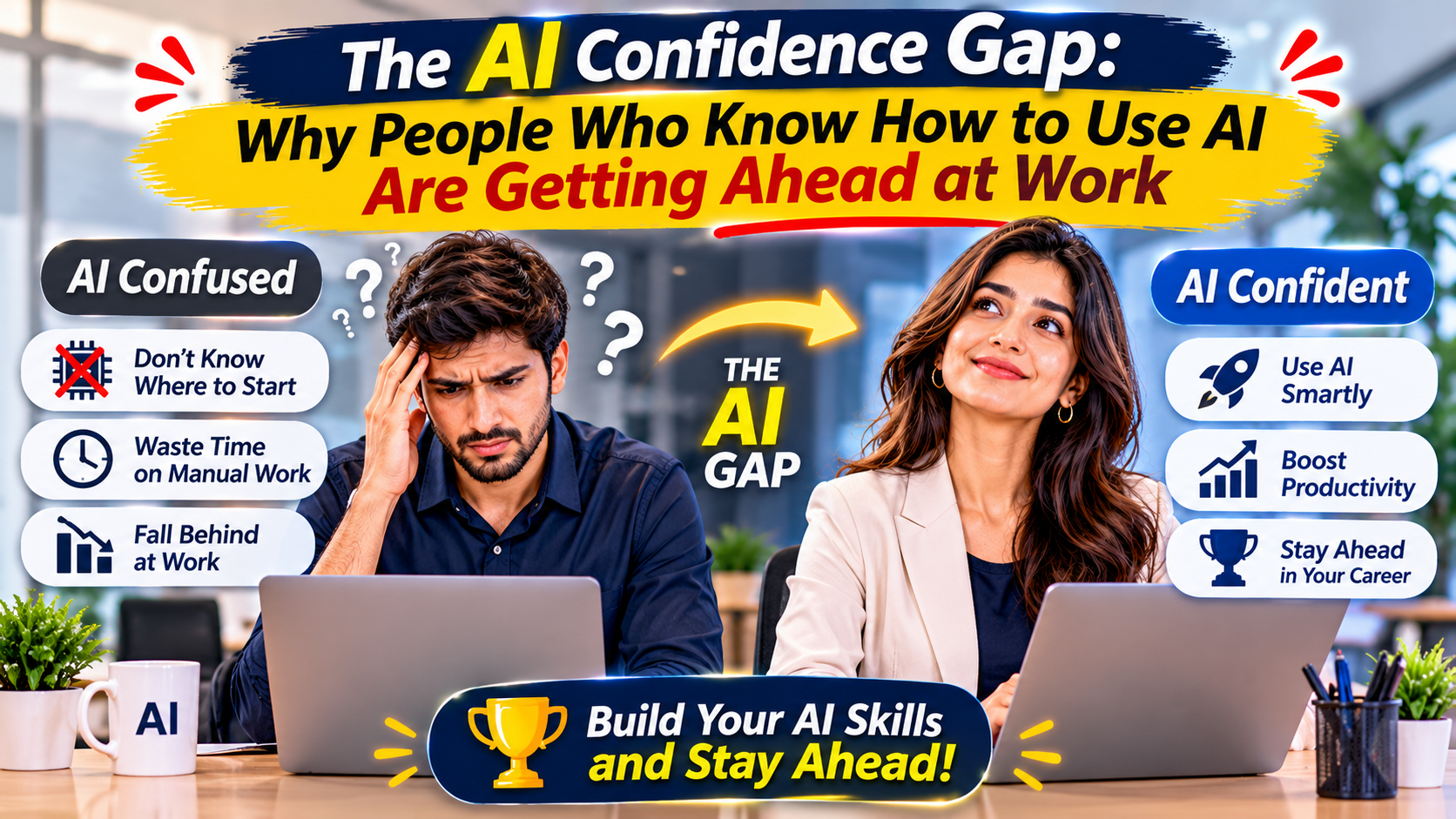
Artificial Intelligence is changing how people work, communicate and solve business problems. From writing reports and analysing data to creating presentations and automating repetitive tasks, AI tools are becoming part of everyday professional workflows. However, not everyone knows how to use them effectively. This difference is creating what can be called the AI confidence gap.
Professionals who understand how to work with AI can often complete certain tasks faster, explore new ideas and make better use of available information. The advantage is not simply knowing which AI tool to open. It is knowing how to use it responsibly to achieve meaningful results.
Quick Answer: The AI confidence gap refers to the difference between professionals who can effectively use AI tools and those who are unfamiliar with them. Developing AI literacy, prompt engineering, data analysis and automation skills can help professionals adapt to changing workplace requirements.
Table of Contents
- 1. What Is the AI Confidence Gap?
- 2. Why Are AI Skills Important at Work?
- 3. AI Skills Every Professional Should Learn
- 4. How AI-Confident Employees Work Differently
- 5. How Beginners Can Build AI Confidence
- 6. The Future of AI Skills in the Workplace
- 7. Frequently Asked Questions
1. What Is the AI Confidence Gap?
The AI confidence gap describes the difference between people who feel comfortable using artificial intelligence and those who hesitate because they lack knowledge or practical experience.
For example, one employee may manually prepare a weekly report, while another uses AI to organise information, identify patterns and create an initial draft. Both need professional judgement, but the second employee understands how to use technology as a productivity assistant.
2. Why Are AI Skills Important at Work?
AI can support several professional activities, including research, communication, planning, documentation and data interpretation.
- Better productivity: AI can assist with repetitive tasks and first drafts.
- Faster research: AI can help organise information and summarise material.
- Improved creativity: Professionals can explore different ideas and approaches.
- Data understanding: AI-assisted analysis can help identify trends.
- Workplace adaptability: AI literacy helps employees understand emerging tools.
3. AI Skills Every Professional Should Learn
Beginners should start with prompt engineering, AI research, content generation, spreadsheet assistance, data interpretation and workflow automation. They should also learn how to check AI-generated information and protect confidential business data.
Explore Artificial Intelligence training at Upskill Now to understand how AI concepts and practical applications fit together.
4. How AI-Confident Employees Work Differently
A marketer can use AI to brainstorm campaigns, a developer can use it to understand unfamiliar code, and an analyst can use it to explore datasets. In every case, the employee remains responsible for checking accuracy and making the final decision.
5. How Beginners Can Build AI Confidence
- Choose one AI tool and understand its basic features.
- Practise writing clear prompts.
- Use AI for small, everyday tasks.
- Compare AI-generated results with reliable information.
- Build a small project that solves a real problem.
6. The Future of AI Skills in the Workplace
AI knowledge is becoming useful across marketing, technology, education, finance and business operations. However, communication, critical thinking, creativity and domain expertise remain important. The strongest professionals will combine these human capabilities with practical AI knowledge.
7. Frequently Asked Questions
What is the AI confidence gap?
It is the difference between professionals who confidently use AI tools and those who lack the knowledge or experience to use them effectively.
Do I need coding skills to use AI?
No. Many AI applications can be used without coding. Technical knowledge becomes useful when building advanced AI applications.
Which AI skills should beginners learn first?
Start with AI literacy, prompt engineering, research, content generation and responsible AI use.
Can AI improve workplace productivity?
Yes. AI can assist with research, drafting, organisation, analysis and repetitive workflows, although results require human review.
Is learning AI useful for non-technical professionals?
Yes. AI tools are useful in marketing, sales, HR, administration, education and many other professional fields.
How can I become more confident using AI?
Practise with real tasks, learn different prompting techniques and gradually build projects using AI tools.
Conclusion
The AI confidence gap is not about who has access to the most advanced technology. It is about who knows how to apply available tools effectively. Professionals who combine AI knowledge with creativity, communication and problem-solving can become better prepared for changing workplace expectations. Start small, practise regularly and make AI a useful part of your professional skill set.
Explore more learning resources through the Upskill Now learning blog and its AI training programme.
Ready to Explore Digital Marketing?
Connect with Upskill Now to learn about the course curriculum, upcoming batches and enrolment process.
Visit Upskill NowContact Upskill Now
Website: www.upskillnow.in
Email: connect@upskillnow.in
Phone: 9999848160 / 9711448765
Address: A-3, Third Floor, Rajouri Garden, New Delhi – 110027.