
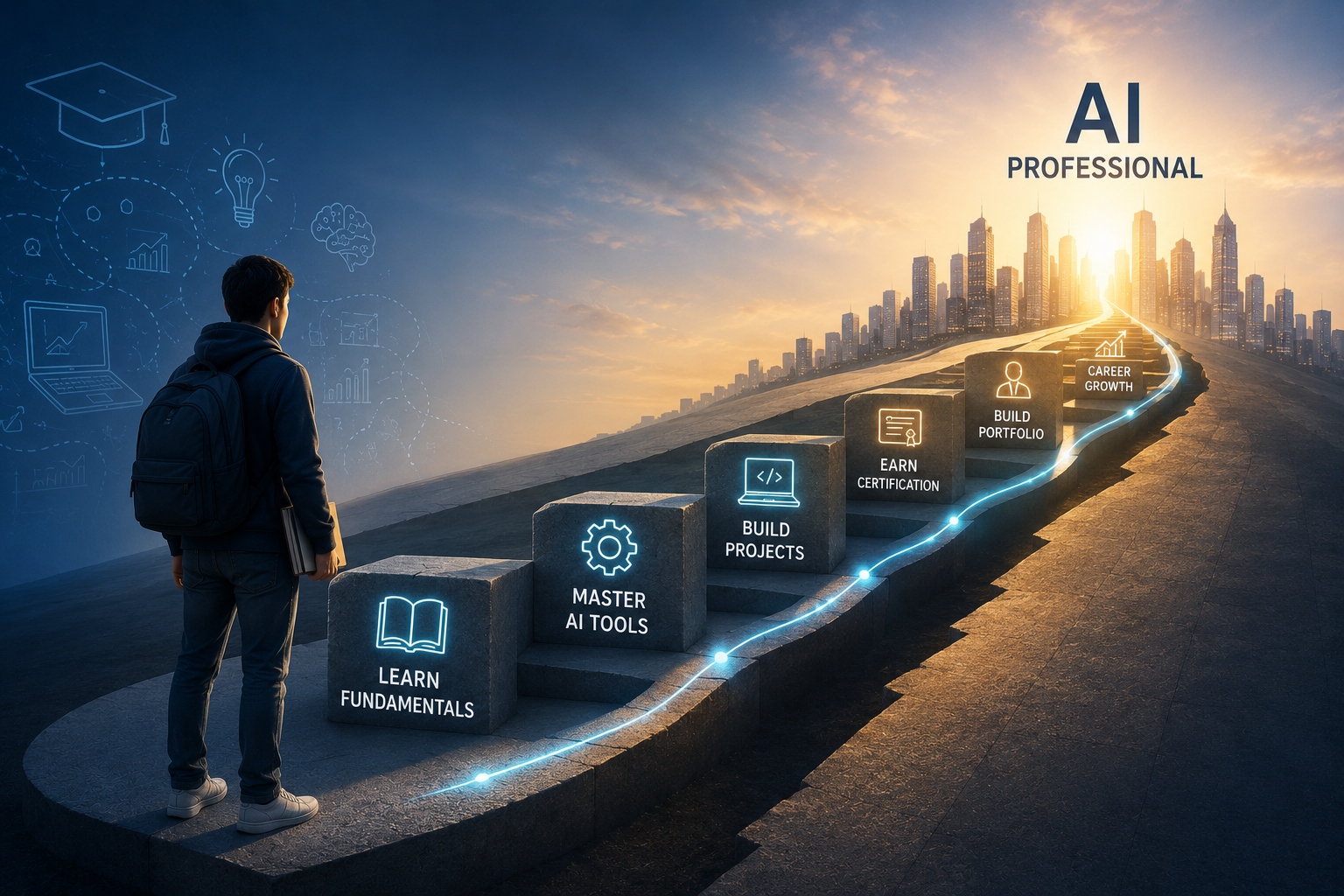
Artificial Intelligence is becoming an important skill for students, professionals, businesses, and working individuals. From Generative AI and ChatGPT to Machine Learning and automation, AI is being used in many different industries.
If you are planning to join an AI course, you may wonder:
What exactly will I learn in an AI course?
The answer depends on the level and type of course. A beginner-friendly AI course generally starts with the basics and gradually introduces practical AI tools, applications, and projects.
In this blog, we will look at the common topics covered in an AI course and what you can expect when you start learning Artificial Intelligence.
What Is an AI Course?
An AI course is a structured training program that teaches learners about Artificial Intelligence, its applications, tools, and technologies.
Some courses focus mainly on using AI tools, while others are designed for learners who want to develop technical AI skills.
A basic AI course may cover:
-
AI fundamentals
-
Generative AI
-
AI tools
-
Prompt Engineering
-
Machine Learning
-
Python
-
Data handling
-
AI applications
-
Practical projects
-
Case studies
The exact syllabus depends on the course and its intended audience.
1. Artificial Intelligence Fundamentals
Most AI courses begin with the fundamentals.
This section helps beginners understand what Artificial Intelligence actually is and how it is used.
You may learn about:
-
What is Artificial Intelligence?
-
How AI works
-
Types of AI
-
Applications of AI
-
AI in everyday life
-
Advantages and limitations of AI
-
Responsible use of AI
Understanding these concepts provides a foundation before moving into more advanced topics.
2. Generative AI
Generative AI has become an important part of modern AI learning.
It refers to AI systems that can generate new content based on instructions provided by users.
A course may introduce applications for generating:
-
Text
-
Images
-
Videos
-
Audio
-
Presentations
-
Code
Learners can understand how Generative AI can be used for education, business, marketing, research, content creation, and productivity.
3. AI Tools
An AI course may also introduce learners to popular AI-powered tools and applications.
Depending on the course, you may learn how to use AI tools for:
-
Writing
-
Research
-
Content creation
-
Image generation
-
Video creation
-
Presentations
-
Data analysis
-
Productivity
-
Automation
The objective is not simply to learn different tools but to understand which tool can be useful for a particular task.
4. Prompt Engineering
Prompt Engineering is another important topic in many modern AI courses.
A prompt is the instruction you give to an AI system.
For example, instead of simply asking an AI tool to "write a blog," you can provide information about the audience, topic, tone, length, structure, and desired outcome.
A prompt engineering module may teach:
-
How to write clear prompts
-
How to provide context
-
How to give specific instructions
-
How to use examples
-
How to improve AI-generated responses
-
How to create reusable prompts
Good prompting can help users get more relevant and useful results from AI tools.
5. Machine Learning Basics
More comprehensive AI courses may introduce Machine Learning, which is a major area of Artificial Intelligence.
Machine Learning involves systems that learn patterns from data and use those patterns to make predictions or decisions.
Beginners may learn about:
-
Supervised learning
-
Unsupervised learning
-
Classification
-
Regression
-
Clustering
-
Training data
-
Testing data
-
Model evaluation
This section is generally more technical than basic AI tool training.
6. Python for AI
If an AI course is designed for technical learners, it may include Python programming.
Python is widely used in Artificial Intelligence and Machine Learning.
A beginner AI course that includes Python may cover:
-
Variables
-
Data types
-
Operators
-
Conditional statements
-
Loops
-
Functions
-
Lists
-
Dictionaries
-
Data handling
-
Basic programming concepts
Python can provide the foundation needed to work with Machine Learning and other technical AI technologies.
7. Data and AI
Data is an important part of many AI systems.
An AI course may introduce learners to basic data concepts, including:
-
Data collection
-
Data cleaning
-
Data organisation
-
Data analysis
-
Training datasets
-
Data visualisation
Understanding data can help learners understand how AI systems learn patterns and generate results.
8. Deep Learning and Advanced AI
Advanced AI courses may go beyond basic Machine Learning and introduce Deep Learning.
Topics can include:
-
Neural networks
-
Deep neural networks
-
Natural Language Processing
-
Computer Vision
-
Speech recognition
-
AI models
These topics are generally more suitable for learners who already have a foundation in programming, mathematics, data, and Machine Learning.
9. AI Applications in Different Industries
A practical AI course should also help learners understand how AI is used outside the classroom.
AI applications can be found in areas such as:
-
Digital marketing
-
Education
-
Healthcare
-
Finance
-
E-commerce
-
Customer service
-
Software development
-
Business operations
-
Content creation
For example, marketers can use AI for content research and campaign planning, while busin