
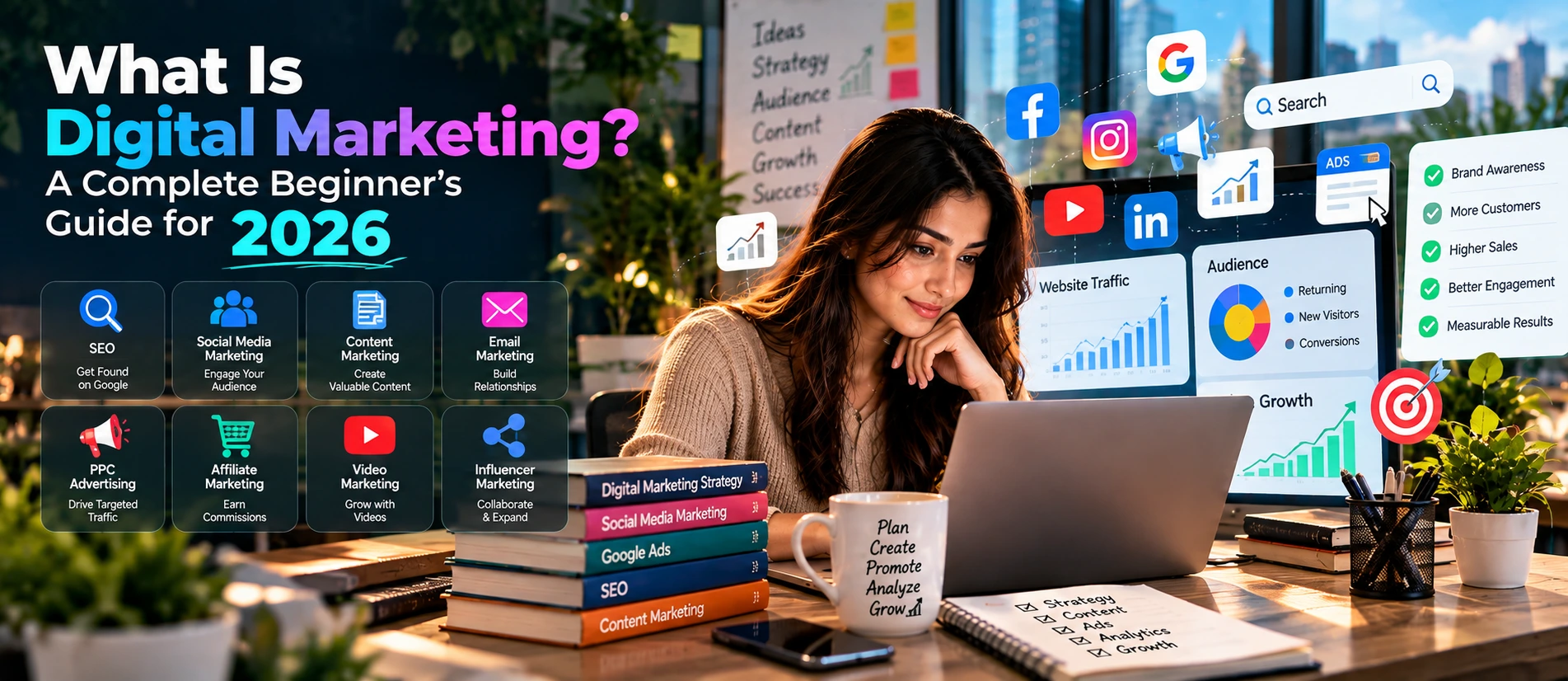
Learn Digital Marketing: A Beginner’s Guide for 2026 →
For beginners, digital marketing can seem complicated because it includes many different channels and strategies. However, once you understand the basic concepts, you can see how these channels work together to attract people, build awareness, generate interest, and encourage customers to take action.
This digital marketing beginner’s guide for 2026 explains what digital marketing is, how it works, its major components, and the basic concepts beginners should understand.
What Is Digital Marketing?
Digital marketing is marketing performed through digital channels and technologies to communicate with a target audience.
For example, when a business:
- Appears in Google search results
- Publishes content on Instagram
- Runs Google Ads
- Sends promotional emails
- Publishes educational blog posts
- Creates YouTube videos
- Promotes products through social media
it is using digital marketing.
The main purpose is to connect a business with people who may be interested in its products, services, content, or brand.
How Does Digital Marketing Work?
A simple digital marketing process can be understood in five stages:
Reach → Attract → Engage → Convert → Retain
1. Reach
The business reaches potential customers through channels such as search engines, social media, advertising, websites, and content.
2. Attract
Useful content, advertisements, videos, offers, or information encourage people to learn more about the business.
3. Engage
The business builds interaction through websites, social media, email, videos, blogs, and other content.
4. Convert
The visitor takes an action such as:
- Making a purchase
- Filling out a form
- Calling a business
- Booking a service
- Signing up for an email list
- Downloading a resource
5. Retain
Businesses can continue communicating with customers through email, social media, content, offers, and other digital channels.
This creates a continuous relationship between a business and its audience.
Why Is Digital Marketing Important?
People use digital platforms every day to search for information, compare products, watch videos, communicate with businesses, and make purchasing decisions.
Digital marketing allows businesses to communicate with audiences through the platforms they already use.
Some important advantages include:
- Reaching online audiences
- Building brand awareness
- Sharing useful information
- Generating website traffic
- Connecting with potential customers
- Measuring marketing activity
- Understanding audience behavior
- Supporting sales and customer relationships
For beginners, it is important to understand that digital marketing is not simply about posting on social media or running advertisements. It is a combination of strategy, content, technology, communication, data, and customer understanding.
Main Components of Digital Marketing
Your Beginner’s Guide to Digital Marketing in 2026 →
Digital marketing consists of several major areas. Beginners should understand the purpose of each one.
1. Search Engine Optimization (SEO)
SEO, or Search Engine Optimization, is the practice of improving websites and content so they can appear in relevant search results.
SEO includes activities such as:
- Keyword research
- Creating useful content
- On-page optimization
- Internal linking
- Technical optimization
- Website performance
- Local SEO
For example, if someone searches for "digital marketing course," a business may use SEO to help its relevant page appear in search results.
2. Social Media Marketing
Social media marketing involves using social platforms to communicate with audiences and promote content, products, services, or brands.
Common activities include:
- Creating social media posts
- Publishing videos
- Creating Reels and short-form content
- Community engagement
- Social media campaigns
- Audience research
- Performance analysis
The goal is not simply to collect followers but to build meaningful communication with a relevant audience.
3. Content Marketing
Content marketing involves creating useful and relevant content for a target audience.
Examples include:
- Blog posts
- Videos
- Guides
- Tutorials
- Infographics
- Case studies
- Ebooks
- Social media content
Good content can help answer customer questions, demonstrate expertise, support SEO, and build trust.
4. Paid Advertising
Paid digital advertising allows businesses to pay for visibility on digital platforms.
Examples include:
- Google Ads
- Search advertising
- Display advertising
- YouTube advertising
- Social media advertising
- Remarketing campaigns
Paid advertising can help businesses reach specific audiences and drive traffic, leads, or sales.
5. Email Marketing
Email marketing involves communicating with customers and potential customers through email.
Businesses can use email for:
- Newsletters
- Product announcements
- Educational content
- Special offers
- Customer updates
- Lead nurturing
Email marketing is particularly useful for maintaining communication with people who have already shown interest in a business.
6. Video Marketing
Video marketing uses video content to communicate information or promote a business.
Videos can include:
- Tutorials
- Product demonstrations
- Educational videos
- Customer testimonials
- Short-form videos
- Brand videos
Video can be distributed through websites, YouTube, social media, and advertising platforms.
7. Affiliate Marketing
Affiliate marketing is a model where individuals or organizations promote products or services and may receive a commission for qualifying sales or actions.
For beginners, it is useful to understand affiliate marketing as a performance-based approach to online promotion.
8. Influencer Marketing
Influencer marketing involves collaborating with creators who have an audience relevant to a particular niche.
Brands may work with creators to introduce:
- Products
- Services
- Campaigns
- Events
- New launches
The relevance and trust of the creator's audience are important considerations.
What Is a Digital Marketing Strategy?
A digital marketing strategy is a planned approach for using digital channels to achieve specific business objectives.
A basic strategy can include:
- Define your goal.
- Identify your target audience.
- Research customer needs.
- Choose appropriate digital channels.
- Create useful content.
- Launch campaigns.
- Measure performance.
- Improve the strategy based on results.
For example, a business that wants more website visitors may focus on SEO and content marketing, while a business looking for immediate paid traffic may use online advertising.
What Is a Target Audience?
A target audience is the specific group of people a business wants to reach.
A target audience can be understood using factors such as:
- Age
- Location
- Interests
- Needs
- Problems
- Buying behavior
- Online behavior
Understanding the target audience helps marketers create more relevant content and campaigns.
What Are Digital Marketing Channels?
A digital marketing channel is a platform or method used to communicate with an audience.
Common channels include:
- Search engines
- Websites
- Social media
- Online advertising
- Video platforms
- Mobile applications
- Content platforms
Different channels can serve different purposes. A business may use SEO for organic visibility, social media for engagement, and paid advertising for targeted campaigns.
Organic Marketing vs Paid Marketing
Digital marketing can broadly involve organic and paid activities.
Organic Marketing
Organic marketing focuses on attracting audiences without directly paying for each visit or interaction.
Examples include:
- SEO
- Blog content
- Organic social media
- Educational videos
- Email newsletters
Paid Marketing
Paid marketing involves paying platforms to distribute advertisements or promotional content.
Examples include:
- Google Ads
- Meta Ads
- YouTube Ads
- Display advertising
- Sponsored content
Many businesses use a combination of organic and paid marketing.
What Are Digital Marketing Metrics?
Discover How Digital Marketing Works →
Digital marketing generates measurable data. Beginners should understand some basic metrics.
Website Traffic
The number of visits or sessions generated on a website.
Impressions
The number of times content or an advertisement is displayed.
Click-Through Rate (CTR)
The percentage of people who click after seeing a link or advertisement.
Conversion Rate
The percentage of visitors who complete a desired action.
Cost Per Click (CPC)
The amount paid for an advertising click in a CPC-based campaign.
Cost Per Acquisition (CPA)
The cost associated with acquiring a customer or another defined conversion.
Return on Ad Spend (ROAS)
A metric used to evaluate revenue generated relative to advertising expenditure.
Understanding these metrics helps marketers evaluate campaign performance.
Digital Marketing Tools for Beginners
Digital marketers use different tools for research, content, analytics, advertising, and optimization.
Some commonly used tools and platforms include:
- Google Analytics — website and marketing analytics
- Google Search Console — search performance and website monitoring
- Google Ads — online advertising
- Google Keyword Planner — keyword research
- Semrush — SEO and competitive research
- Ahrefs — SEO and backlink research
- Canva — visual content creation
- Meta Ads Manager — Facebook and Instagram advertising
Beginners should focus on understanding what each tool does and when to use it, rather than trying to learn every tool at once.
How to Start Learning Digital Marketing as a Beginner
If you are completely new to digital marketing, follow a simple learning sequence.
Step 1: Understand the Fundamentals
Learn basic concepts such as target audiences, marketing funnels, digital channels, content, traffic, leads, and conversions.
Step 2: Learn SEO
Understand keywords, search intent, on-page SEO, technical SEO, content optimization, and basic analytics.
Step 3: Learn Social Media Marketing
Understand content planning, audience engagement, social platforms, and social media analytics.
Step 4: Learn Content Marketing
Practice creating useful blog posts, social media content, videos, and other educational resources.
Step 5: Understand Paid Advertising
Learn the fundamentals of Google Ads, social media advertising, campaign objectives, targeting, budgets, and performance metrics.
Step 6: Learn Analytics
Understand how to measure website traffic, engagement, conversions, and campaign performance.
Step 7: Practice
Create a small website, blog, social media page, or sample marketing campaign and apply what you learn.
Common Digital Marketing Mistakes Beginners Should Avoid
Trying to Learn Everything at Once
Digital marketing is a broad field. Start with the fundamentals and gradually develop specialized knowledge.
Focusing Only on Followers
Followers are only one type of social media metric. Engagement, website visits, leads, conversions, and other business objectives may also matter.
Ignoring the Target Audience
Marketing becomes more effective when content and campaigns address the needs and questions of a clearly defined audience.
Creating Content Without a Strategy
Publishing content consistently is useful, but content should have a clear purpose and audience.
Not Measuring Results
Without analytics, it can be difficult to understand what is working and what needs improvement.
Relying Completely on Automation
Digital marketing tools and AI can improve productivity, but human strategy, creativity, review, and decision-making remain important.
Frequently Asked Questions About Digital Marketing
What is digital marketing in simple words?
Digital marketing is the process of promoting a business, product, service, or brand through digital channels such as search engines, websites, social media, email, and online advertising.
Is digital marketing easy for beginners?
The basic concepts can be learned step by step. Because digital marketing includes many different areas, beginners should start with the fundamentals before moving into advanced topics.
What are the main types of digital marketing?
The major areas include SEO, social media marketing, content marketing, paid advertising, email marketing, video marketing, affiliate marketing, and influencer marketing.
Do I need coding to learn digital marketing?
You do not generally need advanced programming skills to begin learning digital marketing. Some areas, such as technical SEO and analytics, may involve technical concepts, but beginners can start without being programmers.
What should I learn first in digital marketing?
Start with digital marketing fundamentals, target audiences, SEO, content marketing, social media, paid advertising, and analytics. Then choose specific areas for deeper learning.
Conclusion
Digital marketing is a broad field that uses digital channels, content, advertising, technology, and data to connect businesses with their audiences.
For beginners, the best approach is to understand the fundamentals first and then gradually learn individual areas such as SEO, social media marketing, content marketing, paid advertising, email marketing, video marketing, and analytics.
By learning the basic concepts, practicing with real projects, and understanding how different channels work together, beginners can build a strong foundation in digital marketing in 2026.
📞 Call: 9999848160 | 9711448765
📍 Address: A-3, Third Floor, Rajouri Garden, New Delhi – 110027