
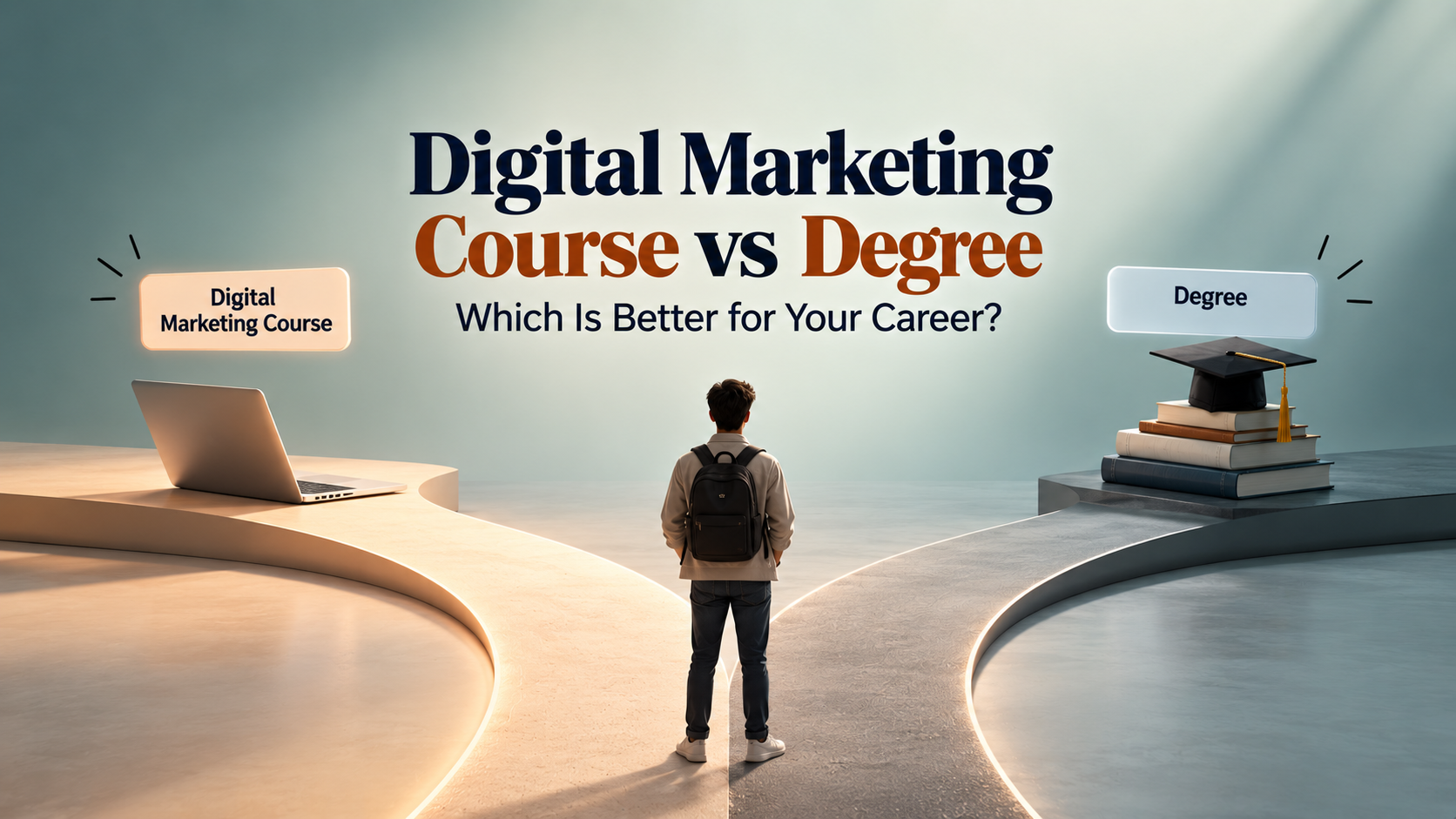
Digital Marketing Course vs Degree: Which Is Better for Your Career?
Choosing between a digital marketing course and a college degree is an important decision for students and early-career learners. Both options can provide useful knowledge, but they serve different purposes. A degree offers structured academic education, while a digital marketing course focuses on a specific professional skill set.
The question of digital marketing course vs degree does not have one answer that applies to everyone. A student who wants a formal academic qualification may need a degree, while someone who wants to develop a specialised marketing skill may find a professional course more relevant.
There is also a third possibility: combining a degree with digital marketing training. This can allow students to develop broader academic knowledge while building practical skills in SEO, content, social media, advertising, analytics, and other digital channels.
This guide compares both options objectively, including their purpose, duration, cost, practical learning, skills, career opportunities, higher education, credibility, limitations, and situations in which each option may make more sense.
Digital Marketing Course vs Degree: Quick Answer
A digital marketing course and a degree should not be treated as equivalent qualifications. They solve different educational and career needs.
- A degree provides broader academic education and a formal undergraduate or postgraduate qualification.
- A digital marketing course provides focused training in online marketing skills and tools.
- A degree generally requires a longer time commitment.
- A digital marketing course is usually shorter and more specialised.
- A degree can be important when a job or higher education pathway specifically requires a formal qualification.
- A digital marketing course can help learners develop practical skills without waiting several years to specialise in marketing.
- The two can be combined when a student wants both academic education and specialised digital skills.
The right choice therefore depends on what you need from education rather than which option sounds better in general.
What Is a Digital Marketing Course?
A digital marketing course is a specialised training program that teaches learners how businesses use online channels to attract audiences, communicate with customers, generate leads, and support business objectives.
Depending on the program, students may learn search engine optimization, social media marketing, content marketing, paid advertising, email marketing, analytics, lead generation, conversion optimisation, and AI-assisted marketing workflows.
A structured digital marketing learning program can help beginners understand these areas and practise them through assignments or projects.
What Does a Degree Provide?
A degree provides structured academic education over a longer period. The subject area depends on the degree selected.
For example, a business degree may cover management, marketing, finance, economics, human resources, operations, communication, and entrepreneurship. A computer-related degree may focus on programming, databases, software development, computer networks, and other technical subjects.
The major advantage of a degree is breadth and formal academic recognition. It can also provide access to higher education pathways and roles that specify a bachelor's or postgraduate qualification as an eligibility requirement.
Digital Marketing Course vs Degree: Education Level
The most important distinction is the qualification itself.
A bachelor's degree is a formal higher-education qualification awarded by a recognised university or institution after completing the required academic program.
A digital marketing course is professional or vocational training. Depending on the provider, a learner may receive a certificate, diploma, or another form of course completion credential.
A course certificate should not be presented as equivalent to a bachelor's degree. Students should understand this difference before deciding to replace or postpone formal education.
Digital Marketing Course Syllabus
Digital marketing courses vary considerably, but a comprehensive beginner-level syllabus may include:
- Digital marketing fundamentals
- Search engine optimization
- Keyword research and search intent
- Content marketing
- Social media marketing
- Google Ads and paid advertising
- Email marketing
- Web analytics
- Lead generation
- Conversion optimisation
- AI tools for marketing
- Campaign planning and reporting
Students considering an AI-focused digital marketing course should check how AI is applied to real marketing tasks rather than judging the program simply by the number of tools mentioned.
Digital Marketing Course After 12th
Students can begin learning digital marketing after Class 12, regardless of whether they studied Commerce, Science, Arts, or another recognised stream, although individual programs may have their own requirements.
Students who are still deciding on their long-term education should consider whether they need a formal degree alongside specialised marketing training.
Digital Marketing Course vs Degree: Duration
Time commitment is another major difference.
A degree usually takes several years because students study a broad curriculum across multiple semesters. The exact duration depends on the type of degree, institution, and academic structure.
Digital marketing courses can range from short introductory programs to more extensive professional training. A longer course may cover more channels and include additional practical assignments, but duration alone does not determine quality.
Learning digital marketing also does not end when the course finishes. Search engines, advertising platforms, social networks, analytics systems, and AI tools continue to change, so professionals need ongoing learning.
Digital Marketing Course vs Degree: Cost
The financial commitment can differ substantially between a degree and a digital marketing course.
The total cost of a degree can include tuition, examination fees, books, transport, accommodation, technology, and other college-related expenses.
A digital marketing course generally has a smaller time commitment and may have a lower overall cost, although fees vary significantly between providers.
Students should compare the total cost rather than looking only at the advertised course fee. They should also consider what practical training, projects, mentorship, tools, certification, and career support are actually included.
Practical Learning: Course vs Degree
Practical exposure can exist in both formats, but its nature depends heavily on the institution and program.
Practical Learning in a Degree
Degree programs may include case studies, presentations, research projects, group assignments, internships, laboratory work, business simulations, or industry projects depending on the field.
However, completing a degree does not automatically mean that a student has strong practical professional skills. Students often need internships, projects, competitions, or additional experience to apply their academic knowledge.
Practical Learning in Digital Marketing
Digital marketing courses may involve SEO audits, keyword research, content planning, social media campaigns, advertising exercises, analytics reports, landing pages, and campaign projects.
The quality of practical training differs between programs. Students should examine actual assignments and project requirements instead of assuming that every course provides extensive hands-on experience.
Skills You Can Develop
The skills developed depend largely on the type of degree and the quality of the digital marketing program.
Skills From a Degree
- Academic and subject-specific knowledge
- Research and analytical thinking
- Communication and presentation
- Problem-solving
- Teamwork
- Subject-specific technical or business skills
- Project and time management
Skills From Digital Marketing Training
- SEO and keyword research
- Content planning
- Social media management
- Paid advertising
- Web analytics
- Email marketing
- Lead generation
- Conversion optimisation
- Campaign reporting
- AI-assisted marketing workflows
The distinction is not that one option teaches skills while the other teaches theory. Good degree programs can be highly practical, and good digital marketing courses can include substantial theory. The difference is mainly in scope, qualification, and specialisation.
Career Options After a Degree
Career opportunities after a degree depend on the subject studied. A business graduate may explore marketing, sales, finance, HR, operations, or management-related roles, while a technical graduate may pursue roles related to their specific field.
Some degree holders may also continue with postgraduate education, professional certifications, competitive examinations, or specialised training.
Why Degree Specialisation Matters
A degree title alone does not determine a career. The subject, institution, internships, projects, communication skills, academic performance, and additional professional skills can all influence career opportunities.
Career Options After Digital Marketing Training
Digital marketing training can lead towards specialised entry-level roles, although actual opportunities depend on skills, experience, portfolio quality, employer requirements, and location.
SEO Executive
SEO professionals work on keyword research, content optimisation, technical SEO, internal linking, search visibility, and performance monitoring.
Social Media Executive
Social media professionals plan content, manage publishing, engage audiences, coordinate campaigns, and analyse platform performance.
Content Marketing Executive
Content marketers develop articles, website content, guides, social media material, videos, and other formats based on audience and business objectives.
Performance Marketing Executive
Performance marketers work with paid campaigns and analyse metrics such as clicks, conversions, leads, acquisition costs, and campaign performance.
Digital Marketing Executive
Digital marketing executives may work across SEO, content, social media, advertising, email marketing, analytics, and campaign coordination.
Freelance Digital Marketer
Freelancers can provide services such as SEO, content marketing, social media management, advertising, website optimisation, analytics, and digital strategy.
Salary: Digital Marketing Course vs Degree
Salary should be considered carefully because neither a degree nor a digital marketing course guarantees a particular income.
Degree holders can enter many different industries, so salary varies according to qualification, specialisation, job role, employer, location, experience, internships, and additional skills.
Digital marketing salaries similarly depend on the role, specialisation, practical ability, portfolio, experience, employer, location, and measurable contribution to marketing objectives.
A student should therefore avoid choosing an educational path based only on advertised salary figures. Career outcomes vary significantly between individuals.
Can You Build a Career in Digital Marketing Without a Degree?
Some digital marketing roles can place substantial emphasis on practical skills, portfolio work, communication, and experience rather than focusing exclusively on academic qualifications.
However, this does not mean that a degree is unnecessary for every career. Some employers and professions have formal educational requirements, and a degree can also be important for certain postgraduate or academic pathways.
Students should therefore distinguish between being able to develop digital marketing skills without a degree and being able to access every possible career opportunity without one.
Can You Learn Digital Marketing While Doing a Degree?
Yes. For many students, learning digital marketing alongside college can be a practical way to combine academic education with professional skill development.
A student studying business, commerce, media, computer applications, design, communication, or another subject can apply digital marketing skills to projects, internships, personal websites, student organisations, or freelance work.
This approach can also help students test whether digital marketing is genuinely interesting to them before making it their primary career specialisation.
Digital Marketing Course vs Degree for Entrepreneurship
Both options can contribute to entrepreneurship, but they address different parts of running a business.
A degree can provide broader exposure to areas such as management, finance, operations, business planning, communication, or industry-specific knowledge.
Digital marketing can provide practical skills for reaching potential customers through search, content, social media, advertising, email, and other online channels.
An entrepreneur may eventually need knowledge from both areas. Understanding how to operate a business and understanding how to attract customers are separate capabilities that can complement each other.
Higher Education and Long-Term Career Planning
A major advantage of completing a degree is that it can provide a foundation for further academic education. Depending on the field, graduates may pursue master's programs, postgraduate diplomas, professional certifications, research, or other qualifications.
A digital marketing course can also be followed by additional certifications and specialised learning, but it generally does not replace the undergraduate degree requirement for programs that specifically require one.
Students who already know they want to pursue higher education should check the eligibility requirements of their intended future programs before deciding how much emphasis to place on short-term professional training.
How AI Is Changing Digital Marketing Careers
AI is changing how marketers conduct research, develop content ideas, analyse information, automate repetitive tasks, create visual concepts, and support campaign planning.
Learning AI tools can therefore be useful, but tool familiarity alone is not a complete digital marketing skill. Marketers still need to understand audiences, positioning, search intent, communication, content quality, analytics, and business objectives.
Students interested in an AI and digital marketing skill path should focus on applying AI to real marketing problems while maintaining human judgement and quality control.
When a Degree May Make More Sense
A degree may be the more appropriate choice when formal academic qualification is important to your career plans.
- You want an undergraduate qualification.
- You plan to pursue postgraduate education.
- Your intended profession has formal degree requirements.
- You want broad exposure to an academic subject.
- You are still exploring different career directions.
- You want the wider college experience, including internships and student activities.
These points do not mean that a degree automatically leads to better career outcomes. Students still need relevant skills, experience, and continuous development.
When a Digital Marketing Course May Make More Sense
Specialised digital marketing training may be worth considering when your immediate objective is to develop online marketing skills.
- You already have an interest in digital marketing.
- You want focused professional training.
- You prefer practical learning and project-based work.
- You want to build a marketing portfolio.
- You want to explore SEO, content, social media, advertising, or analytics.
- You want to add digital marketing skills to an existing degree.
A specialised course should still be evaluated carefully. Course quality, trainer expertise, practical assignments, curriculum depth, and student support can vary considerably.
When Combining a Degree and Digital Marketing Makes Sense
For some students, the choice does not have to be either a degree or digital marketing. Combining both can provide a broader educational foundation along with a specialised professional skill.
For example, a student can pursue a BBA, BCA, BA, B.Com, or another degree while learning digital marketing through projects, internships, certifications, or structured training.
The benefit of this approach is that students can develop both academic credentials and practical skills. The trade-off is additional time, effort, and potentially additional cost.
How to Choose Between a Digital Marketing Course and a Degree
The strongest decision is based on your actual career requirements rather than on which option is more popular online.
- Identify whether your intended career requires a formal degree.
- Decide whether you want broad academic education or specialised professional training.
- Review the curriculum rather than relying only on course or college advertisements.
- Check practical learning, internships, projects, and portfolio opportunities.
- Consider your total education and training costs.
- Think about whether you plan to pursue higher education later.
- Consider your preferred learning style and the amount of time you can realistically commit.
- Research actual career requirements instead of choosing based solely on expected salary.
Questions to Ask Before Making a Decision
- Do I need a bachelor's degree for the career I want?
- Do I want broad academic knowledge or a specialised skill?
- What type of work do I want to do after completing my education?
- Will I need postgraduate education later?
- How much practical experience can I gain?
- Can I combine digital marketing with my degree?
- What is the total cost of the education or training?
- Does the course or degree provide opportunities to build a portfolio?
Common Mistakes to Avoid
- Assuming a certificate is equivalent to a bachelor's degree
- Assuming a degree automatically guarantees employment
- Choosing a course only because it promises a high salary
- Ignoring practical experience
- Choosing an institution without reviewing its curriculum
- Assuming every digital marketing course provides the same training
- Ignoring communication and analytical skills
- Failing to research higher education requirements
- Expecting immediate expertise after completing a short course
How to Build Experience While Studying
Whatever educational path you choose, practical experience can make your learning more useful.
Work on Personal Projects
Create a website, content project, small online business, or marketing experiment and document what you learn.
Complete Internships
Internships can expose students to real deadlines, teamwork, reporting, clients, workplace communication, and professional processes.
Build a Portfolio
Keep your strongest projects in a portfolio and explain the objective, approach, tools, work completed, and measurable results where available.
Develop Communication and Analytical Skills
Writing, presentation, research, data interpretation, and problem-solving can support both academic and professional career development.
Digital Marketing Course vs Degree: Final Checklist
- Determine whether a formal degree is required for your target career.
- Identify whether you prefer broad or specialised education.
- Review the actual syllabus.
- Check practical learning opportunities.
- Consider internships and portfolio development.
- Research realistic career paths.
- Consider higher education requirements.
- Calculate the total cost.
- Consider your available time.
- Decide whether combining both options is practical.
Conclusion
A digital marketing course and a degree are not direct substitutes. A degree provides broader academic education and a formal qualification, while digital marketing training provides focused skills for online marketing.
A degree may be more appropriate for students who need formal higher education, want broader academic exposure, or plan to pursue careers or postgraduate programs with degree requirements.
A digital marketing course may be more appropriate for learners who specifically want to develop online marketing skills, build a practical portfolio, or add a specialised skill to their existing education.
For some students, combining the two may provide the strongest overall foundation. A degree can provide broader knowledge and academic credentials, while digital marketing training can add practical skills relevant to modern online business.
The best choice is therefore not the option with the most attractive advertisement or the highest promised salary. It is the option that matches your educational requirements, career goals, financial situation, interests, and willingness to keep developing your skills.
Contact Upskill Now
Interested in learning digital marketing? Connect with Upskill Now for more information about digital marketing training and learning options.
A-3, Third Floor, Rajouri Garden, New Delhi – 110027
Phone: 9999848160 | 9711448765
Email: connect@upskillnow.in