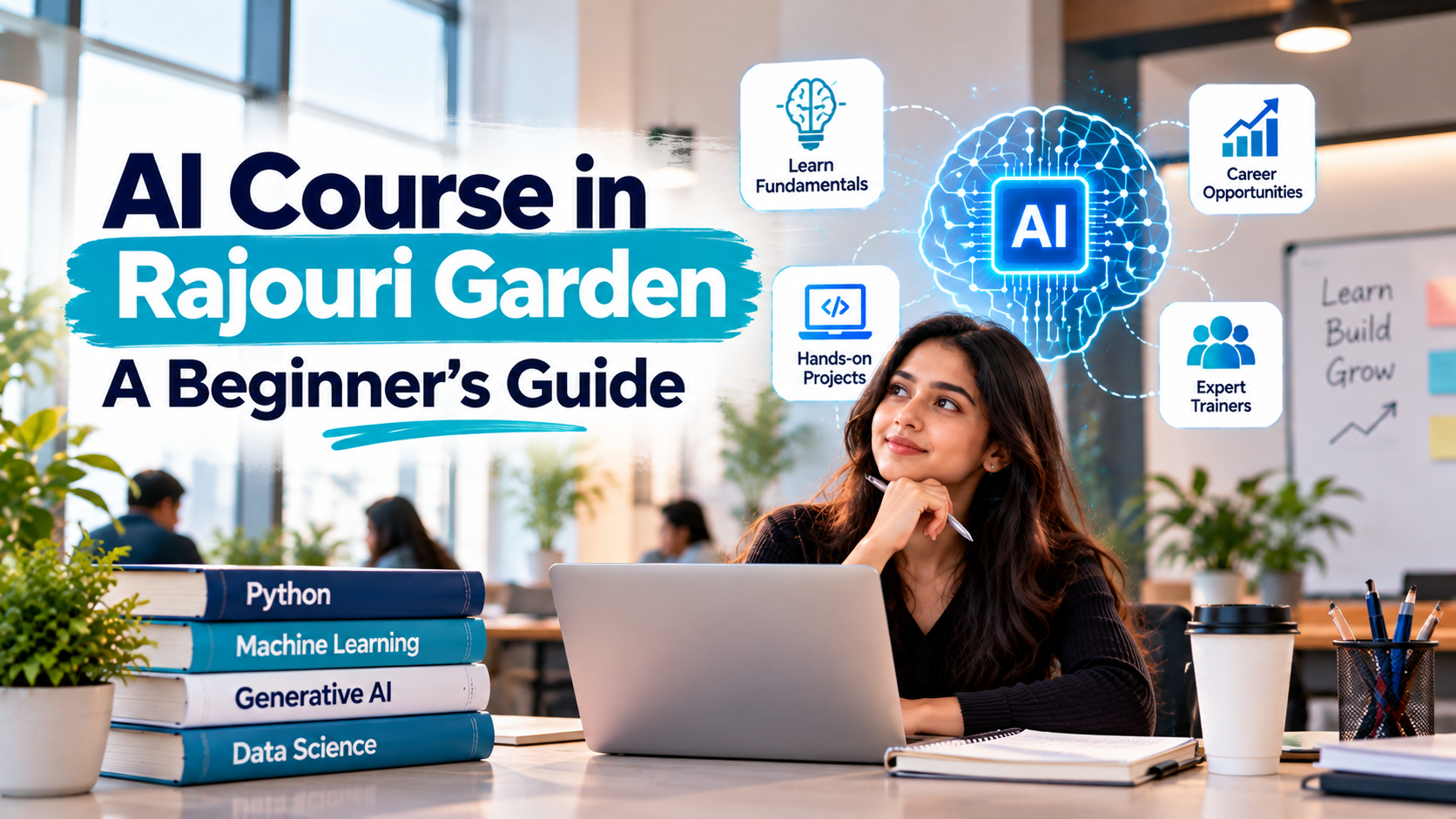
AI Course in Rajouri Garden: A Beginner's Guide
Artificial Intelligence is becoming an important skill across technology, business, marketing, education, finance, healthcare, and many other industries. As AI tools and applications become more accessible, beginners are increasingly looking for structured ways to understand the technology and build practical skills.
If you are searching for an AI Course in Rajouri Garden, choosing the right program can make your learning journey much easier. A good beginner-level course should not overwhelm you with advanced concepts from the beginning. Instead, it should introduce AI step by step, explain important concepts clearly, provide practical exposure, and help you understand how AI is actually used.
Rajouri Garden is also a convenient location for learners in West Delhi, making classroom-based AI training accessible to students, graduates, working professionals, and career changers. However, location should not be the only factor you consider when selecting a course.
What Is an AI Course?
An AI course introduces learners to the concepts, technologies, tools, and applications used to build or work with Artificial Intelligence systems. Depending on the course level, the curriculum may include AI fundamentals, machine learning, Python, data handling, generative AI, neural networks, automation, prompt engineering, and practical projects.
For beginners, the objective is not necessarily to become an advanced AI engineer immediately. The first step is to understand how AI works, where it is used, what different AI technologies can do, and how you can gradually develop technical and practical skills.
A structured AI learning program can help beginners move from basic concepts toward practical applications without having to learn everything at once.
Who Should Consider an AI Course in Rajouri Garden?
AI is not limited to students from a computer science background. The right beginner course can be useful for people with different educational and professional backgrounds, depending on their goals.
Students who are interested in technology can use an AI course to develop skills alongside their academic education. Fresh graduates can explore AI-related career paths and build project experience. Working professionals may use AI training to improve productivity or transition toward technology-oriented roles.
Entrepreneurs, marketers, content creators, and business professionals can also benefit from understanding how AI tools can be applied to research, content creation, automation, analytics, customer support, and other workflows.
Why Learn AI as a Beginner?
One of the biggest advantages of starting early is that you get time to build your foundation gradually. AI includes several interconnected areas, and trying to learn everything simultaneously can create unnecessary confusion.
Beginning with fundamental concepts allows you to understand important terminology before moving into more advanced subjects. You can then decide whether you want to explore machine learning, generative AI, data science, AI automation, computer vision, natural language processing, or another specialization.
Learning AI can also improve your ability to evaluate AI-generated information, understand the limitations of AI systems, and use AI tools more effectively instead of treating them as simple search or content-generation utilities.
What Should a Beginner Learn in an AI Course?
A beginner-friendly curriculum should ideally follow a logical progression. The exact modules will vary between institutes, but several areas are useful when building an AI foundation.
1. Introduction to Artificial Intelligence
The course should begin with the fundamentals. You should understand what Artificial Intelligence means, how AI systems differ from traditional software, and where AI is used in everyday applications.
This foundation makes later topics easier because you will already understand the basic terminology and concepts.
2. Machine Learning Fundamentals
Machine learning is an important part of modern AI. Beginners should understand concepts such as datasets, features, training, testing, prediction, classification, regression, and model evaluation.
You do not necessarily need to start with complicated mathematics. A good beginner course should explain concepts progressively and introduce technical depth as your understanding improves.
3. Python for AI
Python is widely used in AI and machine learning workflows. Beginners who want to move toward technical AI roles should consider learning Python alongside their AI fundamentals.
Important beginner topics can include variables, data types, conditions, loops, functions, lists, dictionaries, modules, file handling, and basic data processing.
4. Data Handling
AI systems depend heavily on data. Beginners should understand how data is collected, organized, cleaned, analyzed, and prepared for machine learning tasks.
Basic exposure to libraries such as NumPy and Pandas can provide a useful foundation for working with datasets.
5. Generative AI
Generative AI is another area beginners may encounter during their learning journey. It focuses on systems that can generate content such as text, images, audio, video, code, and other outputs.
A beginner-level curriculum can introduce concepts such as large language models, prompt engineering, AI assistants, content generation, and responsible AI usage.
Practical Learning in an AI Course
Reading concepts is only one part of learning AI. Practical exposure can help you understand how those concepts are applied to actual problems.
For example, beginners can work on projects involving data analysis, simple prediction models, AI-powered applications, chatbots, content generation, automation workflows, or other suitable use cases.
Projects also give learners something tangible to demonstrate when building a portfolio. Instead of simply mentioning that you studied AI, you can show what you learned and how you applied it.
How to Choose an AI Course in Rajouri Garden
There can be several training options available to learners in and around Rajouri Garden. Therefore, comparing courses carefully is important before enrolling.
Check the Curriculum
Start by examining the complete syllabus rather than relying only on the course title. Look for a logical progression from fundamentals to practical applications.
A beginner should be able to understand what will be taught during the first few weeks, what tools will be introduced later, and whether the program includes practical assignments or projects.
Check the Teaching Method
The teaching format can significantly influence your learning experience. Find out whether classes are instructor-led, recorded, online, classroom-based, or offered through a combination of different formats.
If you are a beginner, opportunities to ask questions and clarify concepts can be particularly useful.
Look for Practical Projects
Projects are an important part of technical learning because they allow you to apply concepts instead of only memorizing them.
Before enrolling, ask how many projects are included, what type of problems they cover, whether students build them independently, and whether instructors provide guidance during development.
Understand the Tools Covered
AI is a broad field, and different courses may focus on different tools and technologies. Check whether the curriculum covers the tools relevant to your learning objective.
If you are interested in technical AI, you may want exposure to Python, data libraries, machine learning frameworks, and model-building concepts. If your objective is practical AI usage, the curriculum may focus more heavily on generative AI tools, prompting, automation, and AI-assisted workflows.
Online vs Classroom AI Training in Rajouri Garden
One important decision for beginners is whether to choose classroom training or online learning. Both approaches can work, but the right choice depends on your learning style, schedule, and requirements.
Classroom training provides a physical learning environment where students can interact directly with instructors and classmates. For learners who prefer structured schedules and face-to-face interaction, this can be useful.
Online training can provide greater flexibility, especially for working professionals or learners who have difficulty attending classes at fixed locations.
Some institutes provide both options, allowing learners to select the format that fits their circumstances.
How Long Does It Take to Learn AI?
There is no single duration that applies to every learner. The time required depends on your existing knowledge, the depth of the course, your learning goals, and the amount of practice you complete outside class.
A beginner can start with fundamental AI concepts and gradually move toward Python, machine learning, generative AI, and practical projects. Someone aiming for a technical career may need substantially more time to develop programming, mathematics, data handling, machine learning, and project-development skills.
The most useful approach is to focus on consistent learning rather than trying to complete a large amount of material in a very short period.
Career Opportunities After Learning AI
AI skills can support different career directions depending on the depth and type of training you complete. Your career path will also depend on your educational background, technical ability, portfolio, experience, and specialization.
Beginners may explore areas such as AI-assisted content creation, AI automation, data analysis, machine learning, software development with AI tools, prompt engineering, or digital marketing with AI.
More advanced technical learning can lead toward areas such as machine learning engineering, data science, natural language processing, computer vision, and AI application development.
Instead of choosing a job title immediately, beginners should first understand their interests and gradually identify the AI specialization that matches their skills.
Build Skills Through a Structured AI Course
A structured course can provide a learning roadmap instead of requiring you to decide independently what to study next. This can be especially useful when you are completely new to Artificial Intelligence.
When comparing an AI course in Delhi, look beyond advertisements and course names. Review the curriculum, teaching approach, practical work, trainer experience, learning support, course duration, and overall learning format.
You should also ask whether the course provides opportunities to build a portfolio. Practical work can help you understand your strengths and identify areas where you need additional practice.
Things to Check Before Enrolling
Before paying the course fee, take some time to verify the details of the program. Ask for the complete curriculum and understand what is included in the advertised course.
Check the batch timings and make sure they fit your schedule. If you are choosing classroom training, consider the location and commute. If you are choosing online training, check the class format and technical requirements.
It is also useful to understand the support available after classes. Ask whether doubt sessions, assignments, project guidance, career preparation, internship opportunities, or other forms of learner support are included.
Most importantly, do not select a course only because it promises a quick career transformation. AI is a broad technical field, and meaningful skill development requires practice, experimentation, and continuous learning.
How Beginners Can Prepare Before Starting an AI Course
You do not need to master AI before joining an AI course. However, a few simple steps can make the learning process easier.
Start by becoming comfortable with basic computer concepts. If you are interested in technical AI, learning fundamental Python concepts before or alongside your course can also be beneficial.
You can also explore basic AI terminology, experiment with responsible use of generative AI tools, and follow beginner-friendly technology content to become familiar with the field.
Most importantly, keep a practical mindset. Try to understand why a particular AI method is being used instead of simply memorizing definitions.
Conclusion
Choosing an AI Course in Rajouri Garden can be a useful starting point for beginners who want to understand Artificial Intelligence and develop practical skills. However, the location of an institute should only be one part of your decision.
Before enrolling, carefully examine the curriculum, teaching format, trainers, practical projects, tools, course duration, learner support, and opportunities to build a portfolio. A structured learning path can make it easier to move from basic concepts toward more advanced AI applications.
Whether your goal is to explore AI as a student, improve your professional skills, or eventually move into a technical AI career, start with strong fundamentals and build your knowledge consistently. The right course should help you understand not just what AI is, but how you can apply what you learn to practical problems.
Contact Upskill Now
A-3, Third Floor, Rajouri Garden, New Delhi – 110027
Phone: 9999848160 | 9711448765
Email: connect@upskillnow.in