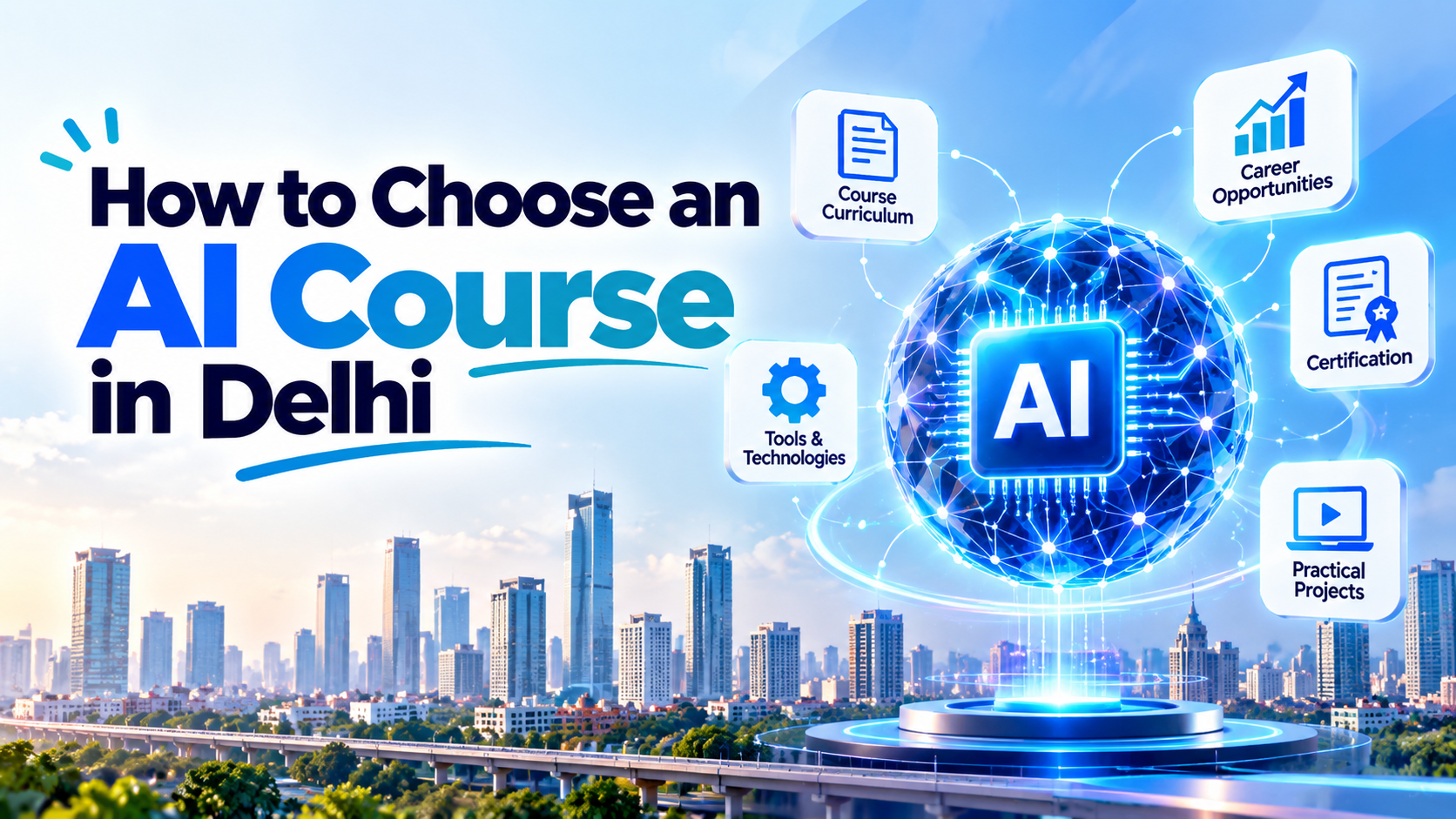
How to Choose an AI Course in Delhi
Artificial intelligence is becoming an important skill across technology, business, marketing, data, automation, and many other fields. As interest in AI continues to grow, Delhi has a wide range of courses, training institutes, certification programs, and learning options for students, graduates, working professionals, and career changers.
However, choosing an AI course in Delhi can be challenging when different institutes offer different syllabuses, durations, teaching formats, tools, projects, certifications, and career support.
The right course depends on your current knowledge, career goal, preferred learning format, technical background, and the type of AI skills you want to develop. Instead of choosing a course simply because it is popular or nearby, it is important to evaluate the complete learning experience.
What Should You Look for in an AI Course in Delhi?
The first step is to understand what the course actually teaches. AI is a broad field that includes areas such as machine learning, generative AI, natural language processing, computer vision, automation, data analysis, prompt engineering, and AI applications.
A beginner may need a different curriculum from someone who already knows Python, statistics, or machine learning. Therefore, the course should match your existing skill level rather than simply offering a large list of advanced topics.
Before enrolling, carefully review the syllabus and identify whether the course provides a logical progression from fundamentals to practical applications.
1. Define Your Career Goal First
Before searching for an AI course, decide what you want to achieve from the training.
You may want to learn AI for a software development career, move into machine learning, work with generative AI, improve your existing technical skills, build AI applications, or understand how AI can be applied in business and marketing.
Your goal should influence the type of course you choose. A beginner-focused AI program may be suitable for someone starting from scratch, while an advanced machine learning program may be more appropriate for a learner with programming and mathematical foundations.
Having a clear objective makes it easier to compare different courses instead of choosing one based only on advertisements or course titles.
2. Check the Course Curriculum
The curriculum is one of the most important factors when evaluating an AI course.
Look beyond the number of topics listed on the institute's website. A long list of tools does not necessarily mean that the course provides comprehensive training.
A well-structured curriculum may include AI fundamentals, machine learning concepts, data handling, Python or another relevant programming language, generative AI, prompt engineering, practical applications, projects, and responsible use of AI depending on the course level.
For learners interested in broader AI and digital skills, an AI master program can be evaluated by checking how these different areas are connected within the overall learning path.
3. Understand the Difference Between AI, ML and Generative AI
Many AI courses use terms such as Artificial Intelligence, Machine Learning, Deep Learning, and Generative AI in their course descriptions. Before enrolling, understand what each area means and which one is relevant to your goals.
Artificial intelligence is a broad field focused on creating systems capable of performing tasks that typically require intelligent behaviour. Machine learning is a major approach within AI that enables systems to learn patterns from data. Deep learning uses neural networks with multiple layers, while generative AI focuses on systems that can create content such as text, images, audio, code, or other outputs.
A good course should explain these concepts clearly instead of using AI terminology only as a marketing feature.
4. Check Whether Python Is Included
Python is widely used in AI and machine learning workflows, making programming knowledge useful for learners who want to build technical AI applications.
If you are a beginner, check whether the institute starts with Python fundamentals before moving into more advanced AI concepts.
If you already know programming, check whether the course moves beyond basic syntax and provides opportunities to use programming for data analysis, machine learning, AI models, or practical applications.
The importance of Python will depend on your chosen AI career path, so the curriculum should match the technical depth you need.
5. Look for Hands-On Projects
AI is a practical field, and projects can help learners understand how concepts are applied to real problems.
When comparing institutes, ask what type of projects students complete during the course. A project should ideally require you to apply the concepts taught in class rather than simply reproduce a demonstration.
Depending on the program, projects may involve machine learning models, predictive systems, recommendation systems, generative AI applications, chatbots, automation workflows, data analysis, or other AI-based solutions.
Practical projects can also help you build a portfolio that demonstrates your skills to potential employers or clients.
6. Evaluate the Trainers
The trainer can have a major impact on your learning experience. Before joining an institute, research the instructors and understand their professional and teaching background.
Look for trainers who can explain technical concepts in a structured manner and connect theoretical knowledge with practical applications.
If the institute provides a demo class, attend it before making a decision. Pay attention to how clearly the trainer explains concepts, answers questions, demonstrates tools, and handles practical problems.
7. Compare Classroom and Online Learning
AI courses in Delhi may be available through classroom, live online, hybrid, or self-paced formats.
Classroom learning can provide direct interaction with trainers and other students. Live online classes can provide flexibility while still allowing learners to interact with instructors. Self-paced courses can be useful for learners who prefer to study according to their own schedule.
Rather than assuming that one format is automatically better, consider your schedule, learning style, commute, availability, and the amount of trainer interaction you require.
8. Check the Duration and Learning Schedule
Course duration should be evaluated alongside the actual number of learning hours and practical sessions.
A very short program may be useful for introductory learning, while a longer program may provide more time for technical concepts, projects, assignments, and revision.
Check whether classes are conducted regularly, whether recordings are available, how assignments are handled, and whether additional practice time is expected outside the classroom.
The right duration depends on your existing knowledge and the depth of AI skills you want to develop.
9. Check the AI Tools and Technologies Covered
AI is developing quickly, and new tools and platforms continue to emerge. When evaluating a course, check whether it teaches concepts that remain useful beyond a single software platform.
Depending on the course, relevant areas may include generative AI, large language models, prompt engineering, AI automation, machine learning frameworks, data tools, APIs, and other AI development technologies.
Tools should support your learning rather than become the entire curriculum. Understanding the concepts behind the tools can help you adapt as technologies change.
10. Evaluate Practical AI and Generative AI Training
Generative AI has created new opportunities for learners who want to understand how AI can be used for content generation, research, coding assistance, automation, productivity, and business applications.
If generative AI is part of your career goal, check whether the course includes practical activities rather than only introductory explanations.
Useful training may include prompt engineering, working with AI models, building AI-assisted workflows, understanding model limitations, evaluating outputs, and developing practical applications.
Look for a program that gives you opportunities to practise these skills instead of simply demonstrating AI tools during lectures.
Why Practical AI Training Matters
Learning AI only through theory can make it difficult to understand how the technology is used in real situations. Practical training gives learners an opportunity to experiment, make mistakes, analyse results, and improve their solutions.
Projects, assignments, case studies, demonstrations, and guided exercises can help bridge the gap between classroom concepts and practical implementation.
When comparing courses, ask how much of the program is dedicated to hands-on learning and whether students receive feedback on their work.
11. Look at Certification Carefully
Certification can be useful as evidence that you completed a particular course, but it should not be the only factor in your decision.
Check who issues the certificate, what assessments are required, whether projects are included, and what the certification represents.
More importantly, consider the skills you will have developed by the end of the course. A strong portfolio and practical understanding can complement a certificate when demonstrating your capabilities.
12. Examine Internship and Career Support
If your objective is to build a career in AI, investigate what career support the institute actually provides.
Some programs may offer resume assistance, interview preparation, internships, career counselling, portfolio guidance, or job-oriented support.
Ask specific questions about how the support works instead of relying only on general statements such as “100% placement” or “guaranteed career growth.”
Find out whether internships involve actual project work and whether career support continues after course completion.
13. Read Reviews from Different Sources
Student reviews can help you understand the learning experience, but they should be evaluated carefully.
Look for detailed feedback about trainers, practical sessions, projects, course material, doubt-solving, and overall support.
Do not rely only on testimonials published by the institute itself. Comparing feedback from multiple sources can give you a broader understanding of the training experience.
14. Compare Course Fees and What Is Included
Course fees can vary considerably depending on the institute, duration, format, curriculum, trainer involvement, projects, and additional services.
Instead of comparing only the advertised price, check exactly what is included in the fee.
Ask whether live classes, recordings, assignments, projects, mentorship, learning material, certification, internship opportunities, and career support are included.
The cheapest course is not necessarily the most suitable, and a more expensive course does not automatically provide better training. The important factor is the value and learning experience provided for the fee.
15. Check the Location and Accessibility
If you specifically want classroom training in Delhi, consider the institute's location and accessibility.
Think about travel time, public transport, class timings, parking availability if relevant, and how frequently you need to attend classes.
A convenient location can make regular attendance easier, but location should still be considered alongside curriculum, trainers, projects, and practical training.
16. Consider Your Existing Skill Level
The right AI course for a beginner may not be the right course for an experienced developer or data professional.
If you have no technical background, look for a program that explains programming, data, and AI fundamentals gradually.
If you already know Python or have experience with machine learning, you may want a more advanced program covering areas such as deep learning, generative AI, large language models, computer vision, natural language processing, or AI application development.
Choosing a course at the appropriate difficulty level can prevent you from feeling either overwhelmed or underchallenged.
17. Look Beyond the Course Name
Two institutes may use the same course title while offering completely different learning experiences.
For example, an “AI course” could refer to a short introductory program, a programming-focused machine learning course, a generative AI program, or a comprehensive career-oriented training program.
Always open the detailed syllabus and compare the actual topics, duration, practical work, trainer interaction, and project requirements.
Questions to Ask Before Enrolling
Before paying the course fee, ask the institute a few direct questions.
Ask what prerequisites are required, which topics are covered, how much practical training is provided, what projects students complete, who teaches the course, whether demo classes are available, and what kind of career support is included.
You can also ask whether the curriculum is updated regularly and how the institute introduces new AI technologies as the field evolves.
These questions can help you understand the actual program rather than making a decision based only on promotional material.
Common Mistakes to Avoid When Choosing an AI Course
One common mistake is choosing a course only because it has a large number of AI tools listed in its syllabus. Tools can change quickly, while strong fundamentals remain useful.
Another mistake is focusing entirely on certification. A certificate is useful, but practical knowledge and projects are important when developing real skills.
It is also important to avoid choosing a course solely because of aggressive placement promises. Understand exactly what placement or career support means and what is actually included.
Finally, do not select a course without checking whether its difficulty level matches your current skills.
How to Shortlist an AI Course in Delhi
Start by selecting three to five courses that match your career objective and experience level.
Compare their syllabus, trainers, practical sessions, projects, tools, course duration, learning format, certification, career support, reviews, and fees.
Then attend demo sessions where available and ask the institute specific questions about the learning process.
After comparing these factors, you can make a more informed decision based on your own requirements instead of choosing solely because a course appears at the top of a search result.
Who Can Learn AI?
AI learning is not limited to computer science graduates. Students from different academic backgrounds can explore AI depending on the type and difficulty level of the program they choose.
Beginners can start with foundational AI and productivity concepts, while learners with programming and mathematics knowledge can move toward machine learning and technical AI development.
Professionals can also explore AI applications related to their existing industry, such as marketing, finance, education, healthcare, business operations, or software development.
Build a Long-Term AI Learning Strategy
Completing an AI course is only the beginning of the learning process. AI technologies and applications continue to evolve, so professionals should develop the habit of continuous learning.
After completing a course, continue building projects, experimenting with new tools, reading technical resources, participating in practical challenges, and improving your understanding of AI concepts.
A structured AI learning program can provide a foundation, but your continued practice will determine how effectively you can apply those skills.
Conclusion
Choosing an AI course in Delhi requires more than comparing course names, fees, or advertisements. The most important factors include your career objective, current skill level, curriculum, trainer quality, practical projects, AI technologies covered, learning format, certification, and career support.
Before enrolling, compare multiple institutes, attend demo classes where possible, review the detailed syllabus, and ask direct questions about practical training and projects.
The right course should help you build a strong understanding of AI while giving you opportunities to apply what you learn. Whether your goal is to explore AI, develop technical skills, work with generative AI, or prepare for an AI-focused career, selecting a program that matches your individual goals can make your learning journey more structured and useful.
Contact Upskill Now
A-3, Third Floor, Rajouri Garden, New Delhi – 110027
Phone: 9999848160 | 9711448765
Email: connect@upskillnow.in