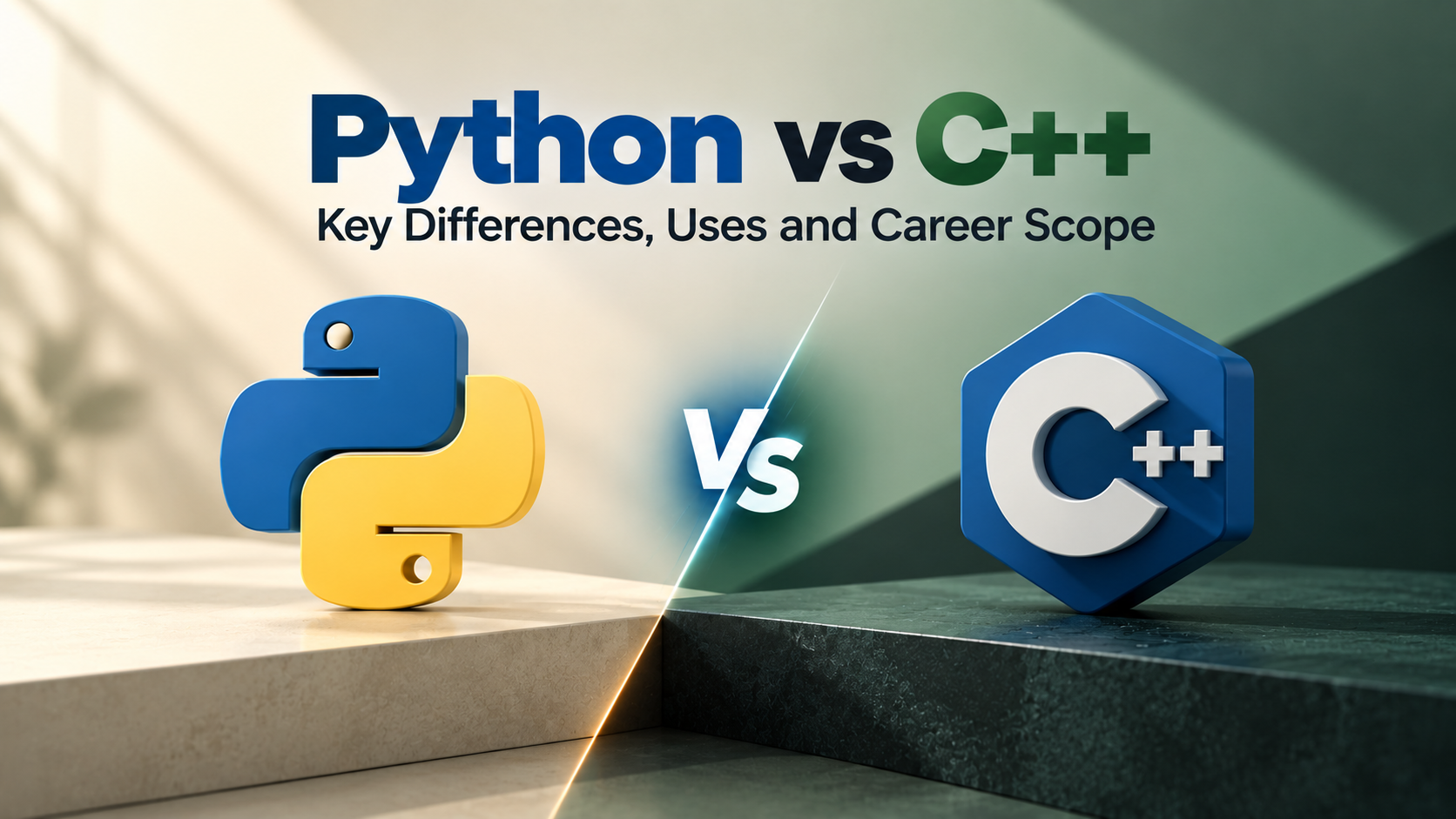
Python vs C++: Key Differences, Uses and Career Scope
Python vs C++ is an important comparison for students, beginners, and aspiring developers deciding which programming language to learn. Both languages are powerful, widely used, and capable of building real-world software, but they are designed around different priorities.
Python is known for readable syntax, rapid development, automation, data analysis, artificial intelligence, machine learning, and a large collection of developer libraries. C++ provides detailed control over memory and system resources and is widely associated with performance-intensive software, game development, embedded systems, system programming, and applications where execution speed and resource efficiency are important.
The right choice therefore depends on what you want to build. A beginner interested in AI or automation may benefit from starting with Python, while someone targeting game engines, systems programming, competitive programming, or performance-critical applications may have stronger reasons to learn C++.
Python vs C++ at a Glance
| Factor | Python | C++ |
|---|---|---|
| Syntax | Concise and readable | More detailed and complex |
| Learning Curve | Generally easier for beginners | Steeper initial learning curve |
| Typing | Dynamically typed | Statically typed |
| Execution Speed | Generally slower for CPU-heavy Python-level code | Generally faster for performance-critical workloads |
| Memory Control | More abstracted | Greater low-level control |
| AI and Machine Learning | Excellent ecosystem | Used in selected performance-oriented applications |
| Game Development | Useful for scripting and selected tools | Strong choice for high-performance game development |
| Automation | Excellent choice | Possible but generally more complex |
| System Programming | Limited compared with C++ | Strong choice |
What Is Python?
Python is a high-level general-purpose programming language designed with an emphasis on readability and developer productivity. Its relatively concise syntax makes it possible to express programming ideas without requiring as much boilerplate code.
Python is used for web development, automation, data analysis, artificial intelligence, machine learning, scripting, testing, scientific computing, and many other applications.
One of Python's biggest advantages for beginners is that the language allows them to concentrate on programming logic early. Variables, conditions, loops, functions, lists, dictionaries, and file handling can be introduced without requiring extensive knowledge of memory management.
What Is C++?
C++ is a compiled, general-purpose programming language that provides both high-level programming features and low-level control over system resources. It evolved from C and supports procedural, object-oriented, generic, and other programming approaches.
C++ is commonly used when performance, resource control, and predictable execution are important. Its applications include game engines, desktop software, embedded systems, high-performance computing, system software, financial technology, graphics, and performance-sensitive applications.
The additional control provided by C++ also means that developers need to understand more concepts, including memory management, pointers, references, object lifetimes, compilation, and resource management.
Python vs C++ Syntax
A simple example demonstrates the difference in how much code each language requires for a basic task.
Python
numbers = [10, 20, 30, 40, 50]

for number in numbers:
    print(number)
C++
#include <iostream>
#include <vector>

using namespace std;

int main() {
    vector<int> numbers = {10, 20, 30, 40, 50};

    for (int number : numbers) {
        cout << number << endl;
    }

    return 0;
}
Both programs perform a similar task, but Python uses considerably less surrounding syntax. C++ requires additional structure because of its compiled environment and language design.
This does not mean that C++ is unnecessarily complicated. The additional syntax is often connected to the control and structure that C++ provides to developers.
Python vs C++: Learning Difficulty
Python is generally easier for a beginner to start with. A new learner can write a small program after learning only a few concepts and can gradually introduce more advanced features.
C++ usually requires more effort at the beginning. In addition to basic programming logic, learners eventually need to understand pointers, references, memory, compilation, header files, classes, templates, and resource management.
However, difficulty should not be confused with usefulness. C++'s complexity is partly a consequence of the control it gives developers.
If your objective is to understand programming concepts quickly and begin building practical applications, Python can provide a smoother starting point. If your objective specifically involves low-level programming or high-performance applications, learning C++ can be worth the additional effort.
Python for Beginners: Building the Right Foundation
For beginners choosing between Python and C++, the most important question is not simply which syntax looks easier. It is which language allows you to build the skills you need without creating unnecessary barriers at the beginning.
Python can provide a practical route through programming fundamentals such as variables, data types, operators, conditions, loops, collections, functions, and object-oriented programming. Once these concepts become familiar, learners can apply them to projects instead of repeatedly studying isolated syntax examples.
A structured Python course for beginners can be particularly useful for learners who struggle with deciding what to study after each fundamental topic. The goal should be progression rather than simply completing a list of tutorials.
Python vs C++: Performance
Performance is one of the most important differences between Python and C++.
C++ is compiled into machine-level instructions and provides developers with considerable control over memory and computational resources. This makes it suitable for applications where execution speed and resource efficiency are critical.
Python is generally slower for CPU-intensive operations when compared with optimized native C++ code. However, this does not mean that every Python application is slow. Python frequently relies on optimized libraries written in lower-level languages, which can perform computationally expensive operations efficiently.
Therefore, the useful question is not “Is C++ faster than Python?” The answer is generally yes for many CPU-bound workloads, but the practical question is whether that difference matters for the application you are building.
Python vs C++: Memory Management
Python handles much of the memory management automatically. Developers normally do not need to manually allocate and release memory for ordinary objects.
C++ gives developers significantly more control. This can be beneficial when working with resource-constrained systems or performance-critical applications, but it also introduces additional responsibilities.
Modern C++ provides tools such as smart pointers and standard library facilities that make resource management safer than older manual approaches. Nevertheless, developers still need a deeper understanding of object lifetime, ownership, references, and resource management.
Python vs C++ for Data Science
Python has a major advantage in data science because of its ecosystem. Libraries for numerical computing, data manipulation, visualization, statistics, and machine learning are widely available.
A typical Python data workflow can involve collecting data, cleaning it, analysing it, visualizing patterns, training a model, and evaluating the result using libraries designed specifically for those tasks.
C++ can certainly be used for numerical computing and high-performance data processing, but it is not generally the first choice for a beginner entering data science.
If your goal is to become a data analyst, machine learning practitioner, or AI developer, Python is usually the more practical starting language.
Python vs C++ for Artificial Intelligence and Machine Learning
Python is widely used for machine learning and artificial intelligence because developers can combine readable programming syntax with a large ecosystem of AI and scientific computing libraries.
Python is commonly used during model development, experimentation, data preparation, evaluation, and research. Developers can then use lower-level technologies where performance requirements demand them.
C++ is important in some AI systems where execution speed, hardware interaction, or resource efficiency is critical. It can be used underneath higher-level frameworks and in applications that require optimized inference or real-time performance.
For someone learning AI from scratch, however, Python is generally the more accessible language to begin with.
Python vs C++ for Game Development
C++ has a strong position in professional game development because modern games often require high performance, real-time graphics, physics calculations, and efficient resource management.
Major game engines and performance-intensive game systems rely heavily on C++.
Python can still be useful in game development for tools, automation, asset pipelines, scripting in certain environments, and learning game programming. However, if your specific goal is professional high-performance game engine development, C++ is generally the stronger language to prioritize.
Python vs C++ for Web Development
Python is significantly more common as a first choice for web development than C++.
Python frameworks such as Django and Flask allow developers to build web applications and APIs without having to manage the low-level concerns that would commonly arise in C++ development.
C++ can be used to build web servers and performance-critical backend components, but its complexity usually makes it an unnecessary choice for a beginner building a conventional web application.
| Development Goal | Better Starting Choice | Why |
|---|---|---|
| Web applications | Python | Strong frameworks and faster development |
| AI applications | Python | Strong AI and data ecosystem |
| Automation | Python | Concise syntax and extensive libraries |
| Game engines | C++ | Performance and system-level control |
| Embedded systems | C++ | Resource control and performance |
| Competitive programming | Either | Depends on contest requirements and personal strengths |
Python vs C++ for Automation
Python is usually the more convenient choice for automation.
A Python script can automate file organization, text processing, report generation, spreadsheet operations, API requests, and many repetitive tasks with relatively little code.
C++ can automate tasks too, but the amount of setup and code required often makes it less attractive when execution speed is not the primary requirement.
This is an important practical distinction: the fastest language is not automatically the most productive language for every task.
Python vs C++ for Embedded Systems
C++ has a strong advantage when software needs to operate close to hardware or under strict resource limitations.
Embedded applications may have constraints involving memory, processing power, response time, and energy consumption. C++ provides the level of control needed for many such systems.
Python can appear in embedded environments, especially on more capable hardware and for prototyping, but it is not generally the first language to choose for highly constrained embedded software.
Python vs C++ for Object-Oriented Programming
Both Python and C++ support object-oriented programming.
C++ provides extensive object-oriented and generic programming features and is often used to teach detailed concepts such as inheritance, polymorphism, constructors, destructors, templates, and resource ownership.
Python also supports classes, inheritance, encapsulation, and polymorphism but allows developers to combine object-oriented programming with procedural and other programming styles.
For beginners, Python can make it easier to understand the purpose of objects without requiring as much supporting syntax. C++ can provide a deeper understanding of how objects interact with memory and program resources.
Python vs C++: Error Handling and Debugging
Both languages require developers to understand errors rather than simply remove them until the program runs.
Python provides readable error messages and exceptions that can be relatively approachable for beginners. C++ also provides compiler diagnostics, runtime errors, and exception handling, but memory-related bugs and undefined behaviour can sometimes be significantly more difficult to diagnose.
This difference makes debugging an important part of learning C++. Beginners need to understand not only syntax errors but also issues involving pointers, memory access, object lifetimes, and resource management.
Python vs C++ Career Scope
Both languages can lead to strong technical careers, but the surrounding job requirements are different.
| Career Direction | Python | C++ |
|---|---|---|
| Python Developer | Strong fit | Not applicable |
| Data Analyst | Strong fit | Less common starting choice |
| AI/ML Developer | Strong fit | Useful for selected performance-focused applications |
| Web Developer | Strong fit | Niche compared with Python |
| Game Developer | Possible | Strong fit |
| Embedded Developer | Limited compared with C++ | Strong fit |
| Systems Developer | Limited | Strong fit |
| Automation Engineer | Strong fit | Possible |
Career scope should not be judged by the programming language alone. A developer also needs databases, version control, testing, debugging, algorithms, software design, communication skills, and project experience relevant to the target role.
Should a Beginner Learn Python or C++ First?
For a beginner with no specific specialization in mind, Python is usually the easier language to start with. It allows you to focus on programming logic while using relatively concise syntax.
However, there are situations where starting with C++ makes sense. If your academic curriculum heavily emphasizes C++, you want to study data structures and algorithms using C++, or your long-term goal is game development, systems programming, or embedded development, beginning with C++ can be a sensible choice.
The most important thing is to avoid changing languages every few weeks because another language appears more popular. Programming fundamentals transfer between languages, but developing those fundamentals requires consistent practice.
Python vs C++ for Students
Students often need to balance academic requirements with career preparation.
If your college curriculum teaches C++ and requires practical examinations, learning C++ is important for academic success. At the same time, Python can be added when you want to explore AI, automation, data analysis, or rapid application development.
This does not have to become an either-or decision forever. A student can learn one language deeply enough to understand programming and then use that foundation to learn the second language more efficiently.
What Should You Learn Alongside Python?
If you choose Python, do not stop at variables and loops. A practical learning path should gradually introduce:
- Python fundamentals
- Programming logic
- Lists, tuples, sets, and dictionaries
- Functions
- Object-oriented programming
- File handling
- Exception handling
- Databases
- APIs
- Git and GitHub
- Practical projects
Upskill Now's Python learning path follows this kind of progression, moving from fundamentals and programming logic toward data structures, object-oriented programming, file handling, exception management, databases, automation, APIs, and practical projects.
What Should You Learn Alongside C++?
C++ learners should build a strong foundation before moving into specialized development.
- C++ syntax and fundamentals
- Functions and arrays
- Pointers and references
- Object-oriented programming
- STL containers and algorithms
- Memory and resource management
- Exception handling
- Templates
- Data structures and algorithms
- Debugging
- Git and software development practices
If your target is game development, you can later move toward game engines and graphics programming. If your goal is embedded development, you may need to study hardware concepts and platform-specific development as well.
Python vs C++: Which One Is Better for Projects?
The best project language depends on what the project is trying to demonstrate.
| Project | Better Choice | Reason |
|---|---|---|
| Expense Tracker | Python | Fast development and simple data handling |
| File Organizer | Python | Convenient automation |
| Machine Learning Application | Python | Strong ecosystem |
| Game Engine Component | C++ | Performance and resource control |
| Embedded Application | C++ | Hardware and resource control |
| Competitive Programming | Either | Depends on requirements and personal proficiency |
Why Project-Based Python Learning Can Be Useful
One reason beginners struggle after completing programming tutorials is that they know individual concepts but do not know how to combine them. A project changes that.
For example, an Expense Tracker can require variables for amounts, lists or dictionaries for records, conditions for validation, loops for displaying entries, functions for repeated operations, file handling for persistence, and eventually a database for more structured storage.
This is the type of progression that makes a practical Python learning program more useful than a course that only focuses on syntax. The learner should repeatedly move from concept to implementation and then from implementation to a more realistic version of the same application.
Can Python and C++ Work Together?
Yes. In real software systems, different languages can be used for different parts of a product.
A Python application may rely on optimized components written in C or C++. This is common in scientific computing, data processing, graphics, machine learning infrastructure, and other performance-sensitive areas.
This means learning Python does not prevent you from eventually learning C++. In fact, understanding both can help developers appreciate the difference between high-level productivity and low-level performance.
Common Mistakes When Choosing Python or C++
Beginners often choose a language based on a single factor. That can lead to an unnecessary learning struggle.
- Choosing C++ only because it is considered more difficult
- Choosing Python only because it is considered easy
- Comparing languages without considering the intended project
- Focusing entirely on execution speed
- Ignoring the technology stack used in the target career
- Learning multiple languages without mastering basic programming
- Thinking that a language alone guarantees career opportunities
The strongest choice is the one that aligns with your immediate learning objective and long-term technical direction.
How to Decide Between Python and C++
Use the following decision framework instead of choosing based only on popularity.
- Choose Python if you want to start programming with a relatively accessible syntax.
- Choose Python if your primary interests are AI, machine learning, data analysis, automation, or rapid development.
- Choose C++ if your target is game engines, systems programming, embedded software, or performance-critical applications.
- Choose C++ if your academic or professional environment specifically requires it.
- Choose Python if you want to build prototypes quickly and iterate frequently.
- Choose C++ if low-level resource control is an important part of your target work.
- Learn both eventually if your career path benefits from both high-level development and lower-level programming knowledge.
Why Choose Upskill Now If Python Is the Better Fit?
If you decide that Python is more aligned with your goals, the next question is how to learn it effectively. A good learning path should not stop after teaching syntax. It should help you move toward practical development.
Upskill Now's current Python program is structured around fundamentals, programming logic, data structures, object-oriented programming, file handling, exception management, databases, automation, and APIs. The program also uses projects such as Student Management System, Expense Tracker, Library Management System, Employee Database Management, Python Calculator, Automated File Organiser, Weather Information Application, and a final capstone to connect concepts with practical development.
This matters because project experience gives learners an opportunity to discover problems that do not appear in isolated coding exercises. Handling invalid input, organizing functions, storing data, debugging unexpected results, and deciding how different components should interact are all part of becoming a better programmer.
Python vs C++: Which One Should You Learn in 2026?
There is no universal winner.
Choose Python if your priority is accessibility, automation, data science, artificial intelligence, machine learning, web development, or rapid application development.
Choose C++ if your priority is performance, game development, systems programming, embedded software, graphics, or applications requiring detailed resource control.
If you are completely undecided and simply want to learn programming, Python is often a practical starting point. If you already know that you want to work close to hardware or performance-critical software, C++ may be the better investment from the beginning.
Conclusion
Python and C++ are both powerful languages, but they are optimized for different development experiences. Python prioritizes readability, productivity, rapid development, automation, data science, and AI. C++ provides greater control over memory and system resources and is particularly valuable for performance-intensive software, games, embedded systems, and systems programming.
For beginners, Python is usually easier to start with. For developers targeting low-level or performance-critical work, C++ can be the more appropriate choice. Neither language replaces the other, and learning one does not prevent you from learning the second later.
The most useful decision is to identify what you want to build first and then choose the language that provides the most practical path toward that goal. If Python aligns with your direction, a structured and project-oriented program such as Upskill Now's Python learning path can help connect programming fundamentals with practical development.
Contact Upskill Now
A-3, Third Floor, Rajouri Garden, New Delhi – 110027
Phone: 9999848160 | 9711448765
Email: connect@upskillnow.in