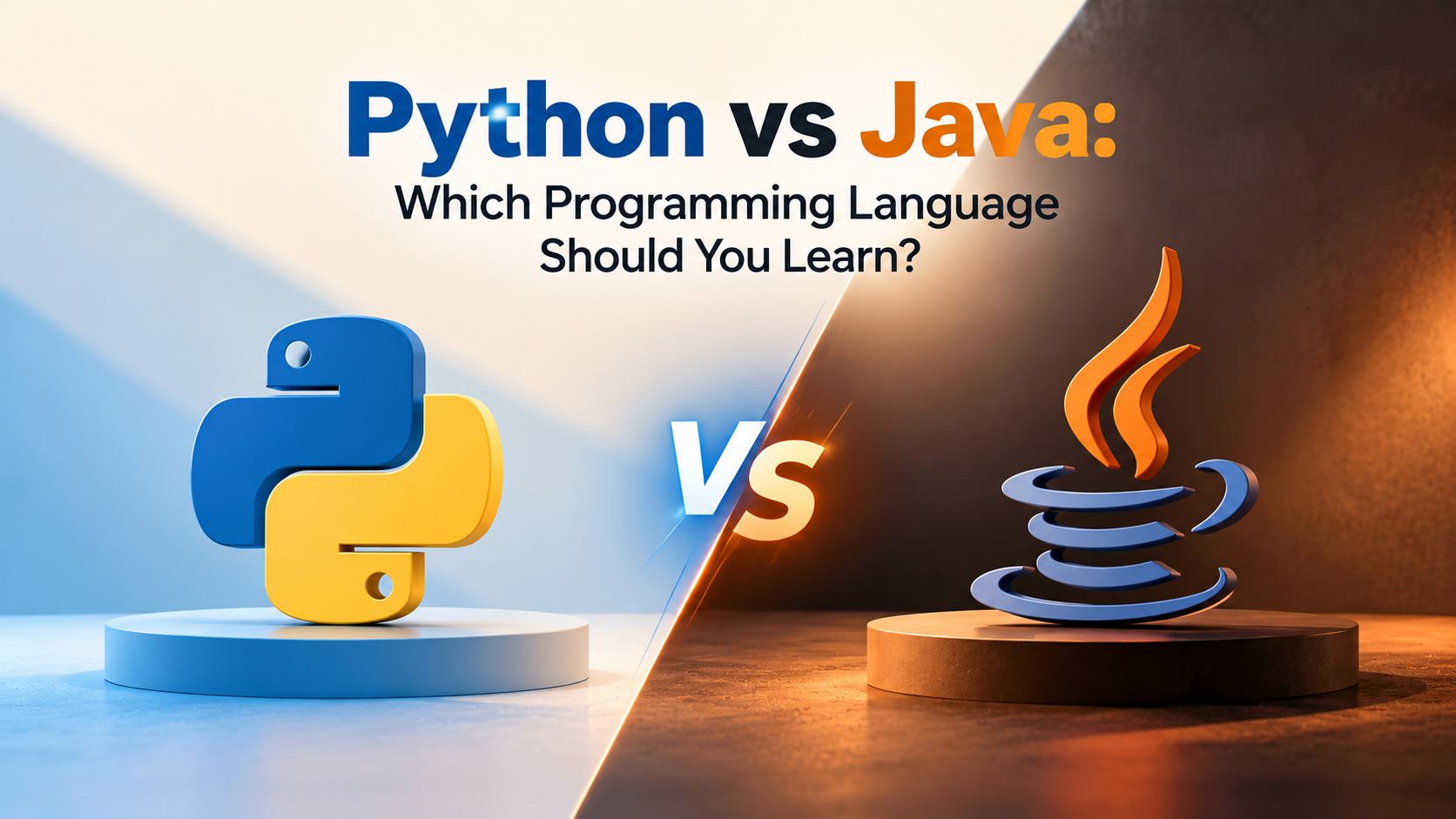
Python vs Java: Which Programming Language Should You Learn?
Python vs Java is a common comparison for students and beginners who are deciding which programming language to learn first. Both languages are widely used, support object-oriented programming, have large ecosystems, and can lead to software development careers. The better choice depends less on which language is “better” and more on what you want to build, how you prefer to learn, and which technical direction you want to pursue.
Python is generally known for readable syntax, rapid development, automation, data analysis, artificial intelligence, and beginner-friendly programming. Java is known for strong typing, structured application development, enterprise software, large backend systems, and the Java Virtual Machine ecosystem.
This guide compares Python and Java based on learning difficulty, syntax, performance, applications, development style, projects, career direction, and practical use cases so that you can make a decision based on your actual goals rather than popularity alone.
Python vs Java at a Glance
| Factor | Python | Java |
|---|---|---|
| Syntax | Concise and readable | More verbose and structured |
| Typing | Dynamically typed | Statically typed |
| Beginner Learning Curve | Generally easier to start | Requires more syntax initially |
| Development Speed | Usually fast for scripting and prototypes | Often more deliberate and structured |
| Data Science | Excellent ecosystem | Less dominant |
| AI and Machine Learning | Very strong ecosystem | Used in some applications but less common for this purpose |
| Enterprise Backend | Strong and growing | Very strong |
| Automation | Excellent choice | Possible but generally less convenient |
| Runtime Environment | Python interpreter | JVM |
Python vs Java: The Basic Difference
One of the easiest ways to understand the difference is to look at how each language approaches programming.
Python tries to keep the amount of syntax needed to express an idea relatively small. This allows beginners to focus more quickly on programming logic.
Java requires more explicit structure. Types, classes, methods, access modifiers, and other elements can make programs longer, but that structure can also make large applications easier to reason about and maintain when teams follow consistent development practices.
Neither approach is automatically better. A short Python program is useful when speed of development matters, while Java's explicit structure can be valuable when an application has a large codebase and many developers working on it.
Python Syntax vs Java Syntax
Consider a simple example that displays a message.
Python
name = "Sukhmani"
print("Hello", name)
Java
public class Main {
    public static void main(String[] args) {
        String name = "Sukhmani";
        System.out.println("Hello " + name);
    }
}
The Python version requires less surrounding structure. Java requires a class and a main method because of the way Java applications are structured.
This difference becomes important for beginners. Python can let you experiment with programming concepts quickly, while Java introduces stronger structure from the beginning.
Which Is Easier to Learn: Python or Java?
For most complete beginners, Python is easier to start with because its syntax is relatively compact and readable. You can write useful programs without first learning as much structural syntax.
Java has a steeper initial learning curve. Beginners need to become comfortable with types, classes, methods, objects, and Java's program structure. However, learning these concepts early can provide a strong foundation for object-oriented programming.
The important distinction is between “easier to start” and “easier forever.” Python may reduce the initial barrier, but becoming proficient in Python still requires understanding data structures, functions, object-oriented programming, exceptions, modules, testing, databases, APIs, and application design.
Python for Beginners: Where a Structured Learning Path Helps
If you are starting from zero, Python can be a practical first language because you can move from variables and input/output to conditions, loops, collections, functions, files, and projects without spending too much time dealing with complex syntax.
A structured Python learning program can be particularly useful when the problem is not understanding individual concepts but knowing what to learn next. A good progression should connect fundamentals to projects instead of treating every topic as an isolated chapter.
This is also where project-based learning becomes important. Building a calculator, expense tracker, file organizer, or database application forces you to apply several concepts at the same time.
Python vs Java: Static Typing and Dynamic Typing
One of the major technical differences is how the languages handle types.
Python is dynamically typed. You can assign different kinds of values to variables without declaring their type in the same way Java requires.
age = 20
name = "Student"
Java is statically typed, so the type is explicitly declared.
int age = 20;
String name = "Student";
Static typing can catch certain type-related problems earlier during development and makes the expected type of a variable explicit. Dynamic typing can make experimentation and quick development more convenient.
For a beginner, this means Python can feel less restrictive at first, while Java encourages you to think about types and program structure earlier.
Python vs Java Performance
Performance comparisons between Python and Java should not be reduced to “Java is fast and Python is slow.” Actual performance depends on the workload, implementation, libraries, architecture, and how the application is designed.
Java runs on the Java Virtual Machine and benefits from technologies such as just-in-time compilation. This can make Java well suited to long-running applications and performance-sensitive backend workloads.
Python code executed by the standard interpreter is generally slower for many CPU-intensive operations. However, Python's ecosystem includes highly optimized libraries that perform heavy computations outside ordinary Python-level loops.
Therefore, if you are comparing the languages for a real project, measure the workload rather than relying only on general performance claims.
Python vs Java for Web Development
Both Python and Java can be used for web development.
Python is used with frameworks such as Django and Flask, among others. It is often attractive when developers want to build applications quickly or integrate web services with data processing, automation, or machine learning functionality.
Java is widely used for backend and enterprise applications, particularly with frameworks such as Spring and Spring Boot. Its mature ecosystem and strong type system make it suitable for large applications with complex business logic.
| Requirement | Potentially Better Starting Choice | Reason |
|---|---|---|
| Quick prototype | Python | Concise syntax and fast development |
| Large enterprise backend | Java | Mature ecosystem and strong structure |
| Data processing integration | Python | Strong data ecosystem |
| Large Java-based organization | Java | Existing technology stack may matter more than language preference |
Python vs Java for Data Science and AI
This is one of the areas where Python has a particularly strong advantage for beginners and professionals working in data-related fields.
Python has an extensive ecosystem for data analysis, scientific computing, visualization, machine learning, and artificial intelligence. Libraries and frameworks make it possible to move from data preparation to model development within the same language.
Java can also be used for data processing and machine learning applications, but Python is generally the more natural choice for someone whose primary goal is data science or AI.
If your long-term plan includes data analytics, machine learning, or AI, learning Python first can reduce the number of language-specific barriers you encounter while learning those fields.
Python vs Java for Automation
Python is particularly convenient for automation because many common tasks can be expressed with relatively little code.
For example, Python can be used to automate file organization, process text files, work with spreadsheets, call APIs, generate reports, and perform repetitive system tasks.
Java can also automate tasks, but Python is often preferred when the primary objective is to write a small utility quickly.
Python vs Java for Object-Oriented Programming
Both languages support object-oriented programming, but their approaches feel different.
Java strongly emphasizes classes and objects. Its ecosystem and language design encourage developers to think in terms of structured types and object-oriented design.
Python supports object-oriented programming while also allowing procedural and functional programming styles. This flexibility is convenient, but beginners need to learn when a class is actually useful instead of creating classes simply because they can.
For students studying object-oriented programming academically, Java can provide strong exposure to concepts such as classes, inheritance, interfaces, encapsulation, and polymorphism.
Python vs Java for Projects
Your choice becomes easier when you compare the type of projects you actually want to build.
| Project Goal | Recommended Starting Language |
|---|---|
| Automation scripts | Python |
| Data analysis | Python |
| Machine learning | Python |
| Quick prototypes | Python |
| Enterprise backend | Java |
| Large Java/Spring ecosystem | Java |
| General programming fundamentals | Either |
| Academic Java coursework | Java |
Python vs Java for Students
Students should consider both career goals and their academic environment.
If your college curriculum, assignments, or placement preparation already requires Java, learning Java can be useful even if you personally prefer Python. The two languages teach many transferable programming concepts, so time spent learning one is not wasted when you later learn the other.
On the other hand, if you are completely new to programming and want to develop programming confidence quickly, Python can be a smoother starting point.
The best choice is therefore not always the language with the easiest syntax. It is the language that aligns with the work you are most likely to do next.
Python vs Java Career Scope
Both languages can support software development careers, but they are commonly associated with different areas.
| Career Direction | Python | Java |
|---|---|---|
| Python Developer | Strong fit | Not applicable |
| Data Analyst | Strong fit | Less common starting choice |
| Machine Learning Developer | Strong fit | Possible but less common |
| Backend Developer | Strong fit | Very strong fit |
| Enterprise Software Developer | Possible | Very strong fit |
| Automation Engineer | Strong fit | Possible |
However, a programming language alone does not determine employability. A Python learner still needs programming fundamentals, databases, Git, APIs, testing, projects, and role-specific technologies. A Java learner similarly needs Java fundamentals, object-oriented programming, databases, frameworks, development tools, testing, and practical projects.
What Should You Learn Alongside Python?
If you choose Python, do not stop after learning syntax. A practical learning sequence can include:
- Python fundamentals
- Programming logic
- Data structures
- Functions
- Object-oriented programming
- File handling
- Exception handling
- Databases
- APIs
- Git and GitHub
- Practical projects
A project-oriented Python curriculum can be useful for learners who want this progression to happen in a defined sequence rather than studying unrelated tutorials.
What Should You Learn Alongside Java?
If you choose Java, focus on building a strong programming foundation before immediately moving into advanced frameworks.
- Java syntax and fundamentals
- Object-oriented programming
- Collections
- Exception handling
- File handling
- Generics
- Multithreading concepts
- SQL and databases
- Git and GitHub
- Testing
- Backend frameworks such as Spring Boot
The framework should come after you understand the language well enough to understand what the framework is doing for you.
Can You Learn Both Python and Java?
Yes. In fact, learning both can be useful once you are comfortable with programming fundamentals.
The mistake is trying to learn both simultaneously when you are still struggling with variables, conditions, loops, functions, and basic problem solving.
A better sequence is to become reasonably comfortable with one language first, build several projects, and then learn the second language by comparing concepts.
For example, once you understand loops, functions, collections, and object-oriented programming in Python, you can learn how the same ideas are represented in Java. This allows you to focus on language differences rather than learning programming from zero again.
Python or Java: A Practical Decision Framework
Use these questions before choosing your first language.
- If you are completely new to programming, consider Python for its approachable syntax.
- If your primary goal is AI, machine learning, or data analysis, choose Python.
- If your target environment is heavily based on Java and Spring, choose Java.
- If you want to automate repetitive computer tasks, Python is often the more convenient starting point.
- If your college coursework requires Java, prioritize Java for your academic needs.
- If you want to learn both eventually, master programming fundamentals in one language first.
- If you already know one language, choose the second based on the type of development you want to enter.
Why Choose Upskill Now for a Practical Python Learning Path?
If Python is the better fit for your goals, the next decision is how you will learn it. A useful program should go beyond syntax and provide a progression from fundamentals to practical application.
Upskill Now's current Python program covers Python fundamentals, programming logic, data structures, object-oriented programming, file handling and exception management, along with databases, automation, and APIs. Its project-based structure includes applications such as a Student Management System, Expense Tracker, Library Management System, Employee Database Management, Automated File Organiser, Weather Information Application, and a final capstone.
This type of progression is useful because the comparison between Python and Java ultimately matters less than what you can actually build with the language you choose. A learner who knows Python syntax but cannot create a working application is still at an early stage, regardless of how many tutorials they have completed.
Common Mistakes When Choosing Between Python and Java
Language selection can become confusing when beginners focus on the wrong criteria.
- Choosing only because one language is popular
- Choosing based only on salary claims
- Assuming an easier language has less career value
- Comparing benchmark numbers without considering the workload
- Trying to learn two languages before understanding programming fundamentals
- Ignoring the technology stack used by the jobs you want
- Believing that learning syntax alone is enough for a developer role
The most useful question is not “Which language is best?” but “Which language gives me the shortest practical path toward the work I want to do?”
Python vs Java: Which One Should You Learn First?
Choose Python first if you want a beginner-friendly entry into programming, data analysis, artificial intelligence, machine learning, automation, scripting, or rapid application development.
Choose Java first if your immediate goal is Java-based backend development, enterprise software, Spring-based applications, or an academic and professional environment where Java is already a major part of the technology stack.
If you are undecided, Python is often the simpler first language for building programming confidence. Once your fundamentals are strong, adding Java becomes considerably easier because programming concepts transfer between languages.
Why Should Google Rank This Article Above Hundreds of Python vs Java Comparisons?
Many Python vs Java articles stop at a basic table saying that Python is easy and Java is fast. That does not fully answer the decision a learner is trying to make.
A useful comparison needs to explain why the differences matter. Syntax affects the learning curve. Static typing affects how programs are developed and checked. Ecosystems affect which projects are practical. Performance depends on the workload rather than a single universal ranking. Career direction depends on the technology stack behind the role.
This article therefore treats the comparison as a decision problem rather than a popularity contest. The right choice changes according to whether the learner wants AI, automation, enterprise backend development, academic programming, rapid prototyping, or a broader programming foundation.
Conclusion
Python and Java are both valuable programming languages, but they solve different learning and development needs particularly well. Python is generally easier to start with and has a particularly strong position in automation, data science, AI, machine learning, and rapid development. Java provides strong structure and remains highly relevant for enterprise software and large backend applications.
If you are a complete beginner, Python can be a practical first choice because you can focus on programming logic without dealing with as much syntax. If your target career or academic path is strongly Java-oriented, learning Java first may make more sense.
The most important decision is not the language you choose on day one. It is whether you continue beyond syntax, build real projects, understand how your code works, and develop the ability to solve problems independently. If Python aligns with your goals, Upskill Now can provide a structured path from fundamentals to practical projects and broader development skills.
Contact Upskill Now
A-3, Third Floor, Rajouri Garden, New Delhi – 110027
Phone: 9999848160 | 9711448765
Email: connect@upskillnow.in